Monday, 3 October 2016

Announcing the Updated Kissmetrics Funnel Report

The Kissmetrics Funnel Report is our most popular report, and for good reason.

Seeing where potential customers drop off and segmenting traffic to find the most valuable marketing channels are game changers for businesses.

And today we’re announcing new features in our Funnel Report that will make it even more powerful.

Let’s start with the new design.

1. More Flexible Design

Previously in the Funnel Report you’d create steps horizontally, like this:

adding-steps-old-funnel-report

Now, to be consistent with the design of our People Search, we’ve changed the layout so you’ll create steps vertically, like this:

adding-steps-new-funnel-report

This new design flow allows for greater flexibility of some new features we’ve added (more on that later).

The visualization has also been updated. Instead of seeing something like this:

old-kissmetrics-funnel-report-design

You’ll see this:

new-kissmetrics-funnel-report-design

Finally, many of our customers have four or more steps in their funnel. In our previous Funnel Report, there was no way to easily see a funnel with five or more steps.

Now it’s as easy as scrolling side-to-side to view additional steps:

sliding-in-kissmetrics-funnel-report

2. Drag and Drop

Did you accidentally create your steps in the wrong order? With the drag and drop feature, you don’t have to go back, delete steps, and then re-create them. You just drag and drop the steps into the correct order.

drag-and-drop-kissmetrics-funnel-report

3. And/Or Conditions

Let’s say you’re a marketer for a SaaS company. You have two ways for visitors to get in touch with your sales team. They can request a demo or sign up. You want to know which one is more effective at driving people to start paying for the product.

Now you’ll be able to see people who have done both events or one or the other. So, in our case, we’ll create a funnel report that looks for people who have visited the site and then signed up or requested a demo.

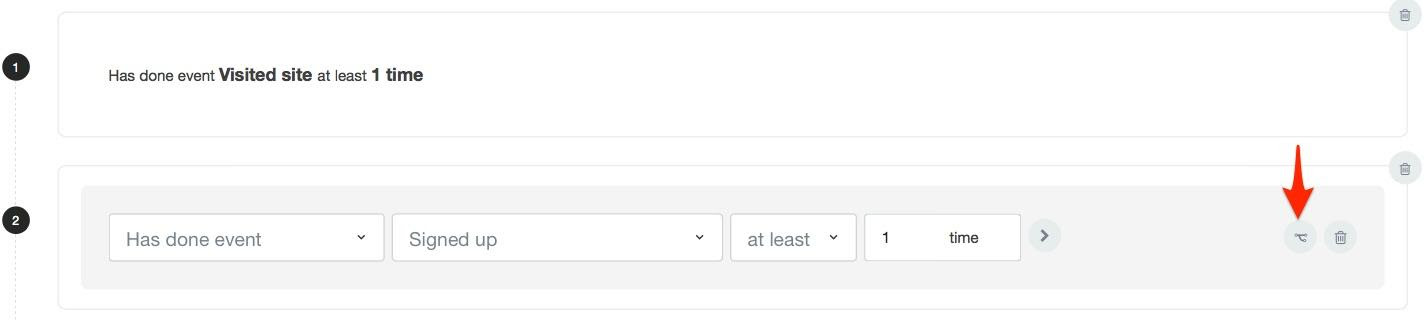
We’ll create our first step, Visited site, and fill in the second event, Signed up. Then we’ll add a condition by clicking on the button that the red arrow is pointing to:
and-or-funnel-report

Click on that button and we’ll get to choose and/or conditions.

and-or-dropdown-kissmetrics

We’ll keep it as or and add the event Requested demo. This will ensure that regardless of whether a person signs up or requests a demo, they’ll be included in this funnel.

visited-site-signed-up-requested-demo-funnel

We’ll run the report and get our data:

signed-up-or-requested-demo-funnel

You can see that Signed up and Requested demo account for a 3% conversion rate.

Want to see the individual numbers for each? No problem, just click on one of the two, and the Funnel Report will show you.

comparing-funnels-kissmetrics

We can see that we’re getting a lot more signups than demo requests.

We can take this even further by adding additional steps to our funnel report to see how one condition may affect the funnel. Let’s continue using this example to illustrate this important point.

If the next steps after Signed up or Requested demo are activating the product and then upgrading, we can see how each condition affects the funnel. Let’s first look at how the funnel performs when people sign up:

comparing-funnels-new-funnel-report

And now we’ll compare that to demo requests:

comparing-funnels-new-funnel-report-2

Big difference! We can see that while 245 people requested demos and 4 of those activated the product, 0 of them continued along in the funnel to paying for the product. All the success of the funnel is due to signups, not demo requests. As marketers, we now know we should focus more of our attention on driving signups and not demo requests.

Now let’s do something similar with a property. We’ll look at all the signups and demo requests that came from San Francisco. Here’s how:

Click on the arrow sign next to the condition:

add-property-to-event

And we’ll add the property “KM City” with San Francisco:

km-city-san-francisco

Visited site and KM City are automatically tracked in Kissmetrics. This means that we track it whenever someone visits your site, and we also look at what city they’re coming from.

So this way we’re telling Kissmetrics to find all the people who visited our site who came from San Francisco.

We’ll then add the second step in our funnel – finding those people who either signed up or requested a demo:

km-city-funnel-signed-up

And run the report:

signed-up-demo-san-fran-funnel

We can see that of the 435 people from San Francisco who visited our site during the selected date range, 9 of them converted to signing up or requesting a demo, giving us a 2.1% conversion rate.

Let’s use one more example. Let’s say we just ran an ad campaign on 10 different sites. We are linking back to our site, and we tagged the URL with UTMs. We gave the “campaign source” as adsfall2016. Now we’ll create a funnel report that looks only at people who came from a UTM with that campaign source.

ad-campaign-hit-funnel-report

You can see that the first step we have in this funnel is finding the people who have visited the site and whose campaign source was adsfall2016. We’re also using the event Ad campaign hit, which triggers whenever someone comes from a URL with UTMs tagged. Ad campaign hit is automatically tracked in Kissmetrics along with any UTM parameters you have tagged.

We’ll add two more steps – viewing a product and purchasing:

funnel-with-ad-campaign-hit

So now you can see how people progress through a funnel when they are coming from a campaign.

4. Numerical Values for Properties

We’ve added the ability to add numerical values to properties in the Funnel Report.

Got all that?

Here’s what it gets you:

Say you’re an e-commerce marketer and you just launched your fall campaign. You want to see the conversion rate for the people who have visited your site and made a purchase of at least $99.

We’ll add the property Order amount to the final step and tell Kissmetrics to find anyone who spent at least $99.

order-amount-with-any-value-kissmetrics

We’ll select the “greater than or equal to” option and place 99 in the text box:

greater-than-or-equal-to-funnel

We’ll run the report and get our data:

ad-campaign-purchased-funnel

This will make finding a specific customer segment even easier.

5. People Who Do Not Have Conditions

With our new Funnel Report, you can find people who have not done an event or do not have a property.

So if you want to find the people who have signed up but have not viewed a product video, you can do that with the Funnel Report. Or, for another example, you can see the people who purchased who did not use a coupon code.

Here’s how to do that:

We’ll create a funnel report that looks at people who have visited our site, have not viewed our product video, and signed up.

We’ll create our first step, Visited site, and then select people who have not done an event. We’ll choose Watched product video as the event.

has-not-done-event-funnel

We’ll add the final step, Signed up, and make our date range the last 30 days:

funnel-wo-viewing-product-video

Now let’s get our data:

did-not-watch-video-funnel

We see that a minority of people visiting our site do not view the product video before signing up. If we want to compare funnels by adding an or condition to our second step, we can do that too:

has-has-not-product-video

Now let’s run the report and click on “Watched product video” to compare the funnels:

watched-product-video-compare-funnels

This shows us that most of the people who signed up had viewed the product video and that people who viewed the product video have a higher conversion rate (2.3% compared to .2%). If we want to improve our site and signups, we’ll want to consider showcasing the product video more prominently as it seems to be an effective conversion driver.

Two Smaller Changes

Finally, we made two minor updates:

1. Design changes to advanced settings

Previously you’d change your advanced settings here:

advanced-settings-old-funnel-report

Now you’ll find those settings here:

advance-settings-new-funnel-report

Click on that gear icon, and you’ll see the attribution, formatting, and conversion rate options:

advanced-settings-new-funnel-report

By default, the Funnel Report will display the conversion rate from the previous step. What’s changed is that now you have the option to view the conversion rate from the first step. Here’s where you’ll find the conversion numbers:

previous-step-conversion-rate

You can easily change the setting to see the conversion rate from the first step by clicking on the First step button:

first-step-conversion-rate

2. Checkbox changed to person icon

In some cases, people enter a funnel in a different order than the steps you have set up. For instance, you may have a funnel like this:

  1. Visited site
  2. Watched product video
  3. Signed up

But what if a customer viewed a product video after signing up? Their steps are:

  1. Visited site
  2. Signed up
  3. Watched product video

By default, the Funnel Report will exclude these people. But you can include them by checking this box:

entered-funnel-checkbox

Now you’ll find that feature here:

funnel-report-copy-change
We are changing the copy to better reflect the feature

Click that icon and you’ll be able to compare the funnel with all traffic. Here’s how it looks:

funnel-with-all-traffic

Take the New Funnel Report for a Spin

If you’re already using Kissmetrics, you can sign in to your account, and the new Funnel Report will be ready for you.

If you’re not already using Kissmetrics, this is a great time to get started.


from The Kissmetrics Marketing Blog http://ift.tt/2dnEJxY
via IFTTT

Email Marketing: What’s Really the Issue With Confirmed Opt-In?

It’s been an interesting couple of weeks in the discussion surrounding confirmed opt-in (COI) and the direction that the industry is headed. I wrote about the inevitability of confirmed opt-in becoming the standard at some point in the future. The discussion began with a rash of Spamhaus listings, which were supposedly generated from a list bomber. We didn’t discuss the merits of how the “list bomber” got the Spamhaus trap addresses, whose anonymity are key to their credibility.

We didn’t talk about how the “list bomber” targeted mainstream marketers who used larger ESP’s. We didn’t talk about just how Spamhaus knew exactly which marketers to list. I bet you didn’t tell Spamhaus if you were hit by this. You can draw your own conclusions from what’s been written, and also what hasn’t been written. It was also interesting timing for this to “randomly” happen just before the holiday period.

So, it’s out there, and one could argue that this was a concerted effort on behalf of someone to drive senders to this practice. The funny thing is that COI isn’t even a radical concept anymore. Think about when you purchase or sign-up for many programs these days. You get a please confirm your email address, confirm your subscription, or confirm your preferences message right away.

Companies do this for the security of their customers. They don’t want to send your information to the wrong person, just because someone made a typo. COI is already a common email practice. You sign up for a Gmail account, and you have to confirm your email address. Nobody sees that email and freaks out, it is standard operating procedure.

Pradeep Mangalapalli, Director of Deliverability Operations, wrote a post last week which highlighted some extensive metrics that we pulled from across the marketing universe (Not just Oracle, we looked at senders regardless of ESP). We found that these campaigns perform at a very high level. Open rates are high, and read rates are also very strong. The spam complaint rate for these types of email is almost zero.

That’s because we understand that for the most part, these messages are now part of the expected back and forth conversation with someone we are doing business with, or interested in receiving information. Affiliate marketers have been confirming permission for years, because they were trying to avoid those previously mentioned complaints.

If you are a marketer who doesn’t want to do COI right now, that’s fine. But I would encourage you to ask yourself (and your team), what are you really afraid of? We’ve established that consumers understand the process now. That wasn’t the case 3 or 4 years ago, but it’s basically mainstream these days. I would propose that the real issue isn’t the actual COI, but a fear that you are going to lose subscribers.

If that is really the case, it is not because of the COI itself, but some other probably more important issues. What does it say if you think 75% of your subscribers won’t click a link in an email whose only purpose is to protect your security?

Maybe they don’t know they were “signing up” for your program. Is the user afraid they are going to be bombarded with email they don’t want? Is it the fact that you aren’t converting 100% of address to your list? Just because you have an email address doesn’t mean it wasn’t faked, made-up, mistyped, or is a valid address at an account they will just never check.

Would you want an ATM card that didn’t have a PIN number, or a credit card where you didn’t have to verify a signature? There’s a reason why you have to activate a credit card you receive in the mail. You activate it so in case it falls in the wrong hands, there’s a step required before that shopping spree. Clicking a link is so much easier.

If you fall in the category of “scared of confirmed opt-in” I would suggest you look a few levels above a simple email. Why would your customers not trust clicking a simple link that protects them and you as a sender from many dangerous elements?

The answer is most likely not the confirmation email, but something else that is probably already costing you money. You can wait until something like CASL comes along and freak out about the “changes” you must make at the last minute, or just fix the leaks today.

Another thing you could do is download Email Deliverability: Guide for Modern Marketers to find out how to achieve email deliverability that really delivers. 


from Oracle Blogs | Oracle Marketing Cloud http://ift.tt/2dDMyCu
via IFTTT

How to Become a Better Search Marketer with Effective Communication

become-a-better-search-marketer

Our job as search marketers is to provide the best results for our clients (both internally and externally). In order to provide the best results, we need to effectively communicate the value of everything we do. An effective communicator will be able to show the value of a search strategy/tactic to get the most out of a program for all parties included.

The search team needs to work together with the rest of the marketing team to educate them on potential risks or wins during any changes in strategy. Search engine optimization should be viewed as a part of the overall marketing strategy and cannot be a standalone solution. Instead, SEO can help all areas of marketing when done correctly. With that mindset, SEO needs to be a partnership between the search marketers and clients.

Education: One of the forgotten jobs of Search Marketers

When people use to ask me what I do for a living, I replied that I am a SEO Analyst/Marketer. I was typically followed up by a blank stare to which I needed to explain that I made things get found online, mainly via Google and Bing. People generally understood the context of my job is, but sometimes thought it is overly complex on the execution. Rather than me showing the execution part of my job, I learned that I need to educate each person. For many years, I thought that the execution of SEO tactics was the most important part of my job. Instead, the communication and education aspects of my job are the most important.

Educating people on search optimization differs based on the audience you are talking to. For example, decision makers will want different information than a developer. Most decision makers don’t care about the how, but rather the why and overall strategy. The decision makers need to hear the information that reassures them that the campaign is worthwhile. On the other hand, developers and webmasters need more information about how to execute the deliverables. Many developers understand what SEO is but still need help on understanding more in-depth tactics or technologies that impact results. It is our job as search marketers to educate everyone on the SEO aspect of online marketing.

New search technologies are constantly being created and we need to stay on top of how to implement and/or advise not to implement. SEO is about guiding the ship for the rest of the team, so we need to not just focus on the SEO side of things. Rather, it is our job as search marketers to help everyone else keep their job.

How to effectively communicate

There are many ways you can effectively communicate with your clients whether they are internal or external. There are four main areas to effectively communicate with your clients.

#1 – Show Results in Relation to Money and Priority

Key stakeholders and decision makers typically do not want to see vanity metrics about keyword rank, sessions, or page views. Instead, show key stakeholders conversions with money associated to each goal. It is more impactful to show your client that your search marketing efforts brought in an additional $50,000 than 20,000 sessions.

On top of showing results with money tied to it, prioritize the actions you deliver on so that they make the most sense for the client. A developer should devote their resources on the items that will hold the highest return on investment.


#2 – Touch on Goals and Results Often (Be Actionable)

The best part of showing results with money tied to it is that those type of results are actionable. Actionable results will help you build off of your previous successes into new campaign ideas and efforts. Also be transparent about what you are seeing with the results. Educate the client when discussing goals and KPIs for websites to get the most value out of the campaign.


#3 – Show Understanding of the Current Situation

As mentioned earlier, don’t be too focused on the SEO side of things. Analyze the whole marketing strategy to find areas that SEO tactics can help enhance the visibility. Search marketers also need to understand how much effort and resources are needed to implement recommendations. Websites will always need maintenance, so the list of “actions” will always be there. Provide recommendations to clients or development teams that will be the easiest for them to implement. You can become more effective as a search marketer by understanding the whole marketing strategy.


#4 – Ask a Lot of Questions

Always ask your clients more questions to understand any potential changes. Asking multiple questions when communicating with your client will provided additional information that could come into use at a later time. There has been multiple situations of when a client mentions that they changed the design of a priority page. Design changes may impact the organic visibility for multiple pages so by asking more questions we were able to educate the client on making the change.

There are multiple times that small information and marketing updates are not communicated to the whole team. Ask questions constantly to know as much as possible about what is going on with the company. Afterall, SEO needs to be a partnership with the whole marketing team.

Become A More Effective Search Communicator

In order to be a more effective search marketer, you need to be an effective communicator. Communicating the benefit of the search campaign is priority number one. Communicate in a way that is actionable and easy to understand.Stay on top of new technologies and updates to the search industry to educate your clients.


Email Newsletter Gain a competitive advantage by subscribing to the
TopRank® Online Marketing Newsletter.

© Online Marketing Blog - TopRank®, 2016. | How to Become a Better Search Marketer with Effective Communication | http://ift.tt/faSbAI

The post How to Become a Better Search Marketer with Effective Communication appeared first on Online Marketing Blog - TopRank®.


from Online Marketing Blog – TopRank® http://ift.tt/2doHOx4
via IFTTT

Weekend Favs October 1

Weekend Favs October 1 written by John Jantsch read more at Duct Tape Marketing

My weekend blog post routine includes posting links to a handful of tools or great content I ran across during the week.

I don’t go into depth about the finds, but encourage you to check them out if they sound interesting. The photo in the post is a favorite for the week from an online source or one that I took out there on the road.

14468702_10154305340715804_1228729597503898249_o

Towerdata – TowerData Email Intelligence provides valuable demographic, interest and purchase data on 80% of email or postal addresses in batch or via a real-time API. Within minutes, you can learn who your customers are, what they’re interested in and their preferred point of contact.

Portent – You’ve got a title. Great! Now, what’s your content strategy? Enter keywords into Portent’s search tool and it will automatically generate ideas for your content.

Inside – Live newsletters. Packed with the trends, news & links you need to be smart, informed, and ahead of the curve.


from Blog – Duct Tape Marketing http://ift.tt/2dvR2ph
via IFTTT