Monday, 8 October 2018

Enterprise B2B Influencer Marketing Interview: Amisha Gandhi, SAP Ariba

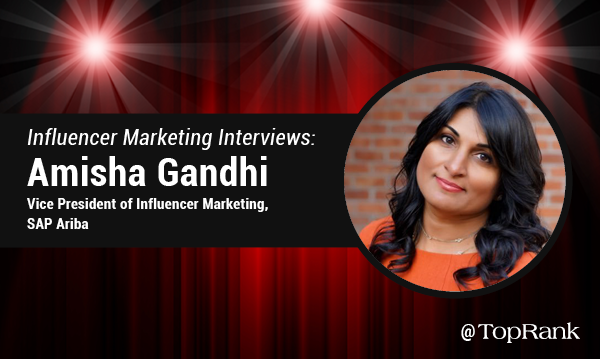
Amish Gandhi Influencer Marketing Interview

Amish Gandhi Influencer Marketing Interview One of the pioneers in the enterprise B2B influencer marketing space that I've been most fortunate to collaborate with most is Amisha Gandhi, (AmishaGandhi) Vice President of Influencer Marketing at SAP Ariba. Whether it was the SAP Leonardo launch microsite with interactive content and 30+ influencers sharing their expertise reaching 21 million views or campaigns like this one with Arianna Huffington plus internal and external influencers for SAP SuccessFactors, there's a lot of success in the momentum Amisha has created in the B2B influencer marketing world. As the creator of SAP's Global Influencer Program, Amisha has numerous B2B influencer marketing case studies being used in articles and presentations all over the industry. Now her focus is specifically with the Ariba global program that also includes working with analysts, communities and brand partners. In this interview, Amisha talks about going beyond creating awareness to working with influencers to engage specific customer personas across the entire customer journey. She also shares her favorite tools and her vision of what influencer marketing will be in 2020. Many B2B companies focus on their influencer partnerships to raise brand awareness and engagement. How does working with influencers in B2B help drive leads, sales and revenue? A lot of companies focus on the awareness piece of influencer marketing and that would be called influencer relations.

Influencer marketing is focusing on the customer journey and driving demand to drive leads and to help with nurture. @AmishaGandhi @SAPAriba

Influencer marketing is focusing on the customer journey and driving demand to drive leads and to help with nurture. That means you are co-creating content for demand generation with influencers, having them be speakers on your lead generation and involved with your high value, high touch customer activities. With influencer marketing, you’re looking to offer a better experience and better knowledge-based educational content with a third-party voice. These experiences can be achieved through content, speaking directly to customers, nurturing them and nurturing your cycle. This is the approach towards working with influencers that will help you to drive sales and show that you can touch pipeline. How is influencer marketing positioned within your company? Ex: independent department that serves the brand and departments / business unites or is it more decentralized? What are the advantages of that structure? Influencer marketing sits within the global marketing group at Ariba in corporate marketing. Ours is somewhat of an unconventional model with an influencer marketing team comprised of analyst relations, third party communities, external business influencers, and advocacy. The advantage of this structure is that it allows us to bring communities of influence together in a way to help drive real business outcomes from awareness to advocacy and with internal and external advocates. What tips can you share about being more effective about influencer identification, qualification or recruitment? The biggest piece of advice I can share is don’t just look at popularity metrics. Go beyond what the numbers are and see what that data really means. Don’t just look at followers, look at engagement. Look at who influencers are engaging with and how long they’ve been engaging. Also, don’t just look at social media. Look at where the influencers are speaking and who else they are connected to. Often times influencers on a specific topic hang out together. Start seeing those connections because that’s going to help you create a more effective program.

Engagement is better than the number of followers. Look at the conversations influencers are driving and take a deep dive across all their channels.  @AmishaGandhi @SAPAriba

Engagement is better than the number of followers. Look at the conversations influencers are driving and take a deep dive across all their channels. Discover where they are blogging to see what they are talking about and if it fits with what you are doing. When recruiting an influencer, make sue that it’s clear you’ve spent quality time getting to know what they care about and why they should care about you. Make it really clear what’s in it for them, not just what’s in it for you. What characteristics make for a successful influencer / B2B brand relationship? The biggest misconception about influencer marketing is that it’s all about social media and that you should buy influence to shout out marketing messages. Companies should approach influencers as partners, not just as people that they can use for their marketing efforts and launches.

Companies should approach influencers as partners, not just as people that they can use for their marketing efforts and launches. @AmishaGandhi @SAPAriba

Leveraging influencers only for promotion is a big complaint from influencers. It’s really about building a relationship that brings value to both parties. When you look at the characteristics for a successful B2B brand relationship you are:
  1. Looking at creating value for both parties
  2. Creating a long term and lasting relationship that is a two way street
  3. Setting up your influencers for success and arm them with knowledge before they walk into any kind of engagement
  4. Arming your brand stakeholders with information as well so interactions are high value between the company and the influencers
  5. Being clear with the influencers on what it is that you’re trying to achieve
Often times the influencers will share their advice from a view of the market that you don’t have, and you need to be open to that. Influencers can bring their outside-in perspective and help drive engagement with their advice. Listening to influencers in this way is a key tenant for a strong relationship. What advice can you share about measuring success with influencer marketing? When you are implementing an influencer marketing campaign understand the business outcome that you are helping to drive. Once you know the specific business outcome, put the metrics you want to track in a dashboard. For example, with a campaign that involves an eBook, your metrics might include social media shares, social impressions to see how it was promoted by influencers, views or downloads depending on how it’s set up. If you set up up measurement correctly with the right tagging you can see how much touch the asset had. If you have Marketo you can see when people come to the asset and where they go after, which helps inform your customer journey and how the influencer marketing pieces are working within your entire marketing landscape. Once you have those metrics in place you can use them as a benchmarks so the next time you have a program you can go back and see what your baseline measurements are. Many marketers overlook engagement. A lot of marketers look at social media impressions and social engagement. In B2B influencer marketing, there’s a lot of focus on engagement with assets and the customer journey, so you will want to make sure you have like minded metrics that fit into your marketing landscape that people will understand. Make sure that you have quantifiable metrics – but also don’t be afraid to bring up qualitative metrics as well. For example, if you did a webinar with influencers, you might say you saw 2X leads and 4X engagement which is going to be important way to report performance. Even if you don’t have hard numbers, you should be able to share comparative metrics so that people understand the value of using influencer marketing versus not .

The quality of content is important as are quantitative and qualitative metrics. It’s important to show both the art and science of influencer marketing. @AmishaGandhi @SAPAriba

The quality of content is important as are quantitative and qualitative metrics. It’s important to show both the art and science of influencer marketing. Speaking of technologies, any favorite tools or platforms you can share? Some of our favorite tools are Traackr, Marketo & Sprinkler. Traackr is for influencer marketing, Sprinklr is for scheduling and putting content out on social media networks and Marketo is what can help you visualize the journey. These are all tools that can help you show the measurability of influencer marketing and to quantify the program. How do you think influencer marketing will have evolved in the next year or two? What will it look like in 2020? I think influencer marketers will start to look beyond influencer relations. Today you see a lot of influencers at events and I think in the next few years you’ll see a lot more influencers during the demand cycle and involved with more content down the funnel. Personalization of content is becoming more important and you’re going to see influencers show up there, talking to different personas. There is also a growing importance around micro-influencers in industries where macro influencers were covering topics like artificial intelligence. I think we'll see more micro-influencers talking about topics like AI and manufacturing. There will be more micro-influencers involved with industry specific content.

I think we’re going to go away from influencer marketing and start thinking about what influences the customer journey. @AmishaGandhi @SAPAriba

In the next few years I think we’re going to go away from influencer marketing and start thinking about what influences the customer journey. B2B companies will move more into influence marketing versus influencer marketing. For those companies that want to be more strategic about influencer marketing, many programs begin as a pilot to determine if it will work for your company and why you are doing it. That way you can build your program based on the outcomes. Influencer marketing will be seen more as a strategic function if you can stretch it across the customer journey. In two years, I think we’ll go beyond influencer marketing. It will be about the intrinsic value of influence. Thank you Amisha!  B2B Forum 2018 If you would like to learn more about B2B influencer marketing from a panel of brand experts, be sure to check out our sesssion at MarketingProfs B2B Forum November 13-15th featuring Konstanze Brown from Dell, Amisha Gandhi from SAP Ariba and Lucianna Moran from Dun & Bradstreet. Here are the details: The Confluence Equation: How Content & Influencers Drive B2B Marketing Success Content and influencer marketing are hot topics for B2B marketers all over the world as two of the most promising strategies for attracting, engaging and converting ideal customers. What many marketers don’t realize is how collaborating with influencers can create even more credible, relevant, and optimized experiences for target accounts. Join moderator Lee Odden and an expert panel of B2B brand influencer marketing executives from SAP, Dell and Dun & Bradstreet to learn how working with influencers and their communities can help scale quality B2B content that gets results.  You'll learn:
  • The variety of benefits from B2B influencer collaboration
  • How major B2B brands plan, implement and measure influencer content
  • About processes and technologies that support influencer marketing success
We hope to see you there! Be sure to check out the other Enterprise B2B Influencer Marketing interviews in this series: Another resource that you might find interesting is this presentation on Big Brand Influencer Marketing:

The post Enterprise B2B Influencer Marketing Interview: Amisha Gandhi, SAP Ariba appeared first on Online Marketing Blog - TopRank®.


from Online Marketing Blog – TopRank® https://ift.tt/2C2L9zt
via IFTTT

Saturday, 6 October 2018

Weekend Favs October 6

Weekend Favs October 6 written by John Jantsch read more at Duct Tape Marketing

My weekend blog post routine includes posting links to a handful of tools or great content I ran across during the week.

I don’t go into depth about the finds, but encourage you to check them out if they sound interesting. The photo in the post is a favorite for the week from an online source or one that I took out there on the road.

  • Picmaker – Create beautiful, free YouTube thumbnails.
  • Hotjar – See how users are interacting with your web and mobile sites.
  • Triggmine – Use AI to manage your online store’s email.

These are my weekend favs, I would love to hear about some of yours – Tweet me @ducttape


from Duct Tape Marketing https://ift.tt/2IEVtim
via IFTTT

Friday, 5 October 2018

How Organizations Can Get Ready for the New Virtual Reality


from Oracle Blogs | Oracle Marketing Cloud https://ift.tt/2y2lILM
via IFTTT

Digital Marketing News: Search & Social’s Strong Ad Growth, Facebook’s Breach Fallout, & Reddit Tops 1B Native Video Views

2018 October 5 News Image

Social and Search Forecast to Contribute Two-Thirds of Global Ad Growth Through 2020
By 2020 search and social are expected to account for 66 percent of global ad spend growth, according to new research data by Zenith. Video ad spend growth has also surpassed that of static images. Spending for online video ads is forecast to grow annually by 18 percent, while that of social media looks to grow by 16% annually. MarketingCharts

Reaction: Facebook advertisers on alert as network breach exposes 50m user accounts
In the wake of Facebook’s recent revelation of a security breach that exposed some 50 million user accounts, advertisers have reexamined their advertising with the social media giant, and some have pulled the plug entirely, at least temporarily, including Mozilla and Sonos. The Drum

Reddit Surpasses 1 Billion Video Views, Closes in on 1 Million Uploads Per Month
Reddit has announced that the social news aggregation and discussion site has topped the billion native video view mark, while also nearing a million video uploads per month. Reddit also revealed that its ad revenue has tripled over the past three years. DigiDay

Employers Are Looking for ‘Influencers’ Within Their Own Ranks
The Atlantic has taken a close look at how some employers are eyeing their own employees and customers as brand ambassadors. The Atlantic

SAP, Microsoft and Adobe announce data alliance
Adode, SAP (client), and Microsoft have announced a data alliance, with the launch of the joint Open Data Initiative. The move is meant to streamline interoperability between the business software firms’ respective platforms. Reuters

Seven Examples of Outstanding B2B Marketing Campaigns
MarTechSeries has examined some of the best recent B2B marketing campaigns, highlighting notable work from firms including Hubspot, Salesforce, Google, and SAP (client). MarTechSeries

2018 October 5 Statistics Image

LinkedIn steps into business intelligence with the launch of Talent Insights
Microsoft’s LinkedIn has recently announced a set of new business intelligence features. With Talent Insights, LinkedIn (client) further expands the firm’s position as an IT productivity tool. TechCrunch

Facebook Added a Premium Option for Its In-Stream Video Ads
Facebook has announced a new premium version of its in-stream video advertisements, with better placement available to a group of select publishers and creators. AdWeek

Pew: Internet adoption, social media usage have been flat since 2016
Social media use, device ownership, and the number of new Internet users have each remained largely flat since 2016, according to new survey research from the Pew Research Center. The report also looks at the issue of saturation. Pew Research Center

Facebook Publishes New Report on the Growing Benefits of Messaging for Business
Facebook recently released a new report exploring how messaging offers expanding benefits for businesses. The study also examines brand-consumer messaging on the platform. Social Media Today

ON THE LIGHTER SIDE:

2018 October 5 Marketoonist Tom Fishburne Cartoon

A lighthearted look at evidence-based marketing by Marketoonist Tom Fishburne — Marketoonist

Being funny can make you money. Just ask Apple, IBM, and Taco Bell — Fast Company

TOPRANK MARKETING & CLIENTS IN THE NEWS:

  • Lee Odden — Episode 78 Interview With Lee Odden — Reach or Miss
  • Lee Odden — 20 Digital Marketing Experts You Must Follow On LinkedIn Right Now — Samantha Marketing
  • Lee Odden — Kristen Hicks finds 3 content creation themes for writers at Content Marketing World — The Content Marketing Writer
  • DivvyHQ (client) — 8 Books Every Content Marketing Manager Should Read At Least Once — DivvyHQ

What are some of your own top content marketing news items for the week?

Thank you for joining us, and we hope you’ll check in once more next week for a new group of the most relevant digital marketing industry news, and in the meantime you can follow us at @toprank on Twitter for even more timely daily news. Also, don’t miss the full video summary on our TopRank Marketing TV YouTube Channel.


Email Newsletter Gain a competitive advantage by subscribing to the
TopRank® Online Marketing Newsletter.

© Online Marketing Blog - TopRank®, 2018. | Digital Marketing News: Search & Social’s Strong Ad Growth, Facebook’s Breach Fallout, & Reddit Tops 1B Native Video Views | https://ift.tt/2wiHYzh

The post Digital Marketing News: Search & Social’s Strong Ad Growth, Facebook’s Breach Fallout, & Reddit Tops 1B Native Video Views appeared first on Online Marketing Blog - TopRank®.


from Online Marketing Blog – TopRank® https://ift.tt/2IKgU1P
via IFTTT

Thursday, 4 October 2018

Want to Go Stress Free? Here Are 6 Reasons to Hire A Digital Marketing Agency

When to Hire a Digital Marketing Agency

When to Hire a Digital Marketing Agency From developing and executing your marketing strategy to measuring results, your plate always has a healthy heaping of responsibilities—all of which are likely served with a side of stress from time to time. If you’re nodding your head in agreement, you’re certainly not alone. A couple years ago, Workfront released its Marketers Stress Report revealing that 80% of marketers feel they have too few team members and too much work. Furthermore, 1 out of 4 marketers said they were “overly stressed” or “stressed to the max.” Fast-forward to today, the stress factor still remains as marketers contend with a myriad of challenges, from lack of internal resources to adapting to the changing digital landscape. The good news, of course, is that a digital marketing agency (like TopRank Marketing) can lend a helping hand. One of the primary responsibilities of any marketing agency is to lighten your workload and alleviate some of the stress that comes with it—and do it in a way that helps drive results. When and how should you tap an agency team in? Below are a handful of scenarios were the help of an outside expert could reduce your production time and improve performance, all while reducing stress.

#1 - When you want to make the most out of an event.

Is your team preparing to host a webinar? Will you have a presence at an upcoming industry conference? Events—whether they be large or small—take plenty of time, effort, and resources to plan if you want to make a meaningful splash. And partnering with a digital marketing agency can give you expertise and bandwidth to make the most out of event marketing opportunities. From content strategy and development to crafting and executing organic and paid promotional strategies, an agency can plug in as a strategic guide early on or provide execution support before, during, or after the event.

#2 - When you’re preparing to launch a new product or service line, or content marketing campaign.

Anytime a new product, service, event, or campaign opportunity arises, it can be an exciting time for any organization, but it can also be hard to balance with your other marketing initiatives and responsibilities. But by tapping into a marketing agency, you can get support at both the strategy and execution levels. If you’ve locked down your promotion or campaign strategy, but you don’t have the internal bandwidth for creation, an agency can plug in with a team of highly specialized individuals—from writers to designers—to get the work done. This enables you to take on a steady strategic and visionary role to guide the launch. If you need an advisor to help you develop your strategy and execute on the final deliverables, that team can take on a consultative role from start to finish, developing a campaign strategy around your core KPIs and creating the content assets that go along with it.

#3 - When you’re working under tight deadlines.

In the marketing world, tight deadlines are nothing new. Whether a needed content asset fell through the cracks or a last-minute request was handed down from the top, you don’t need to pull all-nighters and overload your internal team. You can shift some or most of the work to a digital marketing partner that offers services across marketing disciplines. Specialized agency team members can work individually a specific need or collaborate on more complex projects.

#4 - When you want to venture into unknown territory.

As the digital landscape continues to evolve at a rapid pace, many marketers want to integrate new tactics such as influencer marketing or interactive content into their digital strategies. But oftentimes they feel lack the time or expertise to do so. An experienced digital marketing agency can give you the lay of the land and provide strategic guidance for how best to dip your toes into new waters. In addition, they can also design a creative strategy around your goals and market considerations, and create the final products.

#5 - When you want to use, not lose, your remaining budget.

You’ve worked hard to secure your marketing budget. But if you don’t use it all, you’ll likely lose what remains—and possibly signal to leadership that you won’t need all those dollars (or more dollars) next year. Whether you want to build a stockpile of custom images or conduct a content audit to uncover gaps and top opportunities, an experienced agency offers several options to make the most of your marketing budget and help you build or continue your marketing momentum.

#6 - When your results aren’t where you want them to be.

Proving the value of your marketing efforts with solid results is your ultimate goal, and perhaps one of your biggest stressors. Whether you feel there’s a hidden opportunity you need to unearth to give results a boost or you’re seeing some lackluster results in general and don’t know where to put your efforts, a marketing agency can provide an independent, third-party perspective. From conversion rate optimization (CRO) to reducing cost-per-lead on PPC campaigns to expanding your search footprint, a full-service digital marketing agency can have its subject matter experts dig into the data and make actionable recommendations for optimizing your content or strengthening your tactical mix.

Boost Your Workload. Improve Performance. Reduce Stress.

Whether you need additional support for a planned initiative like making the most out of an industry event or a last-minute project with a tight deadline just popped up, don’t stress. Find a partner instead. Marketing agencies exist to provide fellow marketers with the support and guidance they need to help reduce stress and help drive results. Ready to reduce stress? Let us help. Take a peek at our digital marketing services and holler with questions.

The post Want to Go Stress Free? Here Are 6 Reasons to Hire A Digital Marketing Agency appeared first on Online Marketing Blog - TopRank®.


from Online Marketing Blog – TopRank® https://ift.tt/2OA36vP
via IFTTT

Wednesday, 3 October 2018

Transcript of Why Sales and Marketing Need Each Other

Transcript of Why Sales and Marketing Need Each Other written by John Jantsch read more at Duct Tape Marketing

Back to Podcast

Transcript

This transcript is sponsored by our transcript partner – Rev – Get $10 off your first order

John Jantsch: Marketing has never needed sales more and frankly, sales people have never needed marketing more than they do today. In this connected world, where people can find out whatever they need to find out, do they really need sales people? In this episode of the Duct Tape Marketing podcast, we talk with Pam Didner. We’re going to talk about effective sales enablement, collaboration, getting marketing and sales together. Check it out.

Hello and welcome to another episode of the Duct Tape Marketing podcast. This is John Jantsch, and my guest today is Pam Didner. She is a content marketer, author, speaker, and has a new book called Effective Sales Enablement: Achieve Sales Growth Through Collaborative Sales and Marketing. So Pam, thanks for joining me.

Pam Didner: My pleasure. And you are based in Kansas city?

John Jantsch: I am in Kansas City, Missouri.

Pam Didner: How is the weather today?

John Jantsch: It’s beautiful today. Well, I don’t know, it’s actually, summer’s hanging on a little longer than I’d like to do. It’s about 90 and humid.

Pam Didner: Oh my gosh.

John Jantsch:  So, we’re waiting for that first fall cool weather to break.

Pam Didner:  It’s coming. It is coming.

John Jantsch: All right, so let’s define the term sales enablement. That’s one of those terms that I bet you could get a whole bunch of people that define it in different ways. So what’s your definition of sales enablement?

Pam Didner: Yeah. In general, if you talk to anybody in sales anywhere in the world, they tend to define that it’s related to sales development and sales training. But for folks who are listening, if you actually look for a sales enablement definition, it’s usually related to development and the training of a sales team.

And my book was written from a marketer’s perspective. Interestingly enough, I was never a sales person, but I have done multiple different jobs supporting indirect sales, and also the sales team. And I feel that there are things that marketing can do to actually support sales.

So the way I defined sales enablement for my book is to deliver a positive customer experience by equipping sales with knowledge, skills, processes, and tools, through cross functional collaborations, obviously that’s between sales and marketing, in order to increase sales velocity, sales retention, and also productivity.

It’s a little bit long, but if you’re thinking about the purchasing cycle in the continuum, obviously via time we’ll pass the baton from the marketing to a sales team. At the end of the day, we want to make sure we deliver that seamless customer experience.

John Jantsch: That’s interesting. I have a little history with this. I actually wrote a book called Duct Tape Selling. The sub title is Think Like A Marketer, Sell Like a Superstar. I was actually writing to sales people saying, “Hey, you need to start acting more like marketers.” So maybe a little bit similar.

Here’s what I kept hearing from people when I’d go out and speak about this. That’s great, but sales and marketing have different goals, different priorities, different support systems, they’re even compensated differently. That was the pushback of hey, how do we get these guys together? So what have you found, how have you found, because I’m sure you’ve heard that same thing?

Pam Didner: Yeah. You are totally right. It’s interesting enough that sales and marketing work in the same company. They even have the same business goal. Drive revenue. But they always have some sort of a misalignment, and I think a lot of the misalignment has to do with two things. First one is long term versus short term, right? If you talk about sales people, they have to meet quota every single quarter. Then if you talk to the marketers, they are building a brand awareness. Obviously it’s a much longer term beyond just one quarter.

Another thing is the top of the funnel versus the bottom of the funnel, because the marketers tend to focus on the demand end, especially in the very beginning of the purchase funnel, and also building the brand awareness. Again, that’s on the top of the funnel as well. But if you talk to sales people, they tend to focus on the bottom of the funnel, right? They want to drive conversion, they want to drive the sales closure.

That also cause a little bit of the misalignment between the sales and marketing. With these short term versus long term, top of the funnel versus bottom of the funnel priorities, that obviously have a huge impact on the resource and the budget allocation when you move down to a technical level.

The way that I see that both sales and marketing work together, is you need to find some sort of commonalities within the misalignment. One of the great way to actually drive that is account based marketing. Obviously, especially for the technology and the complex sales, that they are specific accounts the sales people go after. And account based selling is nothing new, but what about working also with the marketing people to tailor and customize some of the marketing campaigns and outreach for a specific account. That’s just one example, if you will. It’s looking for commonality within misalignment. I think that will be the first step to do.

John Jantsch: Okay, here’s the really tough question to get us both in trouble. In that description, and in the traditional sense, do we even need the sales function anymore, then?

Pam Didner: That’s actually a very good question. I still think sales function is absolutely necessary, and I am a marketer. I never can qualify myself as a sales person. And I think marketers need to think that the sales is just another marketing channel, and sales people need to think that marketing is another hidden sales force. Does that make sense? They complement each other in a way, and I loved supporting my sales people when I was in the corporate world. But I don’t think I can do their job. I still think that sales people provide a huge amount of value, and to bring the revenue actually to the company. I don’t think marketing can actually take that 100%.

John Jantsch: [inaudible] always described the difference between sales and marketing is that marketing controlled the message and sales typically controlled the client relationship, and was much closer to the client. How do we get marketing closer to the client?

Pam Didner: I think there are multiple ways to do that, but before I talk about that, John, you brought a very good point. Traditionally, marketing tend to focus on messaging and sales focus on client relationship. With the rise of digital, especially in social media, don’t you think that marketing is actually doing some of the customer services? And also managing the client relationship, right? Because you have to talk to the customers and it’s no longer just one way communication, it’s actually a two way communication. So I actually see the modern marketers are taking on some of the client relationship on its own, naturally, just because of digital technology. That’s one way I’m looking at it.

John Jantsch: Not to mention the data that we now have. I think that the segmenting is better, personalization of content is better, and so I think all of those elements have … I think a lot of people are missing the boat by not using those elements to get closer as well.

Pam Didner: Yes. You are totally right. Leveraging data is actually a great competitive advantage, if you will. Unfortunately, to be honest with you, my generation, probably along with yours, we kind of grew up with traditional marketing. So data, looking at data day in and day out is not necessarily what traditional marketers do. I have to intentionally learn, and make an effort to do that. I agree with you that something, especially probably for the millennials that come into the workforce, that will come naturally to them. But at least for the existing workforce that’s currently in the marketing field, this is something that we still have to learn. Does that make sense? But I do agree with you 100%.

John Jantsch: What does today’s, I mean I made my comment earlier about do we even need a sales function, and I agree with you. I was actually just opening that up for, so a lot of sales people listening can say, “How dare you?”

Pam Didner: Yeah, John. How dare you?

John Jantsch: What does today’s sales person need from marketing, though, so that they are relevant?

Pam Didner: I think there are multiple things that the sales team needs. In the past, I think sales people can be a super hero. They can do a lot of client relationship, accelerating the purchase funnel on their own. But in the current modern world, you need a team to support you. You cannot do anything on your own anymore, if you think about it. I think the marketing team can be the back end to actually support a sales team, and there’s multiple ways that the marketing team can do, right?

In addition to give the sales people MQL, which is marketing qualified leads, marketing people have done email marketing inside out. They probably know how to optimize that, and I know a lot of sales people do many email marketing campaigns on their own for their prospects. So getting the tips and tricks from the marketers doesn’t hurt.

And social media, obviously, marketing people are pretty much on the front of that. Again, tips and tricks and teaching sales people how to do that better doesn’t hurt.

Social selling is related in terms of how to do research of your prospect on LinkedIn, on social media, and using the hash tag, and what of and keyword search. How do you use keyword search, how do you use hashtag properly? Again, marketers can provide some help. On top of that, there’s a lot of messaging, even content, that marketers create.

If you think about it and try to map the customer journey along with the sales processes and also methodology, there may be some content on the marketing side that can also be used on the sales side. If it cannot be used, obviously it can be modified and customized in certain way. So the content sharing between sales and marketing is another way that marketing can contribute.

And the last one, if you will John, a lot of the stuff that marketing people are doing can easily be part of a sales on boarding, and so is training. How to do social selling better, how to actually do research better online. All this can be part of the on boarding training and continuous training of the sales people. So there are multiple ways that marketers can contribute. I’m just sharing with you several examples.

John Jantsch: Now, one of the things that I’ve encountered in talking to a lot of sales people over particularly the last five to seven years, is that some of them got tired of waiting for the company, for the company culture, to shift and bring sales and marketing together. A lot of very successful sales people have said I’m just going to go out and build my own reputation. I’m going to blog, I’m going to participate in social media, I’m going to get speaking at maybe regional conferences where my customers might be there. In your opinion, should companies go as far as elevating their sales people in those veins?

Pam Didner: I think it’s actually good, but there’s a couple of things I want to address. If you are actually in a small business or, I would say, a mid size company, and having sales people speak and talk about the brand, is probably not their thing. You want everybody to talk about your brand and also your product, and you become a brand ambassador or your company’s ambassador to promote your products and services.

However, in the bigger enterprises that be hundreds or thousands of a sales force, they usually have a policy and also processing place to do that, and you need to understand your corporate policy and make sure there’s no code of conduct violations, or whatnot. Right? And if you actually go out and talk about your products, sometimes you have to use examples. And say if you talk about specific accounts, will the other accounts be mad that you didn’t mention them?

So there is always a fine line in terms of should you do that or not? My recommendation is always look at your corporate policy and check with your senior management, especially VP of sales. Some of them welcome that, some of them feel, you know what, you should not do that and you should use your time more effectively making calls. So that’s when-

John Jantsch: “Those idiots in marketing aren’t sending me any good leads!” I can hear people screaming that.

Pam Didner: Yeah. This is something that, you’ve got a good point, John. From my perspective, if that’s the case there should be a very honest conversation between sales and marketing. At the end of the day, you’ve got to have a come to Jesus meeting. You know what I’m saying? And the sales people need to be very frank and say I’m doing all this because you are not giving me stuff. And now, what can we do or what can you do, to actually help us out?

So I think at the end of the day, it’s the service level agreement that needs to be finalized and also communicated, so sales can do their jobs. But if they feel that being a brand ambassador or company’s ambassador that can get them leads, I don’t know. It may not be a bad thing. What do you think, John?

John Jantsch: I’m a big fan of it, but I do know that it’s like everything, it’s fraught with land mines as well, potentially, when you’ve got shareholders and things to consider. But in the small business, which quite frankly, I have a lot of small business owners as listeners, and I think that they should find ways to … If I was considering making a purchase and the sales person from one company was speaking at a conference I was attending, and the other people were just sending me brochures, to me that would be a great competitive advantage. But again, it’s probably individual considerations.

Pam Didner: I do agree. And individual company considerations, yes, absolutely.

John Jantsch: Absolutely. I’ve always said that one of the best sources of lead generation is happy customers, and a lot of companies are investing pretty significantly in customer experience and service. So how could a comamonas use that investment as a way to help sales?

Pam Didner: You’re talking about customer services, right? You’re talking about wholesales, specifically? I just want to be-

John Jantsch: The kind of stuff that would generate raving fans and referrals, and things like that.

Pam Didner: Yeah, I totally agree that customer service or the post sales experience is incredibly critical, and this is so true, so true for technology companies or SaaS based products, because when you offer any kind of SaaS based products, there’s always a learning curve, right, that the user has to go through to get familiar or get competent and efficient with your tools.

The post sales is very critical in terms of getting cross sales and also up sales in the future. And fortunately, the customer service department is not a necessary part of the sales team or part of the marketing team. They tend to be a team of its own. What I have come to realize, especially working in the marketing side of things, at the end of my job in the corporate world, I got a chance to actually work with the customer service team, because understanding what kind of questions they ask actually helped me to determine what kind of content I should create. Does that make sense?

We also feed that kind of information back to the product team. So when they created next version or next generation of their product, some of the features can be incorporated. On top of that, some of the key learnings or the questions that were asked as part of the customer service team, we tried to feed into a sales team so they can get kind of like first hand information and just give them a heads up that when they implement certain tools, there’s a couple glitches they may encounter, and the sales people can prep their contacts.

It’s interesting how customer service in the past tends to be a division of its own. Now a lot of the data they collected, and John you mentioned how important data is, that is feeding back to the marketing for the content creation, and feeding back to the sales team to improve their client relationship, and even the product development. So I think it’s very critical to actually have that relationship with the customer service team as a marketer.

John Jantsch: So if we are going to have effective sales enablement, what does the new sales-marketing-service team look like? Does it have to fundamentally be changed in how we structure that in organizations?

Pam Didner: That’s actually a good question. In an enterprise, it’s almost impossible, right, to change the organizational structure and the sales team and the marketing team will continue to actually have their differences. I don’t think we can overcome that overnight, per se. And the way that I recommend it in my book is, you need to take some baby steps. If there’s a huge or there’s a big gap between the sales and marketing, is it possible you could find some sort of commonality and start it with small initiatives, for example.

The second thing is, if there’s already some sort of misalignment but can you make that alignment even closer and drive multiple different joint initiatives together? I don’t think the two circles will completely overlap, and my recommendation is make an effort to align as much as possible, but be aware that the sales and the marketing team always have different goals.

John Jantsch: But you know what? Get somebody from marketing and go get them in the car, and go call on some accounts with them.

Pam Didner: Actually, I do agree with you, and that’s one of my recommendations in terms of trying to understand sales processes and sales methodologies is to shadow the sales person for a day or for a week. If nothing else, they can get a sense of the pain of the sales people for the continuous rejections. But yes, it is very important to actually try to understand sales issues and concerns in order to better support them.

John Jantsch: Speaking with Pam Didner, author of Effective Sales Enablement. Pam, where can people find out more about you and your work and your book?

Pam Didner: Excellent questions. You can always google Pam Didner, D-I-D-N-E-R. And I also have my own website, pamdidner.com. Just go there, check it out, I blog and I also have a podcast, Seven Minute Marketing With Pam, and the book Effective Sales Enablement will be launched on October 3 in the UK, and on October 23 in the US. And you can obviously pre order on Amazon. The things I really want to share with your audience is that if you purchase my book, and you read the book, and you discover absolutely nothing, nothing usable in the book, schedule a call with me. More than happy to actually help you out. Tell me your challenges, I will see what I can do.

John Jantsch: Awesome. That’s about as good a guarantee as you’re going to get from an author, so Pam, thanks for making that offer and we will obviously have links to everything in the show notes when you check this out, so Pam, thanks for joining us. Maybe we’ll catch up with you out there on the road sometime soon.

Pam Didner: My pleasure. Thank you so much.


from Duct Tape Marketing https://ift.tt/2xVrMp5
via IFTTT
Why Sales and Marketing Need Each Other

Why Sales and Marketing Need Each Other written by John Jantsch read more at Duct Tape Marketing

Marketing Podcast with Pam Didner
Podcast Transcript

Pam DidnerThis week on the Duct Tape Marketing Podcast, I chat with Pam Didner. After almost 20 years in corporate America, where Didner held a variety of senior leadership positions in departments as varied as finance and accounting, supply-chain management, and global marketing strategy, she decided to strike out on her own.

Didner is now a public speaker, facilitator and coach, consultant, and author with a focus on global content marketing. She is the author of two books, including the forthcoming Effective Sales Enablement: Achieve sales growth through collaborative sales and marketing.

On today’s episode, Didner discusses her new book, and what small and mid-sized business owners can do to build a bridge between the sales and marketing teams that encourages mutual understanding, fosters a greater internal support network, and helps serve the larger goals of the business.

Questions I ask Pam Didner:

  • How do you define sales enablement?
  • How do you bring sales and marketing together when they have such different goals, priorities, and support systems?
  • Is the sales function obsolete?

What you’ll learn if you give a listen:

  • How technology and data has brought the sales and marketing functions closer together.
  • Why small businesses can benefit from turning their salespeople into brand ambassadors.
  • How to use the information from your customer service team to shape your marketing and sales approaches.

Key takeaways from the episode and more about Pam Didner:

Like this show? Click on over and give us a review on iTunes, please!


from Duct Tape Marketing https://ift.tt/2IzMGyp
via IFTTT