The post Digital Marketing News: Brand Trust, B2B Content, LinkedIn’s Rising Engagement, Digital Video Ad Spend Growth, & More appeared first on Online Marketing Blog - TopRank®.


from Online Marketing Blog – TopRank® http://bit.ly/2PGv5Io
via IFTTT
The post Digital Marketing News: Brand Trust, B2B Content, LinkedIn’s Rising Engagement, Digital Video Ad Spend Growth, & More appeared first on Online Marketing Blog - TopRank®.
Peter Armaly is a Senior Director and Advisor for Oracle SaaS Customer Success. He is responsible for program design and execution of skills enablement for the customer success organization and in that capacity he works closely with senior executives both internally and externally. Peter is a highly accomplished marketing and customer success practitioner/leader who leverages his background by speaking and blogging about the challenges and opportunities around developing sophisticated customer-centric approaches.
Jeff Kleven is a Principal Customer Success Manager for Oracle SaaS. He is responsible for Oracle clients' adoption and success of their use of HCM Cloud. Jeff has held various client facing roles over the past 17 years in HCM Cloud, including direct sales, partner management and enablement as well as customer success.
Recently, Peter sat down with Jeff to discuss a topic that speaks to the core of the Customer Success mission, transparency with customers.
Peter: Jeff, I know you’re a fan of transparency. So, you might be interested in an article in a recent issue of the Harvard Business Review. I found it intriguing because it says that companies should make their processes visible to customers while at the same time making the customers visible to employees. Radical, right? Imagine revealing all the sausage making that goes on behind the scenes to your customers. You might be wondering why would anyone think that’s a good idea? Or maybe you’re not wondering that at all and think it’s a no brainer. In any event, the author of the piece argues “when consumers can’t see the work that’s being done to serve them, their perception is that less effort or value went into delivering the service, so they don’t appreciate or value it as much.” Fascinating. It’s true that the article mostly places this in the context of B2C but in this age of the cloud I’m not sure it matters much. So what I want to hear your thoughts on is this. How do you think it might be to your advantage as a Customer Success Manager to reveal what goes on at Oracle when the customer seeks help with adopting more of a solution?
Jeff: Great question, Peter, and a good read as well. Yes, I’m a huge fan of transparency and believe clients appreciate that approach. In fact, one of the best examples of a request for transparency came to me from a CIO of a global consulting firm. He said, ‘Jeff, we use your cloud application across the globe; we need you to be prescriptive. Tell us how to be the best client your organization has.” Wow. He trusted that through me, our organization could recommend modules, best practices, professional services, partners etc. so they could in fact be the best client we had. Isn’t that the dream of every Customer Success Manager? When I think about how we can help clients with our solutions, opening the ‘curtain’ of our organization’s processes for our clients can only help. My experience is this: Clients are disappointed or upset at issues we create. However, if we admit to those faults and have a plan that we share with the clients to prevent those issues from re-occurring, we earn their trust. That HBR article talks about customer perception when interacting with a supplier. Back when retailers adopted point of sale (POS) terminals for debit and credit, studies showed that even though the payment transaction time took longer, customer satisfaction didn’t fall, as you might logically think it would. Instead, the opposite happened. Customers’ satisfaction went up as they perceived the wait time was shorter (even when it wasn’t). The moral of that story for me is this: Don’t be shy about making your clients aware about what’s happening during their product/service transactions. Share what goes on behind the scenes as they’ll appreciate the transparency and who knows, maybe they’ll make suggestions that will improve your overall service/product.
Peter: Of course there are boundaries, right? McKinsey wrote this piece about the dark side of transparency that makes good points about exercising some discretion. But I like to think that most people we deal with in business are respectful and that we treat them with respect in return. So we’re not going to inundate them with too much information and especially information that’s superfluous. One thing Customer Success Managers must always keep in mind, if they’re going to authentically execute a true customer-centric mission, is to be mindful of the customer’s perception. Too much of anything is almost as bad as too little of anything. So, would you agree that transparency requires the same sort of balancing act?
Jeff: Absolutely. Transparency does require a balancing act as no one wants to hear about another company’s dirty laundry. We have all had experiences hearing employees complain about their employer, whether is it a call center employee or perhaps a bank teller. I propose that clients will appreciate transparency and when appropriate, access to those internal resources. Transparency breeds trust and trust breeds opportunities for improvement. Take, for example, Customer Advisory Boards. If your company is truly interested in feedback from you clients, create these groups and truly listen to their feedback. Take that feedback and act on it. Demonstrate how the feedback has translated into improvements and voila, you have a closed-circuit feedback mechanism that all started with a transparent approach to working with clients. We all experience B2C interactions and a common one is an oil change. My local garage displays a small handwritten note on the dash afterward saying ‘John completed your oil change today’. What a great approach to share the pride of work that is delivered in a personalized fashion. Can we as Customer Success Managers provide similar B2B service? I think we can. Make it personal and make it transparent!
Peter: Bravo, Jeff. Be open and honest enough to authentically seek ways to improve the service from the people who are consuming it, but don’t go too far with your information sharing so as to make them question your company’s ability to get its act together and deliver high quality service in a consistent manner. This discussion makes me think of something. If you’ve read my blog posts over the last couple of years, you’ll know I’m a big proponent of scaling customer success through the collection of data and the automation of customer outreach. But this conversation grounds me a bit by reminding me that there is a lot of nuance in the vendor/customer dynamic that cannot easily be programmed or automated, no matter how much data you collect about the customer. It might come someday through very sophisticated artificial intelligence, but for now there’s no replacing the skills of an experienced and respectful customer success professional when it comes to developing deeper, trust-based relationships with customers. So, maybe a future conversation can be about how human customer success pros can elevate their value to customers by focusing more and more on what computing can’t do.
Thanks for this, Jeff. It’s been fun.
Discover how else you can enhance the customer experience with “Go Further with Customer Experience Optimization.”



The Kentucky Derby has long been referred to as the fastest and most exciting two minutes in sports. And when it comes to your B2B content marketing efforts, getting your audience to sit on the edge of their seats, glued to your content for two whole minutes can be a major feat. To generate Kentucky-Derby-like attention for your B2B brand, your content marketing strategy needs to leverage the right tactical mix for your audience, industry, product mix, and objectives. However, over the last decade, the content marketing field has become crowded and even convoluted with hopeful tactical and strategic champions. The field has evolved from traditional winners like blogging and eBooks to include a new breed of favorites like influencer marketing, interactive content, and more. So, when and where should you place your B2B content marketing bets? Read on to learn about the latest content marketing tactics and their odds of putting your brand in the winner’s circle.
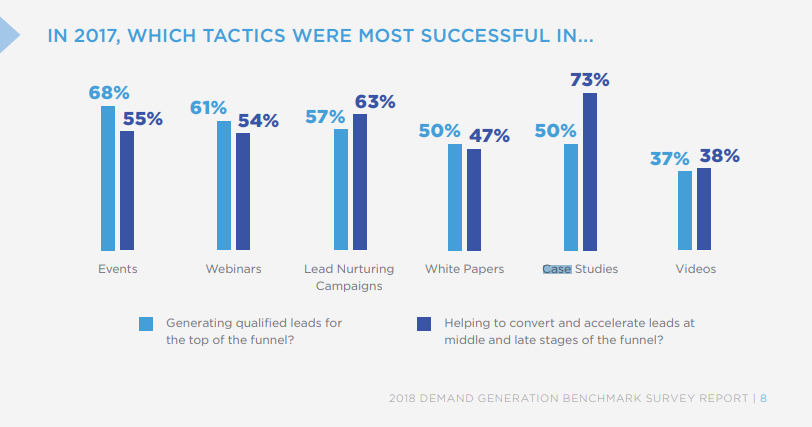 Image credit: 2018 Demand Generation Benchmark Survey Report Odds: When prospects are in the consideration or conversion stage of the buyer journey, proof and evidence can help guide them towards a purchasing decision. If moving more buyers through the funnel means winning for your brand, relevant and insightful case studies are a great bet.
 Odds: If you’re looking to go bold at every stage of the funnel, All That and a Bag of Chips is as good as gold. To ensure that this horse is crossing the finish line first, consider pairing it with another horse in the race to slingshot it to victory. For example, create an interactive infographic, eBook, or influencer-driven landing page. You might just see your results compounded.
The post The B2B Content Marketing Derby: When & Where to Place Strategic Bets appeared first on Online Marketing Blog - TopRank®.

Transcript of Everything You Need to Know About Podcasting written by John Jantsch read more at Duct Tape Marketing
This transcript is sponsored by our transcript partner – Rev – Get $10 off your first order

John Jantsch: This episode of the Duct Tape Marketing podcast is brought to you by SEMrush. It is our go-to SEO tool for doing audits, for tracking position and ranking, for really getting ideas on how to get more organic traffic for our clients, competitive intelligence, backlinks and things like that. All the important SEO tools that you need for pay traffic, social media, PR and of course, SEO. Check it out at semrush.com/partner/ducttapemarketing. We’ll have that in the show notes.
John Jantsch: Hello and welcome to another episode of the Duct Tape Marketing podcast. This is John Jantsch and my guest today is John Lee Dumas. He’s the host of EOFire, an award-winning podcast that interviews successful entrepreneurs seven days a week. That’s right. Every single day except over 1,400 interview, a million monthly listeners. It’s really become not only a great place for you to get inspiration just entrepreneurially but also to learn about podcasting. We’re going to talk about a variety of things today including a new passion project that’s turned into a big business all by itself, I think. Something called The Freedom Journal. John, welcome back.
John Lee Dumas: Well, John, I’m glad to be back and to combine over 2,000 episodes which is just mind-boggling.
John Jantsch: Yeah, it really is. I’ve done it the long hard way. Well, you’ve done it the really fast cool way. Let’s start there with my guessing. Is there anything new in the world of podcasting that you’re seeing coming that you are telling people that they need to pay attention to?
John Lee Dumas: Yeah. I say over and over again, if I launched Entrepreneur On Fire today, it would fail. It would fail in 2016 because (1) I was not a good podcaster when I launched. It took me a long time to get my “interview chops” and that’s why I did it daily so I could really get to practice. Now, I’m over 1,500 episodes. If I launched the show today, it would fail because it’s too broad. It’s not niche enough. I land grabbed. I was there early enough. I wasn’t as early as you, of course, but I was there early enough where I was able to land grab and really get a name and momentum that I’ve continued to be able to build momentum, momentum, momentum. I got there because of that.
John Lee Dumas: If I wanted to launch a successful show today in 2016, I would have to find a niche. I’m not just talking like a narrow niche. I’m talking like a narrow, narrow niche where I would just say, “Hey, I’m going to dominate this topic in the podcasting world, and the area that I’m passionate about and that I have some value to give. I’m going to do it in a meaningful way.” People that launch these broad topic podcast, I think, are going to struggle because there’s just a lot of saturation out there in the broad markets, but there’s never enough niche podcast, people that find that unique value distinguisher that’s going to make them win. That’s what’s new in 2016. In my opinion, podcasting is hot. It is the golden age of podcast and you’ll hear it over and over again, but for a host, if you’re starting any time this year or next, find that narrow niche and dominate it.
John Jantsch: One of the things that I have attributed to podcasting that not everybody talks about. Obviously, there are a lot of people out there that would love to have this success in the revenue that’s come with that success directly related to podcasting that you have, but I talk a lot of small business owners and actually tell them that one of the little talked about things that podcasting can bring you is access. There are many, many people that I have gained access to because I said, “Hey, I want to interview you and promote your book” as opposed to, “Hey, I just want to talk to you for 20 minutes and pick your brain.” I think a lot of business owners miss that opportunity. I think there is a place for podcasting for somebody to just interview hot prospects in their community or people that are doing what they want to be doing in their community. What do you think about type of podcasting?
John Lee Dumas: I think that’s great. I think the regional podcast is really powerful. I look back and I’m not honestly, personally, super religious of a person, but when I first heard about podcasting, it was from my friends that were talking about going to church services or more likely missing church services and then listening to the podcast afterwards like on Monday or Tuesday. I was like “What’s a podcast? What do you mean by that?” They described and I was like “Oh.” Churches were, interestingly enough, pretty early in on the podcasting game like back in the mid 2000s. Literally, some churches were doing this for people that would miss church. They proved that it can be a regional win. The people in the community will say, “Hey, I missed that service, but I want to hear what the sermon was about. Let’s do this.” People today are winning regionally as well. I think that’s really important.
John Lee Dumas: I have a couple friends in the City of Portland, Maine where I was born and raised and actually launched EOFire back in 2012 in Portland, Maine that are doing really cool regional podcast that are being listened to because people want to know what’s happening in Portland, not just in the world. They want the niche podcast. They want the specifics. That’s why people like picking up the local newspaper because they’re going to see their kids in the high school basketball game. They’re not going to get that on USA today. That’s why local newspapers are still winning on some levels. I think regional podcast will as well.
John Jantsch: People love to talk about the tools and the technology involved in podcasting. I had Mike Stelzner on recently and he’s a social media examiner. He is always pushing me on the, “Oh, you need to do this to make your audio better and that to make your audio better.” What’s your current mic mixer recording editing software setup?
John Lee Dumas: Yeah. Let me break it down. (1) It’s so much simpler than people think. All you need is a computer, a microphone of some sorts and then recording and editing software. Those are the three things you need. 99% of people that are listening right now, (1) they have that computer. They’re good to go. To be honest, these days, a high-level android or iPhone can honestly work as well. (2) Moving into microphones, I’ll recommend three real quick because I think it’s got a good two different price levels, but my guess to be on my show at a minimum have to have the Logitech Clearchat. It’s 30 bucks. You can get it on Amazon. It’s a USP. It’ll plug into USB ports, to headsets, which is important having a headset and to really quickly get into why that will cut out echo which is really important and feedback as well.
John Lee Dumas: The Logitech Headset Clearchat is 30 bucks on Amazon, if you want to go up to what I consider a really high quality mic. It’s actually my number one recommendation. Combining cost and quality, that’s the ATR 2100. ATR 2100, 80 bucks on Amazon. It’s an amazing quality mic. My number one when you combine the cost and quality. I’m on a Heil PR-40. It’s 350 bucks. It’s not cheap. To be honest, if I was launching a podcast today, I’d be going ATR 2100 all the way downtown. The Heil PR-40 is a broadcast quality mic, but until you really generate significant revenue, the ATR 2100 is all you need. Honestly, people like Tim Ferriss, he was one of the top ranked business podcast, that’s what he uses. People don’t complain about his audio. They just love the show. For recording and editing software, I’m obsessed with Adobe Audition. That is 20 bucks a month. You have to subscribe to the Adobe Creative Cloud for that. I recorded and edited all 1,500 EOFire episodes in Adobe Audition.
John Lee Dumas: If you want to go free, you have Audacity, which is great for MAC and PC. If you want to go MAC because you’re a MAC lover, then GarageBand works really great as well. Again, that’s to record and edit your episodes and then you’re good to go. That’s a podcast. You just need to submit it to iTunes.
John Jantsch: Adobe Audition works PC, MAC too, right?
John Lee Dumas: Yes, it does both.
John Jantsch: It doesn’t matter. Right. Yeah. What about a mixer? Again, I know, now, we’re going down the rabbit hole of making-
John Lee Dumas: Sure.
John Jantsch: …this more complex, but I found that when I switched to just a little simple two-channel mixer, it powered my mic a lot better.
John Lee Dumas: Yeah. I think a mixer can add benefit, for sure. I recommend for people that struggle with the techy stuff, just don’t even go with a mixer, personally. Again, that would be me launching today. Now, I launched in 2012 and I hired people like Cliff Ravenscraft too as a tech geek. I love him for it. He set me up with a PreSonus FireStudio mixer and Firewire that goes into my MAC. This is the setup that I’ve had since 2012. I just pressed the power button. That’s why it works for me because I don’t touch anything. I don’t touch the knobs. I’m just good to go, but with computers, as they are today, with the audio cards in them and with Adobe Audition, Audacity or GarageBand, whichever one you choose, they have FX and that’s just the letter FX that you can just add to improve the audio. I personally don’t think you need a mixer like you use to, but like you said, it can help with the boost and the gain and taking out some of the hissing noises that is best to do at the source rather than after the fact.
John Jantsch: Plus, I sound so much sexier with a little reverb don’t you think?
John Lee Dumas: You do sound sexy, I would say.
John Jantsch: What do you do after you hit stop? Again, I don’t want to go down this whole road of all the technical stuff.
John Lee Dumas: Sure.
John Jantsch: I’m more interested in the fact that you produce so many shows. You, obviously, are getting some help after you hit stop. I’m guessing that, maybe, the last time you fuzz with the actual podcast.
John Lee Dumas: Yeah. I have a whole team now at, again, Episode 1500 four years later. From day one, I learned it. I got my hands dirty. I learned everything. I think it’s important to know how to do these things because if you don’t know how to do these things, you don’t know how to train your team to do these things. I really am glad that I got my hands dirty and I can do all of this stuff. The editing, the exporting, the uploading into the media host, like all of those things I can do, but I have a team in place now that when I hit the stop button, they take it and they run. I do go back. I have my little checks and balances where I’m making sure that everything has been uploaded correctly to the media host and to iTunes into my website, but it’s very minimal, the work that I do after the stop button because my team is in place. It took me years to get here. I think that people should not be afraid of getting their hands dirty to start.
John Jantsch: I completely agree. The technology has gotten so simple to use. Once you know how to do it or once you know how you want your process done, it’s really easy to make a checklist for a virtual assistant to do most of these steps because they all have access to these tools today too.
John Lee Dumas: It’s unbelievable. I actually run the world’s largest podcasting community, Podcasters’ Paradise. Every week, I’m doing a free podcast masterclass for anybody that wants to attend. In that masterclass, I show people the eight steps, all the way from hitting record all the way to submitting to iTunes. There’s eight steps. I show you how to do those eight steps live. I do it live during this workshop in under three minutes. Once you know it, it’s super simple.
John Jantsch: Yeah. That’s so great too because I think part of what holds people back is, they’re thinking, “Oh, who has hours everyday to be doing this podcast?”
John Lee Dumas: Right.
John Jantsch: You’re right. It’s simple.
John Lee Dumas: Right.
John Jantsch: What do you think about the rush to live video that’s going on right now? Again, I know that’s not podcasting but in some ways, it fits into that medium, that space. Are you a fan of it or you think it’s here to stay, you think it’s a fan?
John Lee Dumas: I’m a fan of it. I think that when you have built up an audience, that audience does want more of you. They want more behind the scenes. They want more little tidbits. I actually have a thing that I call JLD rants where I will use video. I’m actually, personally, not a huge, what I would call, “live video person” as much as I am nearly live video person. I say that because I do use, pretty much, daily SnapChat, Instagram stories and Instagram. When I hit publish, it’s immediately available to the world, but I’m not recording it live like I can do a 10-second video on SnapChat and be like, “Oh, that was terrible.” I can redo it and redo it until I like it. Then I publish it, and then it’s available to the world. It’s not, for me, technically live. It’s like near live.
John Lee Dumas: I think some people are fighting a lot of success with stuff that is live like Facebook Live and be a good example. Like Periscope, before Facebook Live came in and butted them out. That is something that I’m seeing people use to build audiences, but I think there’s a really big concern here going back to what I said about the land grab is, there’s a lot of noise out there in this world, a lot of noise. Unless you have an audience that knows, likes and trust you because you built that up through different channels and you have something of meaning to say, then I think you’re going to lose when it comes to live video. Why I think Periscope personally lost and a lot of people within Periscope wasted a ton of time, because they had flip on Periscope and they would bring their face, want it from the screen and they’d be like “Oh, John, thanks for coming. Where are you from? Okay. Yeah. Sarah from Ohio.”
John Lee Dumas: Nobody wants to tune in consistently or something where you’re just welcoming people and shouting out where they’re from. Once you’ve heard your name a couple times, that cool feeling rubs off. Now, people want meaning. They want value. That’s why Gary Vaynerchuck is blowing up. Not to mention, he’s also investing a ton of money boosting his stuff because he has disposable income to put $300, $400, $500 into each one of his videos to really force it into people’s feeds because it’s paid a play when it comes to Facebook. I think the live video is a great way to practice. It’s a great way to really start to try to build that audience who knows, likes and trust you, but just be careful that you’re not just adding more noise to the world. You have to add value.
John Jantsch: Yeah. I think that, again, this sounds so silly to have to keep saying all the time, but there has to be a purpose, there has to be a strategy.
John Lee Dumas: Yeah.
John Jantsch: Am I there to promote other things I’m doing? Am I there to try to give another flavor to the content that people already like. That’s where, I think, you’re right. A lot of people just turn it on and go, “Okay.”
John Lee Dumas: To put an exclamation point on your point is, every time I flip on SnapChat, I have a quote that I’m inspired by. I have a list of 1,000 quotes that I love. What I’ll do is, I’ll say, “Hey, guys. This is a quote that I love from a great entrepreneur. I’ll obviously give the name and the credit to that person.” Then I’ll say, “No, I want to do a rant on this quote about how I think it affects us as entrepreneurs today.” Every one of my SnapChat rants, my Instagram story rants, my Instagram videos, they are all on purpose with a point where I’m saying, “Okay, there’s this great quote by Henry Ford.” Then I’ll go through it and then I’ll say, “Now, this is where I think you can take that quote and use it today.” For me, they’re all mini stories, mini rants off of meaningful words from successful entrepreneurs.
John Jantsch: Let’s now shift gears and talk a little bit about a project that you have been working on, I don’t know, I’m going to say, it seems like a year maybe. It’s been more than a year.
John Lee Dumas: Yeah, two years.
John Jantsch: Two years. Okay, thefreedomjournal.com, a different home for what we’re going to talk about today. Let’s describe that. What is The Freedom Journal?
John Lee Dumas: It was in early January of 2015 where I just hit the tipping point where so many of my listeners of EOFire, what I call, whom I lovingly refer to, I should say, as Fire Nation were just asking met this question over and over again for the years leading up to 2015. Finally, this was like “Okay, this question is so important to people.” That was like “John, you now interviewed thousands of successful entrepreneurs, what’s their secret to success?” My answer, up to that point was always, “They work hard. Hard work is such an important ingredient.” That absolutely, it remains at the forefront of what I say to people to this day. That’s such an important ingredient, but I knew that I wanted to give them more as well.
John Lee Dumas: I really look to people like you, John, who are on my show Episode 563 and other great entrepreneurs like Tony Robbins, Barbara Corcoran, Brian Tracy that I’ve interviewed and I said, “All of my past guests, they know how to set and accomplish goals.” That just kept coming up when I was doing this in-depth study back in early 2015. I said, “Okay, how can I create a tool, a solution? How can I bridge that gap where my guests were successful entrepreneurs are setting and accomplishing meaningful goals and winning and a lot of my listeners are not in losing? How can I fix that? How can I create a solution?” That’s where the idea for The Freedom Journal came. I knew I wanted it to be special. I wanted it not to just be like a PDF or something like an app, like that could be easily replicated or just hitting on a desktop. I wanted it to be special.
John Lee Dumas: I knew from day one it was going to be this gorgeous, stunning, hard cover journal that someone would be proud to hold. I set about learning everything that I could learn about goals and the setting of them and the accomplishing of them. It took me a full year to create the content within The Freedom Journal. Then fast forward to January of 2016, coming up on a year ago, I launched The Freedom Journal via Kickstarter. I didn’t know what people in 2016 were going to think about a hard cover journal. God forbid, it’s not virtual or in the clouds, so who knew but I trusted that this was something that was needed and it just went viral. It became the sixth most funded publishing campaign of all time. It did $453,000 in just 33 days. Again, this is for a $39 journal. We did over 9,000 sales of The Freedom Journal in just those 33 days.
John Lee Dumas: You, being an author, John, you know that book sales are pretty hard to come from. This is what I’ve been told by other big time authors, if you get over 1,500 sales, you’re starting to get into the 1%. In 33 days, boom. On that 9,000 sales as we are speaking today, I’m over 14,000 Freedom Journal sold. Again, this is not a $9 book. This is a $39 hard cover journal. It just connected with people. They saw that they could actually have an accountability partner that wouldn’t let them fail because that’s what it is. It’s a step by step guide to setting a smart goal, specific, measurable, attainable, relevant, time bound. Then accomplishing that goal in 100 days through daily tasks, nightly recaps, 10-day sprints. Every 10 days you’re accomplishing a micro goal, quarterly reviews. You’re looking back over the previous 25 days. You’re seeing what worked to amplify that or what didn’t work to make adjustments and shift so that by day 100, you’ve accomplished your number one goal.
John Jantsch: As I listen to you describe that, that’s actually the path that I have proposed for most business owners. You have your annual planning, which, maybe, that’s where you set your big audacious goal for the year but obviously, then you got to break it down into focus priorities for the quarter and then all those priorities break down into many, many little tasks and then you just start going to work on daily and weekly. Not only an individual goal planning, I think it’s a tremendous … maybe you ought to have a sub freedom journal and created as a business planning too.
John Lee Dumas: Yeah. That’s not-
John Jantsch: Then people think that was really boring.
John Lee Dumas: …co-branding, John.
John Jantsch: Let’s do it. Let’s do it. I’m up for it.
John Lee Dumas: Yes.
John Jantsch: I think it’s a great idea. The one thing I want to look back to and then let’s talk a little bit about why The Freedom Journal has been so successful in your mind, this isn’t new information. How many people for years and years and years have talked about setting smart goals? What stops people from doing it? I think intellectually, everybody gets it, but why don’t they take action or stick with it?
John Lee Dumas: I think it’s overwhelming. I think people, when they look at what they want to grow in 2016, they have so many options. They have the website to build, the podcast to create, the blogs, to write the email list, to grow, the YouTube videos, the social media. They have everything. They just get overwhelmed. They get distracted. They lose focus. That’s why The Freedom Journal was incredibly focused on accomplishing your number one goal in 100 days. The subtitle is not accomplish all of your life goals in 100 days because that’s why people fail. They set too many goals with too many different endpoints. They don’t have that time boundedness, which is so critical. That’s why that 100 days is in there. They just get so distracted. Life, frankly, just takes over.
John Lee Dumas: For me, I know, looking back at my journey that setting the one goal of launching EOFire, which I did in about three, three and a half months. It was right around 100 days, which again, back then in 2012, I wasn’t thinking I had 100 days, but looking back on it and I was confused, I was like “Wow, that actually took me just about 100 days, but I really had to stick to a plan.” I had a mentor that was guiding me every step of the way. I know that by me setting the goal of launching EOFire and then accomplishing that goal by launching it about three, three and a half months later, that was me knocking over the one big Domino that was the result for the chain reaction of awesome that happened post EOFire. If I was trying to do 100 different things and I never launch EOFire, I would have been successful at nothing because EOFire was the catalyst for all of my success. That had to become real. That had to become published for me to do anything of significance or substance from that point forward.
John Lee Dumas: Once I did press publish with EOFire, that Domino knocked over all these other things that have since led to us today where we’re generating multiple six figures of revenue every single month from very diverse streams of income. Sometimes 10 and sometimes up to 15 every single month which we report at eofire.com/income because we wanted to share how our business has grown from accomplishing one goal, launching a podcast.
John Jantsch: It’s the classic example of doing more by really focusing on less.
John Lee Dumas: Yeah, so much.
John Jantsch: I think that that’s the typical business owner. It’s like “Okay, we’re going to do our annual plan and here are our 12 strategic initiatives” and nobody can hold more than two or three at the most and really have any accountability. It really does apply. Let’s say you accomplish that one goal in 90 days or 100 days. Is it then simply a matter of saying, “Okay, what’s the next big one and let’s put that in the hopper”?
John Lee Dumas: Absolutely. Because that’s what I was really seeing that my guest were succeeding in. They were setting that one big goal, accomplishing that meaningful goal and then saying, “Okay now that I’ve accomplished this incredibly meaningful goal, what’s next?” For me, it was Podcasters’ Paradise, which is now over 3,000 members over $4 million in revenue, but that goal could never have been set without accomplishing the first one first. It’s one step at a time. Now, of course, you’re doing and accomplishing other things along the way. That’s really important to do, but your one clear, concise focus is on one thing. Right now, I have one focus. One focus right now and that’s on the next journal that I’m launching this coming January. Nothing else matters to me. That is my one focus. I will accomplish other things along the way, but I will absolutely make sure that that number one focus gets accomplished for the January 23rd launch because that is my number one.
John Jantsch: Well, what that allows you to do is make choices, right? You get asked to do this. You get asked to do that. You get asked to do that. Well, now, it’s like “Well, this one serves my goal. These two don’t.” Easy choice, right?
John Lee Dumas: Yes.
John Jantsch: There has been a lot written about these dual principles of attention and intention. I’d love to hear your thoughts on that. The idea of intention, meaning, “Here’s where I want to go. Here is my goal,” but then the attention part is, “Okay, so here are the things or the three things that I have to focus on in order to meet that goal.” I think what happens is, not enough people really carefully construct both of those elements.
John Lee Dumas: I think a lot of people don’t construct, sometimes, either of those elements. That can be a really big struggle. I’m curious. I’m turning this back on you, John, because I’m curious about where you’re coming from for this. What’s an example of where you’ve seen this happen, like maybe from your audience?
John Jantsch: Well, yeah. My intention that drives me and of course, it’s evolved over the years, but my intention and what really got me going on Duct Tape Marketing was that I saw a lot of small business owners doing what I think is the funnest thing in the world, owning your own business, but it was taking the life out of them because they couldn’t figure out the marketing part. My intention is somewhat of a mission to save small business owners from themselves, one small business owner at a time or to ultimately have millions of small businesses, small business owners that now have a much richer life because they’ve been able to figure out this marketing thing. That, ultimately, is my intention but that’s a pretty big thing.
John Jantsch: My attention, then, is on quarterly almost, “Okay, what’s going to move me towards that goal? Well, perfecting this system or building this tool or having this conversation.” Those become the things that are the priorities, so to speak, for the quarter that I know are driving me towards that bigger thing, that there’ll be more big rocks that come along each quarter, but that the ultimate thing driving me is that one thing that is the intention of my entire business.
John Lee Dumas: I think it’s important that we do realize that this is the journey. This is the journey that we’re on and a lot of people just have this end goal. You see this happen in Silicon Valley all the time. You have people that literally kill themselves for years and they sacrifice everything else for that one IPO, that one sale. They think that that’s going to just solve everything and change the world, and then they finally … 99.9% of them end up failing and it never works. They go back to ground zero but the 0.1% that actually even does work for, they’re just like “Oh my God, what’s next? Now, I have no purpose in life. This was my life.” They never achieved any kind of balance, any semblance of understanding that is the journey. It’s all about the journey and that’s with your quarterly and annual goals and my 100 days. It’s about recognizing and experiencing the journey, intentionally.
John Jantsch: I think if you have a big enough, what I’ve referred to as intention, it’s like the horizon. It’s going to keep moving away from you. You almost want to have something that you never can actually-
John Lee Dumas: Never.
John Jantsch: …ultimately realize, but then it’s important to turn around and say, “Wow, look how far we’ve come,” occasionally. John, thanks so much for joining us. I’m talking to John Lee Dumas. He is the host of EOFire. Find it at eofire.com. Of course, we talked, today, a little bit about The Freedom Journal, thefreedomjournal.com and maybe you’ll come back in January of 2017 and we’ll talk about your new project.
John Lee Dumas: Well, I’d love that.
John Jantsch: I hope to see you out there on the road.
John Lee Dumas: Definitely.
Everything You Need to Know About Podcasting written by John Jantsch read more at Duct Tape Marketing
Marketing Podcast with John Lee Dumas
Podcast Transcript
 Ok, so maybe the title of this post is a little bold, but in this episode, I talk mostly about podcasting with one of the most prolific podcasters on the planet.
If you’re a longtime reader you know that I think podcasting is an amazing tool for lead generation as well as audience building.
My guest for this week’s episode of the Duct Tape Marketing Podcast is John Lee Dumas. John is is the founder and host of the award-winning podcast EOFire, where he interviews successful entrepreneurs seven days a week. He is also the author of The Freedom Journal, a hard-cover journal that helps guides you to accomplishing your biggest goal in 100 days. As you may have guessed from the title and this introduction, John and I talk about podcasting.
John wasn’t always a podcasting phenomenon. The day he graduated from college, John joined the Army and served our country for seven years before attending law school. After deciding law school wasn’t the right fit, he ventured into the corporate world and lived in Boston, New York and San Diego, where he discovered podcasting. Fast-forward to today, John has over 1 million monthly listeners.
Like this show? Click on over and give us a review on iTunes, please!
This episode of the Duct Tape Marketing Podcast is brought to you by SEMrush.
SEMrush is our go-to SEO tool for everything from tracking position and ranking to doing audits to getting new ideas for generating organic traffic. They have all the important tools you need for paid traffic, social media, PR, and SEO. Check it out at SEMrush.com/partner/ducttapemarketing.

Twitter needs to change. This truth is acknowledged by everyone affiliated with the social media network, including its co-founder and CEO. Jack Dorsey sat with Chris Anderson and Whitney Pennington Rodgers of TED last month for a roundtable discussion about the state of his company, and the path ahead. Specifically, their chat centered on Twitter’s conversation health, and how to improve it. During the talk, Dorsey laid out some interesting ideas. Today we’ll touch on several of them — including one proposed shift that could fundamentally alter the platform’s very fabric — with an eye on the potential impact for B2B marketers and influencers.
Well, one of the things — we started the service with this concept of following an account, as an example, and I don't believe that's why people actually come to Twitter. I believe Twitter is best as an interest-based network. People come with a particular interest. They have to do a ton of work to find and follow the related accounts around those interests. What we could do instead is allow you to follow an interest, follow a hashtag, follow a trend, follow a community, which gives us the opportunity to show all of the accounts, all the topics, all the moments, all the hashtags that are associated with that particular topic and interest, which really opens up the perspective that you see. But that is a huge fundamental shift to bias the entire network away from just an account bias towards a topics and interest bias.As with his conversation health analysis piece, it’s not entirely clear to me what Dorsey is advancing here. Is the idea that we will no longer be able to choose who we follow, and our feeds will instead be based entirely on topical areas of interest? (For me personally, this would be annoying, because there are certain people within my areas of interest that I actively choose to follow, and some I actively choose not to. I don’t think I’m alone.) Or maybe it’s more about how Twitter’s algorithm serves us content outside of the people we follow. Right now, this does seem to be mostly account-driven. For example, you’ll see a tweet on your timeline from someone you’re unfamiliar with, and a message above will explain it was selected due to other users (i.e., “@NickNelsonMN and @CaitlinMBurgess follow this person”). Shifting this to more of a topical basis wouldn’t deter the ability to customize one’s own feed, and could actually be quite beneficial if done right. In either case, the marketing implications are worth considering.
The post The Impact of Twitter’s Proposed Shakeup on Marketers and Influencers appeared first on Online Marketing Blog - TopRank®.

Businesses love having access to so much more data about their audience, customers, competition and overall environment. However, the amount of data is growing exponentially to the point where many companies are struggling to manage this unwieldy amount of information.
That leaves many unsure of how to best work with their data in a way that yields the most insights. Here are some ways I have leveraged available data in a way that has provided significant business benefits:
Frame Everything Around Marketing ObjectivesDon’t go for the “needle in the haystack” approach to working with data, hoping you’ll eventually get to the information that drives results. Instead, to get the most out of your data, you need to know what you are using it for and what you need to find within the information to achieve those objectives.
If your objective is to draw more traffic to your site, then you need to work with data that will explain why people go to sites and what type of information draws them there. Or, if your primary marketing objective is to improve your brand’s reputation, focus on the data that reveals online opinions, including praise and complaints found on review and social media channels or hashtags that call out your brand on social media.
Look at Data as an Answer to Key Business QuestionsLike the marketing objectives, you can work more effectively with your data by seeking out answers to critical business questions. For example, look for data that tells you where you can get the most value and ROI for your ad spend. Therefore, you would want to focus on data that delivered insights into the highest-converting traffic channel.
Don’t Assume AnythingOften, marketers think they have a good idea about their audience and what they want. Then, they look at the data in a way that reflects what they think they already know whether it is for an online ad or a mobile marketing campaign. Therefore, the one “don’t” on this list of working with data is to not assume you think you already know -- because you don’t know the audience the way the data does.
Instead, it’s important to be open minded when working with the data to be prepared for different findings. That way, you are more likely to recognize that these insights may signal a new direction for marketing messaging or targeting that you would have otherwise missed.
Data-Driven Marketing TacticsOne of the best ways to work with data is to apply it to specific marketing tactics where the information can directly address specific objectives, such as greater audience and customer engagement, deeper understanding of specific audience needs, and the ability to reach audience members across channels and locations.
Data-driven marketing tactics include personalized marketing, which continues to be a challenge and opportunity in terms of delivering the right message to each audience member when they want it. Using that data to create specific customer profiles that direct how to develop customized content is an ideal way to work with data.
Look for specific insights in the data related to how to improve the overall customer experience, that provides a blueprint for how to deliver multi-channel experiences, and what type of products should be developed in the long term.
Automate and Integrate the Data Collection and Categorization ProcessBecause data is multiplying faster than can be managed appropriately with traditional analytics solutions, it’s better to automate and integrate as many data sources as possible to minimize duplicating any work. Some of these automation and integration tools will even pull information into one location to facilitate the development of the customer personas and personalization insights you need to deliver on those specific marketing objectives.
Get AI AssistanceWorking at a faster rate than any human, artificial intelligence can essentially do the job of organizing the data for you. Look for platforms or tools that incorporate machine learning so that you can further the automation benefits for handling data. In taking over much of the time-consuming work and producing new ways of looking at the data, you may be able to apply the insights to your marketing campaigns and content for improved results.
Share the DataOne of the best ways to work with data is to share it across departments and functions because that can lead to a greater understanding of the bigger picture for many within the company beyond marketing.
Or, data could be available from customer service that might inform how marketing should address customers or audience members. And, since the customer journey can involve many aspects of your company and travel across locations, it helps to put all those data destinations together into one map. Hence, this collaboration over data can yield ways to address objectives related to enhancing the customer experience.
Keep MeasuringAt no point should you stop measuring and monitoring the data as well as researching what’s available to help you collect and categorize the ongoing external and internal information.
See how you can use data to create more personalized messaging for better results with the “Go Further with Marketing Automation.”


