Anyone who’s worked on a marketing pitch deck has dealt with customer personas — those artificial audience ideals like “Maggie the Millennial” and “Craig the CTO.”
Over the past decade, customer personas have grown from a relatively new innovation to an unavoidable component of most marketing strategies — to the point that it’s hard to imagine a campaign pitch without them.
But as popular as customer personas remain, they’ve outlived their usefulness — because a new generation of marketing technology has eliminated the need for them.
Back when segmentation was the best we could do, personas helped us group our audiences by age, career, taste, and other attributes — then target different campaigns toward each of those groups. But today’s automation personalization tools go far beyond this level of resolution, mapping out unique and adaptive individualized journeys for every one of your customers.
In this new world of predictive individualized modeling, customer personas are showing their age. They’re clunky, contrived and obsolete — and it’s time for them to die.

To see why, let’s take a closer look at what, exactly, personas told us about our audiences. Then we’ll examine the audience insights we get with today’s individualized personalization tools. As we contrast the two approaches, the more clearly we’ll see why it’s time to move beyond segmentation — and consign yesterday’s customer personas to the garbage heap.
Customer personas helped us make actionable predictions in a world of limited resolution.
The goal of customer personas was never to describe specific individuals, of course, but to help break large and complex audiences into targetable groups. Through a combination of survey responses, transactional data and market research, we formed hypotheses about these groups’ tastes, aspirations and ideals — which helped us design distinct campaigns that spoke to each of those sets of traits.
This approach was helpful enough, as far as it went. Back in the early 2000s, when the digital data ecosystem was still in its infancy, we worked with what we had — and what we had, more often than not, were incomplete datasets gathered months ago.
Just as a 1970s analog TV set provides far lower resolution than a modern 4K HDTV, yesterday’s fragmented, time-delayed datasets gave us low-resolution views of our audiences.
We filled the gaps in those data sets with our own intuitions and best guesses, constructing hypothetical audience models that seemed to fit the patterns we detected. And so, audience personas were born. At the time, personas represented a major step forward from the even older world of “one-size-fits-all” email marketing — and for the next few years, they proved their worth by helping us make actionable predictions about our audiences, delivering higher ROI than the original broad-based approach.
But just as old analog TV sets gave way to modern plasma-screens, the old low-resolution world of audience personas is rapidly showing its age as high-resolution audience data becomes instantly available. All of a sudden, yesterday’s “targeted” predictions don’t seem so targeted anymore.
Today’s journey modeling tools provide a far higher level of resolution on individual customers.
As useful as audience personas were, they were always hemmed in by one glaringly obvious limitation: they described hypothetical groups of people — not real, individual customers. Their intent was to take vastly complex datasets and make them manageably simple, within the technological capabilities at our disposal.
Back when personas were first dreamed up, the idea of modeling a separate journey for every single customer was unrealistic — but data science and machine learning have advanced by leagues since those days.
When audience segmentation represented the cutting edge of marketing technology, individual journey modeling was vastly beyond the computing power of the time, or the resolution of the datasets we had access to. We contented ourselves with rough sketches of hypothetical groups of customers, based on months-old data — because, quite frankly, it was the best we had to go on.
Today, on the other hand, we’ve got a wealth of real-time data on every customer’s interactions across hundreds of touchpoints, from in-store points of sale to email interactions and social media posts. What’s more, we’ve got a new generation of mathematical modeling tools that enable us to derive insights from those interactions in real time — and use those insights to predict where each customer is heading next.
Predictive individualized modeling lets us deliver magical moments to individuals — not personas.
The quantum leap from personas to individuals is a critical one, because it vastly increases our ability to recognize the most meaningful turning points on their journeys. That means we can meet them directly, as individuals, at precisely the moments that matter most — serving up a personalized email diet that sparks one magically connective moment after another.
When “Craig the CTO” suddenly retires and takes up fly fishing in Montana, we no longer have to wait for the data to catch up with him, so we can sort him into another box.
In fact, the latest generation of predictive individualized modeling tools never puts Craig in a box at all. We don’t need one — because we recognize exactly where he’s heading next, and we’re ready to meet him there with messaging that feels as personal as notes from an old friend.
Over time, those magical moments of connection build a lifetime of trust — and deliver far greater value than any persona-based campaign. Witness the contrast for yourself, and you’ll clearly see why it’s time for audience personas to be consigned to the dustbin of history.
Personalization matters a great deal in marketing. How much should you personalize though? And when should you individualize? Check out “Personalization vs Individualization: What They Are and How to Use Them” to find out.


from Oracle Blogs | Oracle Marketing Cloud https://ift.tt/2ZTFbe8
via IFTTT


 The most popular social media marketing post of 2019 is by our CEO Lee Odden, with the latest version of our all-new BIGLIST, featuring over 50 social media marketing blogs to help marketers find great sources of marketing advice. From trends and strategies to tactics and analytics, the group of blogs curated in Lee's post explore social media and marketing, including at least a few blogs that are hopefully new to you. Are you following them all? Check out all of Lee’s 2,600+ posts
 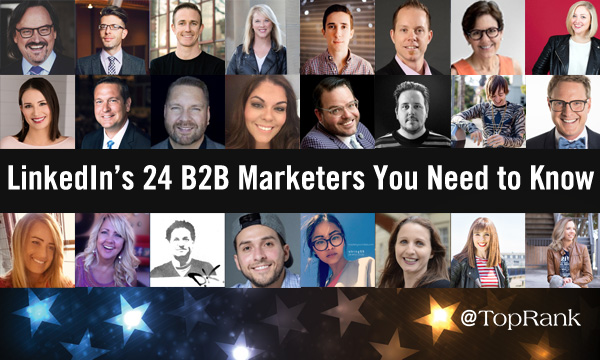 LinkedIn* published a list of top B2B marketers, and in our second-most popular social media marketing post of the year I dug in and took a look at this group of leading industry professionals, including
  The third most popular social media marketing post of 2019 on our blog comes from Senior Content Strategist Nick Nelson, who shared how to use five under-the-radar LinkedIn marketing features, including: • Robust & Simplified Audience Targeting • Revamped Analytics • Content Suggestions • Site Re-Targeting • Lead Gen Forms Nick's excellent post highlights some of the most useful yet overlooked features for driving results on LinkedIn. Check out all of Nick's posts
  Offering up over 80 social media marketing statistics relevant to B2B marketers and featuring insight from Sprout Social, Hootsuite, Pew Research Center, SME, and other, this post by me was our fourth most popular search marketing piece of the year. [bctt tweet="“It’s clear that B2B social media marketing is strong and growing stronger, and it’s also apparent that direction and guidance in where to focus your B2B social efforts is needed now more than ever.” @LaneREllis" username="toprank"]
 Our fifth most popular social post of 2019 is a look I took at why Twitter lists are still a great tool for B2B marketers, exploring how they offer many engagement, nurturing, and trust-building benefits that smart B2B marketers can’t afford to pass up. [bctt tweet="“When it comes to Twitter lists your own creativity and ingenuity are the only boundaries.” @LaneREllis" username="toprank"]
 Our sixth most popular social media marketing post of 2019 was a look at the previous year's top articles about the subject, each offering helpful insight and research-based strategy.
 Showing how five top B2B brands are maximizing their LinkedIn engagement by using showcase pages, expanded group communication and more, in our seventh post popular social media post of 2019 I took a close look at how B2B companies are connecting with audiences through LinkedIn.
 Nick earned a second entry on our most popular social media marketing list with his look at where Facebook, Twitter, and LinkedIn stand when it comes to B2B video. [bctt tweet="“Modern B2B marketers understand that the key to an effective digital content strategy is meeting customers where they’re at, and giving them what they want.” @NickNelsonMN" username="toprank"]
 Our Senior Content Marketing Manager Caitlin Burgess earned the number nine spot on our top social media marketing posts of the year list, examining a selection of the biggest changes to arrive on the social scene during the year. Following scandal, criticism, and calls for increased privacy and relevancy, Caitlin looked at how social platforms are working harder to recapture their original allure as safe communities and conversation destinations. Check out all of Caitlin’s posts
  The final entry on our list of the top social media marketing posts of the years is one I wrote that details how five top B2B brands are making the most of Twitter to increase engagement. With examples implemented creatively by Adobe*, Deloitte, Dun & Bradstreet, GE, and Intel, this article looks at the wide variety of successful methods leading B2B brands are using for building a solid and sustainable Twitter brand strategy. We can't thank Lee, Nick, and Caitlin enough for writing and sharing these top ten social media marketing posts of 2019 — congratulations to you all on making the list!


 What Else?
 What Else?
 What Else?
 What Else?
 What Else?
