Tuesday, 4 August 2020

Welcome to Content Marketing Unlocked: Your Free Blogging Course

Blogging is so effective that there are over a billion blogs on the web.

Just think about that… that’s roughly 1 blog for every 7 people.

Sure, we don’t really need any more blogs, but people still create them because they can be such effective marketing channels.

And best of all, unlike social sites, the moment you create a blog that has an audience, you can continually reach them without having to worry about algorithm changes.

So, to help you with your content marketing efforts, I’ve created a free 4-week training course called Content Marketing Unlocked.

Introducing Content Marketing Unlocked

As I mentioned, over the next 4 weeks I am going to teach you all about content marketing.

Everything from the basics of content marketing and how it works to the advanced parts such as generating traffic and sales from blogging.

To get you started, make sure you watch the welcome video:

The welcome video breaks down what you’ll learn over the next 4 weeks and, under the video, you’ll find a goal worksheet and a course outline.

Then you’ll learn about the history of content marketing:

In that lesson, you’ll find 2 worksheets:

  1. Content outline – this will show you how to outline and create content.
  2. Content steps – this breaks down the steps you need to follow in order to write amazing content.

After you get the hang of writing content, you’ll want to learn how to rank your older (existing) content on your site.

And in that lesson, you’ll also get a list of tools that you should use and a master resource guide that’ll help speed up the process.

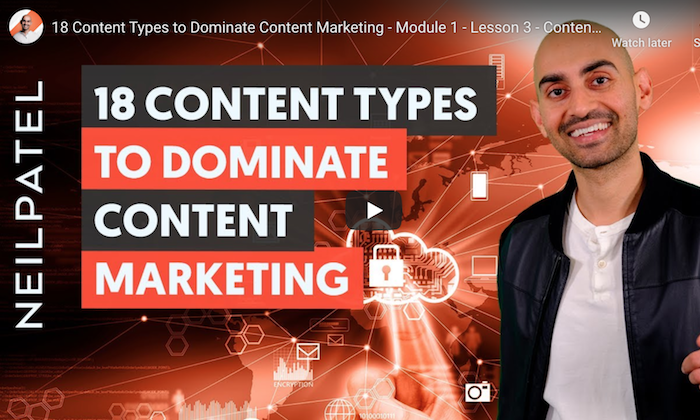
From there I teach you about the different types of content you can leverage to get more traffic. Believe it or not, there are actually 18 types you should be using.

Over time I will continue to add more lessons, but I don’t want to drown you in information by embedding all the lessons in this post.

So, what else will you learn?

The four lessons above are a great start, but there is much more to the content marketing course. This is what you can expect from Content Marketing Unlocked:

Week #1

Lesson #1: Getting Started

  • Course Introduction
  • Strategies You’re Going to Learn
  • What Google Wants
  • Content Production Strategy Overview
  • Understanding the Algorithm & Updates
  • The Right Mindset

Lesson #2: History of Content Marketing

  • History of Content Marketing
  • Fact & Fiction About Content Marketing
  • Understanding Your Target Audience
  • How to Find Keywords That Will Make You Money
  • Refining Your Keyword Lists
  • Content Examples

Lesson #3: Optimizing Your Existing Content

  • How to Audit Your Existing Content
  • How to Optimize Your Content the Right Way
  • How to Re-Write Your Content So It Gets You Traffic
  • Step-by-Step On-Page Optimization Tactics
  • Content Templates to Rewrite Your Content

Week #2

Lesson #1: Major Content Types

  • Credibility & Trust Through Content
  • Types of Content
  • Blogs
  • Articles
  • Infographics
  • Videos / Visual Content
  • Podcasts / Radio Shows
  • Facebook Posts / Pages
  • Courses / Digital Classes / eBooks / Checklists
  • How-to Guides
  • SlideShare / PowerPoint / Webinars
  • Photographs / Graphics / Art
  • Instructional Guides
  • Magazines (Digital & Print)
  • Streaming Media (Periscope, Facebook Live, Snapchat)
  • Forums / Wikis / Groups / Resource Centers
  • Whitepapers / Case Studies
  • Memes (Twitter/Facebook)
  • Testimonials / Reviews
  • Content Templates for Different Content Types

Lesson #2: Pilar & Cluster Pages

  • Turn Your Keywords Into An Outline
  • How to Write Content That Gets You Traffic
  • Topical Clusters
  • Pillar Pages
  • Cluster Pages
  • Pillar & Cluster Templates

Lesson #3: Alternative Content Strategies

  • Building Authority Through Guest Posting
  • Content Production Tools
  • Plugins to Use
  • FAQ Schema
  • Live Case Studies, Market Data & Field Reports
  • Share Worthy Content
  • Content Outline Templates

Week #3

Lesson #1: Marketing Your Content

  • Site Structure
  • Theme & Topic
  • How to Rank Your Content Faster
  • Promote Your Content on a $0 Budget
  • Content Marketing Strategy
  • Content Promotion Workflow

Lesson #2: Link Building Tactics

  • What is Link Building?
  • External Link Building
  • Internal links
  • Your Link Profile
  • Advanced Linking and Off-Page Optimization Strategies
  • How to Build Links from Authority Sites
  • How to Launch Link Campaigns

Lesson #3: Tracking & Analytics

  • Setting Up Google Analytics / Google Tag Manager
  • Setting Up Google Search Console
  • Must Have Content Marketing Tools
  • Live Ranking Case Studies, Market Data & Field Reports
  • Determining KPI’s
  • Budget Planning

Week #4

Lesson #1: Ranking 1 Long Term

  • You’ve Got Content & Links, What’s Next?
  • Content Marketing in a Competitive Space
  • How to Get Started if You Are New & Have Little to No Budget
  • How to Scale if You Do Have a Budget
  • Build a Brand Long-Term

Lesson #2: Media Outlets

  • Getting on Huge Media Websites (Forbes, HuffPost, NYTimes, etc)
  • Guest Blogging
  • Podcasts
  • Social Media
  • Connecting with Influencers

Lesson #3: Omni-Channel Strategies

  • Going Omni-Channel
  • Back Office Infrastructure
  • Analyzing and Measuring Results
  • More Content Marketing Case Studies
  • Become A Great Content Marketer
  • Summary – How to Get the Most Out of This Course

How can I follow along?

You can go to the training section of this site as I keep all my courses there.

Every Monday, Thursday and Saturday I will be adding new lessons and content.

Each lesson is roughly 10 minutes in length and contains worksheets, templates, cheat sheets, checklists, spreadsheets, and more that will make your life easier.

In general, if you take the time to follow along each week and complete your homework assignments, it shouldn’t take you more than two to three hours each week.

Some weeks will be less work, but because this course involves writing and promoting content, you will have to put in a little bit more effort than some of my other courses.

As a heads up, I won’t be blogging about each lesson, so the easiest way to keep up is to subscribe to my YouTube channel.

Once you click the link above, you’ll see a subscription box popup on YouTube. All you have to do is click the “SUBSCRIBE” button.
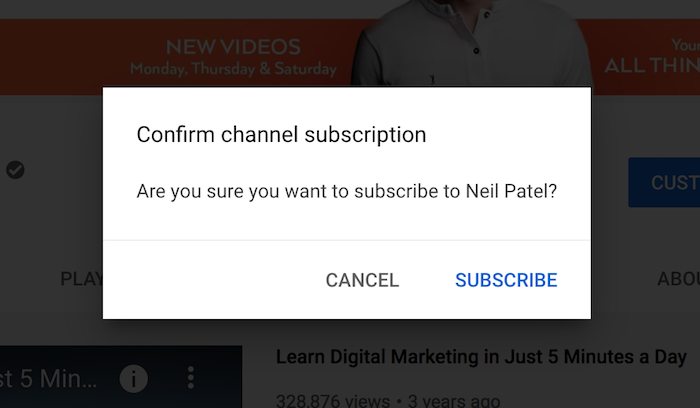
A screenshot of a cell phone Description automatically generated

Once you click “Subscribe,” you’ll notice a bell image next to the subscribe button. Make sure you click that as well.

A close up of a logo Description automatically generated

When you click on the bell, you’ll be given a few options.
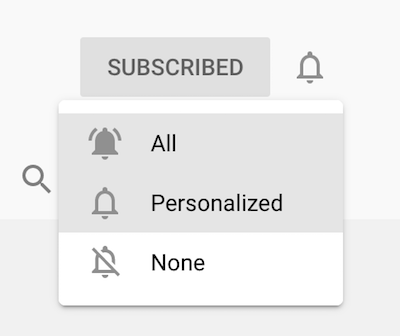
A screenshot of a cell phone Description automatically generated

Click on the “All” option. Next to the “Subscribed” button, you should see a new bell notification:

A close up of a logo Description automatically generated

This makes it so YouTube notifies you when I release a new Content Marketing Unlocked lesson.

Conclusion

I hope you enjoy Content Marketing Unlocked.

I created this course because content marketing is one of the best ways to market your business and compete with the large companies.

Best of all, you won’t have to spend a dollar on marketing.

Let me know what you think about the course so far.

And also, what free course would you like me to create next?

The post Welcome to Content Marketing Unlocked: Your Free Blogging Course appeared first on Neil Patel.


from Blog – Neil Patel https://ift.tt/39V8d20
via IFTTT

How to Communicate Your Brand Story with Simple Marketing

How to Communicate Your Brand Story with Simple Marketing written by John Jantsch read more at Duct Tape Marketing

Marketing Podcast with Donald Miller

Marketing Made SimpleIn this episode of the Duct Tape Marketing Podcast, I interview Donald Miller, the CEO of StoryBrand. At StoryBrand every year Don helps more than 3,000 business leaders clarify their brand message. Combined, Don’s books have spent more than a year on the New York Times Bestsellers list. His books include: Blue Like Jazz, A Million Miles in a Thousand Years, and Scary Close.

Don is widely considered one of the most entertaining and informative speakers in the world. His audiences are challenged to lean into their own story, creatively develop and execute the story of their team, and understand the story of their customers so they can serve them with passion. Don’s thoughts on story have deeply influenced leaders and teams for Pantene, Chick-fil-A, Steelcase, Intel, Prime Lending, Zaxby’s, and thousands more.

Don’s latest book Marketing Made Simple helps you to define what to do once your marketing messages have been clarified.

Questions I ask Donald Miller:

  • How does memoir writing move into writing about marketing?
  • How do you make your story sexy?
  • What does Marketing Made Simple accomplish?

What you’ll learn if you give a listen:

  • How you can improve your marketing by improving your story
  • How to start with the problem that you solve
  • How to differentiate yourself in the market
  • Once you’ve clarified your message what do you do with it

More about Donald Miller:

Like this show? Click on over and give us a review on iTunes, please!

WordStreamThis episode of the Duct Tape Marketing Podcast is brought to you by WordStream, online advertising made easy. It is so easy to waste time and money on online advertising. That is why you need tools like WordStream in your corner. Check out WordStream.com today.


from Duct Tape Marketing https://ift.tt/3i6Qh7E
via IFTTT

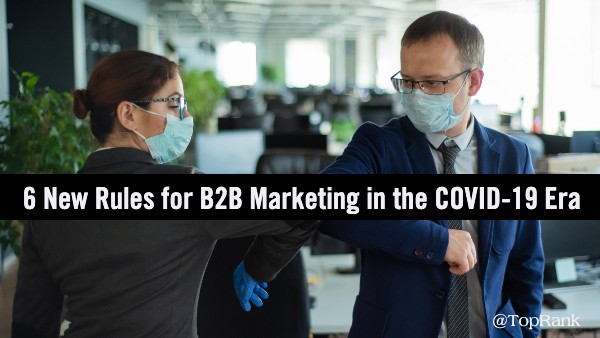
6 New Rules for B2B Marketing in the COVID-19 Era

B2B Marketing Rules Covid-19

B2B Marketing Rules Covid-19 I was supposed to go to an Alanis Morissette concert this July. When the pandemic hit hard in March, I wasn’t ready to cancel my ticket yet. Surely, surely we would have it sorted in time for an outdoor concert four months from now. I held out hope. Then, in June, she rescheduled for July, 2021. And now I’m wondering if that will be enough time. Isn’t it ironic?  Don’t you think? All of which to say: This pandemic has been around for longer than we thought it would, and is looking to linger far longer than we would like. What seemed like a brief, surreal interlude to be gotten through has now become a reality to live with, at least for the time being. As B2B marketers, we need to reassess how we are adapting our marketing to our buyers’ current situation. We’re no longer scrambling to cobble together short-term fixes — we need to be out of reaction mode and into strategic planning mode. Our marketing agency has been helping clients revise their marketing plans for months now, from messaging and audience to tactics and measurement. Here are a few rules we’ve picked up that other marketers should follow:

6 New Rules for B2B Marketing in the COVID-19 Era

Rule #1: Always Be Relevant

Okay, this is less a NEW rule than a timely reminder. I’m sure most marketers who read our blog (as smart, skilled and beautiful as you are) don’t need to hear it. But just in case: You should never come to an audience without something of value. Corollary: “Something of value” can not equal “Knowledge of how our product/solution can improve your life.” People are distracted and stressed. They’re dealing with a new crisis every day. They’re spending way more time with their children than is psychologically healthy. And they have more content than ever before to occupy their free time. If you’re asking for their attention, you must reward it. Be entertaining, be useful, be both if you can. [bctt tweet="'Be entertaining, be useful, be both if you can' in your #B2B content marketing, says @nitewrites." username="toprank"] After you deliver, then you can ask for a next step. But make sure your content is intrinsically valuable.

Rule #2: Encourage Interaction

The pandemic lifestyle is, to put it lightly, isolating. Who would have thought you could miss hearing co-workers rock in their chairs, play music a little too loud, or bump into you in the hallway? Most of us are craving social interaction. If you’re used to broadcasting with your content, it’s time to consider how you can start conversations. How can you interact with your audience on a human level? How can you encourage them to interact with each other, too? Think how much your audience would value a lively, thought-provoking conversation with their colleagues and peers. You can encourage interaction with content in a few easy ways:
  • Host a LinkedIn Live chat
  • Run a Twitter chat
  • Sponsor a topic-themed chat in a video conferencing app
  • Run an interactive webinar
In general, look for ways you can call out a subset of your audience and get them talking, both to each other and to your brand representatives. We can all use a little more social interaction right now.

Rule #3: Keep Messaging Empathetic

I don’t know about you, but I cringe every time I see an ad about something “going viral.” We are 6 months into a viral pandemic and marketers are still running ads about going viral! How can this be?  This is just one example of how completely innocuous messaging pre-COVID can seem tone-deaf now. Does your content have an anecdote about a dinner party with 15 people? Does your header image feature a crowd of people? Are you talking about “going into the office” or “thinking about this on your commute?” If so, you’re alienating your audience. Not every piece of content has to be about the pandemic, or being nostalgic for the world that once was. But there needs to be a baseline of empathy: Working from home, social distancing, and mask-wearing are all facts of everyday life.

Rule #4: Experiment with Formats

In the time before the pandemic, we all spent hours looking at screens every day. It’s just there were different screens, in different environments. It was easier to differentiate between the office and home, work and play. Now, our surroundings are homogenous throughout the day — and the content we consume feels same-y, too. Think about content fatigue as you plan your calendar. Is your audience looking for another wall of text? Do they want to look at another grid of talking heads?  Our agency is finding more success right now with multimedia, interactive content. Our B2B Influencer Marketing report is an example. The content includes case studies, influencer participation, and original research, presented in an animated, dynamic way. Essentially, keep in mind that idea of efficiently delivering value. Can your blog post be a quick video or audio interview instead? And can that video be five minutes long instead of 10?  [bctt tweet="Can your blog post be a quick video or audio interview instead? And can that video be five minutes long instead of 10? says @nitewrites." username="toprank"]

Rule #5: Collaborate on Content

For me, one of the stranger elements of pandemic life is learning how similar I am to everyone else. I had an urge to do puzzles in March — all the stores were sold out. I wanted to make bread in April — the stores ran out of flour. In May, everyone bought bikes.  Right now, every B2B business is missing their trade shows and in-person demos. So most of them are doubling down on content. The best way to differentiate your content is to bring your audience voices they can’t hear anywhere else. Co-create content with influencers. Feature subject matter experts in your organization. Tap your current and prospective customers to get their take. The more voices you can bring to your content, the more it will stand out to your audience.

Rule #6: Re-Align Measurement with Current Goals

Per rule #1, people are less interested in promotional content right now. Businesses may have put their purchasing plans on hold, or at least tightened budgets. Marketing’s chief goal right now is likely to be establishing brand credibility, creating thought leadership content, and building relationships for the future. As your goals change, your measurement must change as well. You can’t measure an awareness campaign in SQLs, or relationship-building in number of demo requests received. That doesn’t mean giving up on measurement or accountability — it just means making the metrics match your goals. For example, you could measure:
  • Brand share of voice
  • Email/Blog subscribers
  • Social media audience/interactions
  • Content consumption metrics (time on page, scroll depth, links clicked)
  • Content resonance (backlinks and social shares)

How New Are These Rules?

So here’s the $100,000 (adjusted for inflation) question: At what point should you stop producing relevant, interactive, empathetic, dynamic and collaborative content? When can you heave a sigh of relief, stop listening to your audience, and start broadcasting promotional messages? When you put it that way, it’s obvious: These rules are best practices for content no matter what’s going on in the world. The pandemic didn’t create the need for these rules; it just amplified how crucial they are. Back in January, we might have had the luxury of ignoring one or more of them. Now we have the joyous necessity of being forced to do better. And that’s the good news: Making your marketing better for the pandemic will make you a better marketer now and for whatever comes next. Need help creating content? We’re here for you.

The post 6 New Rules for B2B Marketing in the COVID-19 Era appeared first on Online Marketing Blog - TopRank®.


from Online Marketing Blog – TopRank® https://ift.tt/3kchOpN
via IFTTT

Monday, 3 August 2020

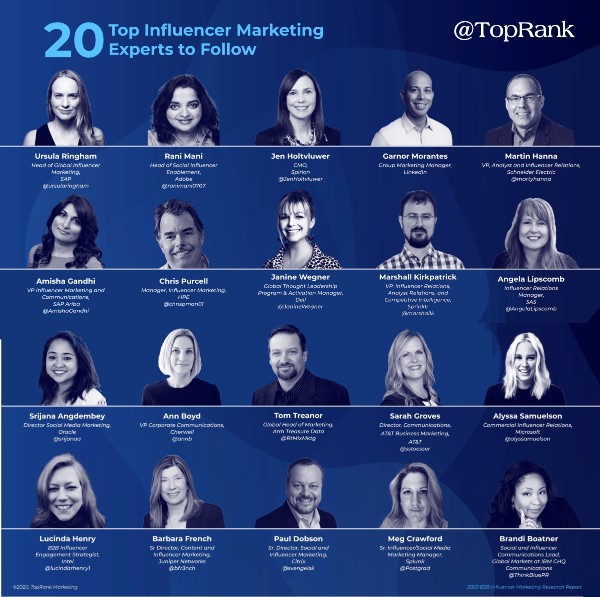
20 B2B Influencer Marketing Pros to Follow from Top Brands

B2B influencer marketing pros from top brands

B2B influencer marketing pros from top brands Recently we published the 2020 State of B2B Influencer Marketing report after surveying hundreds of B2B marketers about their experiences, best practices, tools, budgets and plans for the future. In an environment where B2B marketing is decidedly digital and marketers are hard pressed to squeeze more productivity out of fewer resources, credible information about marketing best practices, operations and trends for the future are in high demand. Judging by the response we've had to The State of B2B Influencer Marketing Report so far, we're definitely meeting a need. There is both optimism and an unrealized opportunity with influencer marketing for B2B companies. For evidence, check out these stats from the report:
  • 78% of B2B marketers believe prospects rely on advice from influencers
  • 74% believe that Influencer Marketing improves customer and prospect experiences
  • 63% agree that marketing would have better results if it included an Influencer Marketing program
  • 60% of marketers who use always on Influencer Marketing programs are very successful vs. 5% who do periodic campaigns
And yet:
  • Only 19% of B2B marketers are running ongoing influencer marketing programs
  • Only half include a plan for influencer activation in their influencer marketing strategy
  • Only 35% of marketers use software to identify potential influencers
  • 60% say they don’t have the knowledge to execute or have the right skills in house to implement ongoing Influencer Marketing programs
Influencer Marketing is a significant opportunity for B2B Marketers to connect with trusted and credible experts that have the attention of audiences that are probably overwhelmed with information and ignoring most of the ads that do get to them. At the same time B2B brands that build relationships to co-create content with these industry voices can integrate influence with thought leadership to build the authority and influence of brand employees. It is very satisfying to have spent the past 8 years focusing on such a niche aspect of B2B marketing to see it now start to grow in acceptance, adoption and maturity amongst some of the top B2B brands in the world.  Where there were previously no positions outside of PR with "influencer" in the title, now it is much more common to find marketers with titles like, Head of Global Influencer Marketing, VP Influencer Marketing and Communications, or B2B Influencer Engagement Strategist. Many B2B marketing professionals with these titles have earned hard won insights into what makes influencer marketing truly work for B2B, especially during a time when brand marketers are highly motivated to focus on strategies and tactics that will help them survive and thrive during the pandemic. To help you connect with the collective wisdom of the B2B influencer marketing crowd, here are 20 B2B Influencer Marketing Professionals to follow (in no particular order): Ursula Ringham Ursula Ringham @ursularingham Head of Global Influencer Marketing at SAP Rani Mani Rani Mani @ranimani0707 Head of Social Influencer Enablement at Adobe Jen Holtvluwer Jen Holtvluwer @JenHoltvluwer CMO at Spirion Garnor Morantes Garnor Morantes /in/garnormorantes/ Group Marketing Manager at LinkedIn Martin Hanna Martin Hanna @martyhanna VP, Analyst and Influencer Relations at Schneider Electric Amisha Gandhi Amisha Gandhi @AmishaGandhi VP Influencer Marketing and Communications at SAP Ariba Chris Purcell Chris Purcell @chrispman01 Manager, Influencer Marketing at Hewlett Packard Enterprise Janine Wegner Janine Wegner @JanineWegner Global Thought Leadership Program & Activation Manager at Dell Marshall Kirkpatrick Marshall Kirkpatrick @marshallk VP, Influencer Relations, Analyst Relations, and Competitive Intelligence at Sprinklr Angela Lipscomb Angela Lipscomb @AngelaLipscomb Influencer Relations Manager at SAS Srijana Angdembey Srijana Angdembey @srijanaa Director Social Media Marketing at Oracle Ann Boyd Ann Boyd @annb VP Corporate Communications at Cherwell Software Tom Treanor Tom Treanor @RtMixMktg Global Head of Marketing at Arm Treasure Data Sarah Groves Sarah Groves @sstoesser Director, Communications, AT&T Business Marketing at AT&T Business Alyssa Samuelson Alyssa Samuelson @alyssamuelson Commercial Influencer Relations at Microsoft Lucinda Henry Lucinda Henry @lucindarhenry1 B2B Influencer Engagement Strategist at Intel Barbara French Barbara French @bfr3nch Sr Director, Content and Influencer Marketing at Juniper Networks Paul Dobson Paul Dobson @svengelsk Sr. Director, Social and Influencer Marketing at Citrix Meg Crawford Meg Crawford @Postgrad Sr. Influencer/Social Media Marketing Manager at Splunk Brandi Boatner Brandi Boatner @ThinkBluePR Social and Influencer Communications Lead Global Markets at IBM Of course there are many B2B influencer marketing practitioners from the consulting and agency world that could be on a list like this, including some of my team at TopRank Marketing. Maybe we'll publish such a list in the future, but for now this resource is focused on people working at B2B brands. If you know of other B2B brand influencer marketing practitioners, who would you add to this list? To tap into the collective wisdom of these and more B2B influencer marketing experts, be sure to check out the full report here. B2B Influencer Marketing Report 2020 *SAP, LinkedIn, SAP Ariba, Dell, Cherwell and Treasure Data are TopRank Marketing clients. 

The post 20 B2B Influencer Marketing Pros to Follow from Top Brands appeared first on Online Marketing Blog - TopRank®.


from Online Marketing Blog – TopRank® https://ift.tt/3kgszYu
via IFTTT

4 Ways Marketers Can Embed More Agile Thinking into Their Organization

Willie Mays exhibited wonderous agility when he turned and sprinted straight to the center field wall to catch a deep fly ball with his back to the plate. And although he didn’t invent it, soccer star Pele, scored with his bicycle kick, a foolhardy tactic if lesser mortals had attempted it to score a goal. They were both incredible athletes who relied on years of training, practice, and knowledge of the game to delight fans and win the game.

Digital marketers must do much the same in the Experience Economy. They draw upon their years of experience, knowledge of marketing, and customer data to win customers over. And they have just moments to decide how to make the right play. Nowadays, customers are bombarded with messaging from a multitude of sources, and if you don’t intrigue and interest them immediately, their attention will be captured elsewhere. Therefore, marketers have only a micro-moment to make the right impression.

And what helps you do that?

Agility.

The importance of agility for marketers

Agility means the ability to move and think easily and quickly. Salespeople have told me that agility is the ability to react to customer emotion or new information in the moment. This skill is even more imperative as customers drive their own unique buying journeys nowadays. They expect marketers to meet them on the channel of their choice with consistent, relevant messaging that strikes the right chord. How do you stand out from the competition and all the noise? You develop a more agile mindset.

The old ways of selling and serving markets don’t apply, not when you have only a micro-moment to stand out from a sea of marketing messages. This doesn’t only apply to B2C, either. B2B customers also expect a B2C-like experience that similarly draws upon emotion.

Agility allows you to keep up with change and then adjust or pivot when the need arises, based on what your metrics say. The key is empathy–putting yourself in your customers’ shoes to know how you can help them. Smart marketers learn that if they can address their customers’ needs in ways that meet their expectations with speed, then their brands will have earned their customers’ business going forward.

Therefore, for marketing teams, agility has to form the fundamental characteristic of organizational behavior and thought. Flexibility is the twin of agility and the two have grown into adulthood. How can marketing teams build more agility into their organization so that they can more easily pivot and tweak campaigns?

It takes four key steps:

  1. Training

Marketers never stop learning. The data always has something new to teach them, but the bedrock of their knowledge comes from their training. Teams should know how to properly use their tools, understand the data before them,  campaign metrics, and how the team works together.

  1. Process

The right processes are those that produce the most efficient results. They are thoughtfully designed around achieving the end goal with minimal friction and empirical proof that the efficiencies gained are measurable. Everyone on a marketing team gets onboard with a process that outlines how an idea is turned into content and put onto a channel during a campaign. And if something isn’t working or can be done better, the process can be refined and revised.

  1. Hiring

While agility can be built over time with practice, hiring people with open minds and ability to flex under pressure goes a long way to being prepared. They’ll be able to react in inventive ways when things aren’t right. Too rigid thinking doesn’t play well in unforeseen situations.

  1. Leadership

Confidence is a critical element of being agile. Knowing you have the requirements to succeed and believing your initiative will be positively recognized are key triggers for action. But part of “having what’s required” comes from strong leaders who create the environment for people to be properly equipped. Leaders play a critical role in instilling confidence in marketing teams and empowering them to be well-informed so they can be decisive when planning, analyzing and running campaigns.

Agility is key

If you could think of one skill or trait that sets marketers and CX professionals in general for successwhat would it be? ? Intelligence? Communications?

I argue that the key skill would be agility. The way forward might seem daunting when you have only  micro-moments to engage customers, but you can turn it around by being able to quickly respond to events as they unfold.

Do customers respond better to one version of email content over another? One design over another? Do they respond better to statistics? Do they like blogs, webinars, or how-to videos? Test, pay attention to campaign results, and optimize. Their behaviors will tell you how to change course and plan better for the next time, and your agility will help you put those plans into action.


Winning customers over in micro-moments takes both emotion and empathy. You use them to tell the story of how your brand can help. Find out more with “Emotion and Empathy: The Storytelling Keys to Content Marketing.”  


from Oracle Blogs | Oracle Marketing Cloud https://ift.tt/3i5nikD
via IFTTT

Sunday, 2 August 2020

Use LinkedIn Ads Dashboard for Free Qualification

On the Fly is our video series with small bites (two mins or less) of marketing and customer experience advice and training from experts, given to you during the current disruption.

Welcome to episode 27 with A.J. Wilcox, LinkedIn Ads expert and founder of B2Linked.com. LinkedIn ads have become indispensable for B2B marketers to build awareness and drive lead generation. In this video, A.J teaches you how to optimize your LinkedIn ads using LinkedIn's free analytics solution.

Targeting on LinkedIn platform is better than most other ad platforms. You can use LinkedIn analytics to see the professional makeup of the people who are using your website with a break down all of the job titles, industries, top company names, and geographies. This will help you reach the people who matter most to your business. For pro tips on how to utilize this free LinkedIn analytics solution, watch the full video:

Visit OnTheFly.Expert to see all episodes. 


You may also want to check out "Get Higher Quality Referrals Using LinkedIn" to learn how to find better prospects on LinkedIn and start that initial conversation.


from Oracle Blogs | Oracle Marketing Cloud https://ift.tt/2PjS1Oh
via IFTTT