Thursday, 11 March 2021

What’s Your Signature Response to Problems?

What’s Your Signature Response to Problems? written by John Jantsch read more at Duct Tape Marketing

One of the ways to create goodwill, positive buzz, and happy customers is to exceed expectations. Responding proactively to problems is, in my opinion, one of the easiest ways to exceed the expectations available.

Problems happen, that’s a fact. You can choose to respond to customer challenges, problems, let downs, screw-ups, and mistakes in one of two ways. You can ignore them and create the kind of friction that drags your trust into the ground or you can respond in such an over-the-top, out of control, nobody does that kind of way that can turn problems into gold mines. If you want to exceed expectations, choose the latter!

For the longest time, Nordstrom had a policy that granted refunds with no receipt, no time limit, no questions asked. A variation of that policy still remains today. This policy is often an example given whenever someone talks about customer service. But it’s really a signature response to a customer problem, and it’s become something that creates incredible word of mouth for them.

Creating what I call your signature response to problem-solving takes a little thought, planning, implementation, and even training, but it can become a very valuable tool for your organization. I’ve mapped out four things you can do to quickly, proactively, and creatively address customer problems with a signature response of your own. 

1. Invite and reward customer feedback

The first step to making problem-solving a core marketing system is to encourage your customers to tell you when something’s not right. This may sound like a simple thing, but there is plenty of research that suggests somewhere near 90% of your customers experiencing an issue will simply go away quietly unhappy.

You should clearly state in all your marketing copy that you welcome feedback and won’t rest until your customer is thrilled. Spell out guarantees, return policies, and make it very obvious how to get in touch with you via phone, mail, live chat, web, or email. You should also build satisfaction surveys, results reviews, and even random phone follow-ups into your standard operating procedures.

Of course, it’s not enough to just ask for feedback and then send it down a black hole; you’ve got to respond.

2. Create a response

In order to get the full impact with this idea, you need to design the manner in which you will automatically respond in order to solve a customer problem. Some of this can and should be handled through clearly spelled out, no strings attached, guarantees, and return policies, but you need to add some flair as well. Adding some creativity in this step is how you turn a response into a signature response. For example, does the CEO show-up with a bouquet of flowers, does the customer immediately receive a month of service free and a dedicated service rep to help guide them through the challenge, do you do whatever it takes to make it right?

The key here is to do something that gets the customer the result they are after but also offers a little ‘wow’ that they can’t help but notice because it was unexpected.

Occasionally, we receive notes from customers who have purchased one of our products but feel it isn’t what they thought it would and want to return it. We cheerfully refund their purchase price, but instead of asking them to return it, we ask that they make it a gift to another business owner. It’s a pretty simple thing on our part, but it really creates a warm response each time we offer it.

3. Act quickly

Speed matters in problem-solving – especially in a technology-filled world that caters to and sustains our desires of instant gratification. You need to act quickly. A fast response time makes customers feel that their concerns are important. In a study by CMO Council, the most important attribute of a good customer experience, according to the customers themselves, is a fast response time.

Zappos is well known for its incredible customer support. They have live chat, email, phone, and social support available 24/7. Customers expect their problems to be solved and fast – it’s another prime example of a signature response they designed for themselves.

4. Empower your team to fix the problem

Another really important piece of the problem-solving puzzle is blame. When you make a mistake, admit it, and move to fix it. When your customer makes a mistake, well, move to fix it. There’s no gain in getting the customer to admit they were wrong, even when they are. One of my favorite business expressions said to my staff in my best dad voice is: Fix the problem, not the blame.

The way to make sure that your signature response to problems is actually delivered as designed is to empower your staff to fix the problem, not the blame!

Let them know that while you have a set of policies designed to make their life simple and your business profitable, they can do what it takes to make the customer happy. Now, if that makes you more than a little nervous that you will be taken advantage of then perhaps you need to refine whom you are attracting as customers. There will always be people who try to take advantage of your willingness to please, but the key lies in setting the proper expectations upfront in all of your marketing messages.

Saving a deal gone bad by reacting in a way that is generally unexpected is how you create positive buzz and customers for life.

Reblog this post [with Zemanta]


from Duct Tape Marketing https://ift.tt/2ONuJmQ
via IFTTT

Reshaping The Online Experience For Virtual Events

Reshaping The Online Experience For Virtual Events written by John Jantsch read more at Duct Tape Marketing

Marketing Podcast with Andrew Davis

Andrew Davis - a guest on the Duct Tape Marketing PodcastIn this episode of the Duct Tape Marketing Podcast, I interview Andrew Davis. Andrew is a bestselling author & keynote speaker. He’s built and sold a digital marketing agency, produced for NBC, and worked for The Muppets.

Questions I Ask Andrew Davis:

  • Who is your favorite muppet?
  • You’ve been producing a video show called Loyalty Loop – how many shows do you think you’ve done?
  • As a professional speaker, what are some things you’ve learned about virtual events that you’ve come away with?
  • Adoption of new technologies is on the rise especially in the last few months, and one of those new technologies is virtual reality. Is virtual reality still in the state where only a few people have truly adopted it?
  • Have you studied virtual reality enough to be able to recommend the right headset or what device you should get?
  • How do we get more engagement on Zoom?
  • How have you altered your presentations for a virtual audience?
  • Are you producing any events?

More About Andrew Davis

More About The Duct Tape Marketing Consultant Network:

Like this show? Click on over and give us a review on iTunes, please!

Layr is redefining the way businesses purchase and manage their commercial liability insurance by giving control of the process back to the business owner.

We are a modern tech-enabled insurance agency that has created an entirely new commercial insurance distribution model which allows businesses to quickly get the insurance they need, completely online, from trusted insurance carriers, all while paying for it monthly on a credit card. Learn more about Layr here.


from Duct Tape Marketing https://ift.tt/3evI65Z
via IFTTT

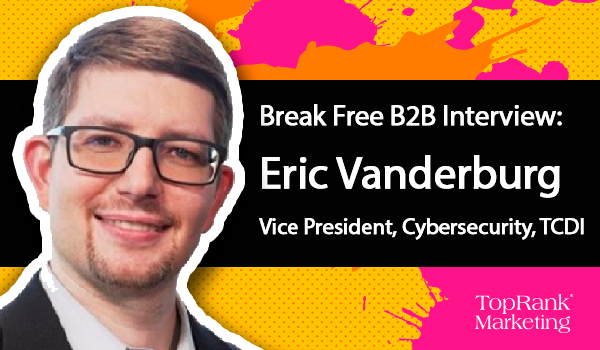
Break Free B2B Marketing: Eric Vanderburg of TCDI on The Changing Cybersecurity Landscape

Eric Vanderburg

Eric Vanderburg For more than a decade our team at TopRank Marketing has fostered a potent community of leading influencers, developing close relationships with subject matter experts in a wide variety of industries. When it comes to B2B influencer marketing, it's only natural to wonder just what an industry influencer actually looks like? In our third season of Break Free B2B Marketing video interviews, we’re continuing in-depth conversations with a powerful selection of top B2B influencers, and taking a close look at the issues that each expert is influential about in their industry. Every successful B2B influencer has a rare mix of the 5 Ps — proficiency, personality, publishing, promotion, and popularity — as our CEO Lee Odden has outlined in “5 Key Traits of the Best B2B Influencers.” Combining every one of these qualities and plenty more is Eric Vanderburg, vice president of cyber security at TCDI, who we’re thrilled to be profiling today. Cybersecurity has always been a priority for smart B2B marketers and business owners, but it’s never been more of a concern than it is right now. In fact, a recent CSO survey has found that over 60% of small and medium business owners are more concerned now about security risks for their remote employees than they were at the beginning of the pandemic. That fear isn’t without good cause. Phishing attacks are up. People are spending more time online than ever before — not just working, but shopping, chatting, browsing, and beyond. Potential pathways to risk are everywhere and that begs the question: how do you keep your employees and data safe? Luckily, while there are a lot of risks out there, there are also industry experts leading the charge when it comes to avoiding them. Experts like Eric Vanderburg. Eric has made a name for himself helping equip businesses with the right tools and knowledge to keep their cybersecurity practices effective and up-to-date. That’s the reason why our Joshua Nite interviewed him for today’s new episode six of the Break Free B2B Marketing Interview series.

Break Free B2B Interview with Eric Vanderburg

If you’re interested in checking out a particular portion of the discussion, you can find a quick general outline below, as well as a few excerpts that stood out to us.
  • 3:01 - Cybersecurity progress separate from the pandemic
  • 4:10 - What can remote workers do at home to support better security for their organizations?
  • 5:27 - Are recent cybersecurity changes here to stay or are we going to regress to the mean?
  • 7:01 - Any cybersecurity mistakes being made that should be addressed?
  • 8:10 - What will the cybersecurity landscape look like when things start to open up again?
  • 9:20 - What can executives or B2B leaders do to better plan for the future?
  • 11:34 - How do you become a thought leader in the cybersecurity space and build an audience?
  • 15:03 - Does having a large following ever get in the way of saying what you want to say?
  • 18:56 - What makes Eric more (or less) likely to want to be involved in a project?
  • 21:07 - Where can people find Eric if they want to get in touch?
Josh: Have you seen any people that were truly prepared for something like this to happen, or has it generally been folks in a bit of a scramble? Eric: I wouldn't say anybody's been fully prepared — there's been a little bit each company's had to do. Some companies have been a little bit better prepared. On the technology side, they had what they needed to enable employees to work from home and have the security in place, and they had good procedures and training. But then, you know, they miss out on some other elements and communication breaks down. And now business email compromise was their downfall, or they got all the others and they didn't do the training, or they had issues implementing the technology, and vulnerabilities or other issues allowed attackers in. So you know, there's a lot of different things you have to do to be secure. And with this pandemic, it's caused many companies to have to react. Unfortunately, when you're reacting without necessarily having a plan in place, it introduces faults and errors. Josh: We've talked a lot about — when we talk about the pandemic — how people's five year plan suddenly became a five week plan or a five day plan. I can imagine there are just a ton of moving pieces that people had to consider as they move forward? Eric: Yes, there really were these complete changes in the way we do business, and not one that companies necessarily plan for somewhere along the line — distributing the workforce and utilizing more contract work, or using us as part of their digital transformation. But others were just blindsided by the whole thing. [bctt tweet="“Unfortunately, when you're reacting without necessarily having a plan in place, it introduces faults and errors.” — Eric Vanberburg @vtamethodman #BreakFreeB2B" username="toprank"] Josh: Are you seeing that as some of these things are rolling out, that there are things that people are overlooking, or getting wrong, or making mistakes that you'd want to correct? Eric: Yes, well, there's quite a few. When a lot of companies that have employees who start working from home, many are using personal equipment, maybe they didn't have a company device, or have a way of properly managing those. So we've had a huge influx out of BYOD — bring your own device — and some companies weren't ready for that. They didn't have a process in place that others were able to take care of with the right approach, either securing those devices with endpoint agents, or just taking the personal device, not really out of the mix, but connecting them into virtual desktops and keeping local resources. And that's helped to secure it, and also giving them the same applications and everything else that they had when they were in the workplace. Josh: I think you address pretty well some of the steps that people can take to solve some of these security issues. So let's talk about when things are starting to open up again. What do you think that the cybersecurity landscape is going to look like as that starts to happen? Eric: I think that we're going to certainly have quite a few new players. I think we're also going to have companies who are much more agile, or used to using some of those resources they are utilizing, which could be in addition to the regular workforce — a lot of other outside consultants or flex resources. We're going to see fewer people in the office, and maybe some offices closing down and opening up other regional places because it's easier to work remotely and to coordinate. Certainly a lot more use of technologies to help coordinate and share, your project management type tools and communication platforms and all that — those are have already seen a big surge. I think we're going to see a lot more there. [bctt tweet="“We're going to see fewer people in the office, and maybe some offices closing down and opening up other regional places because it's easier to work remotely and to coordinate.” — Eric Vanberburg @vtamethodman #BreakFreeB2B" username="toprank"] Keep your eye on the TopRank Marketing Blog and subscribe to our YouTube channel for more Break Free B2B interviews. Also check out episodes from season 1 and season 2. Take your B2B marketing to new heights by checking out out previous season 3 episodes of Break Free B2B Marketing:

The post Break Free B2B Marketing: Eric Vanderburg of TCDI on The Changing Cybersecurity Landscape appeared first on B2B Marketing Blog - TopRank®.


from B2B Marketing Blog – TopRank® https://ift.tt/3bBBeT1
via IFTTT

Wednesday, 10 March 2021

Growing A Niche Focused Coaching Business With Ann Gusiff

Growing A Niche Focused Coaching Business With Ann Gusiff written by Sara Nay read more at Duct Tape Marketing


Agency Spark Podcast with Ann Gusiff

Headshot of Ann Gusiff who is a guest on the Agency Spark PodcastThe Agency Spark Podcast, hosted by Sara Nay, is a collection of interviews from thought leaders in the marketing consultancy and agency space. Each episode is designed to spark ideas you can put into practice for your agency today.
In this episode of the Agency Spark Podcast, Sara interviews Ann Gusiff. Ann is dedicated to bringing marketing know-how to remodelers through education and coaching. She believes that for remodeling contractors, marketing is done best when it’s handled internally, and that’s why she launched her coaching program in 2019. Ann loves to guide companies to think strategically and make the most of their marketing expenditures. She is a Master Certified Duct Tape Marketing Consultant and since 2010 has used Duct Tape’s proven systems and tools with clients and stays current with the latest in marketing tactics and tools.

Questions Sara asks Ann Gusiff:

  • What motivated you to start your own marketing coaching business?
  • Shed some light on why you felt like you had to refund one of your first clients?
  • How and why did you make the transition to being more niche focused?
  • How has focusing on your niche helped you better serve your clients?
  • Over the last year, have you had to approach getting in front of an audience and speaking for leads differently than you had previously?
  • How do you go into a speaking for leads presentation with the goal to convert people into clients?
  • How are you different than a marketing agency and why do you choose to focus on coaching?
  • How important do you feel asking the right questions are in your coaching relationships?
  • Are there any resources that you’d recommend to get people more comfortable with the role of coaching?

Resources mentioned:

Where you can learn more about Ann Gusiff:


from Duct Tape Marketing https://ift.tt/2OaLIjp
via IFTTT

10 Ways Trust Creates Standout B2B Marketing Experiences

One standout red citrus slice in a sea of yellow slices image.

One standout red citrus slice in a sea of yellow slices image. What does trust bring to the B2B marketer’s strategy table in 2021? While it may be simpler to ask what trust can’t do for B2B marketers and brands seeking to develop successful strategies for our eventual post-pandemic professional landscape, savvy marketers are best served by taking a close look at all the things that trust can do. Research has shown the power of trust in developing successful marketing, which is why the theme of trust is a central tenet running through our own State of B2B Influencer Marketing Research Report, featuring survey data, case studies from B2B brands of all sizes, insights from top B2B marketing experts, plus a list of 20 top influencer marketing practitioners from B2B brands. Brand trust, advocacy and customer experience are among today's most important goals for B2B brands, but why is trust so important, and how can brands build trust? Here are 10 ways trust creates standout B2B marketing experiences, from building better brands to providing measurable performance, and so much more. Let’s step right up to a virtual cavalcade of marketing approaches that benefit from a greater focus on trust, and look at what we can do to build greater trust into our B2B marketing efforts.

1 — Trust Builds & Strengthens Relationships

You can’t top trust when it comes to building and strengthening relationships, whether it’s creating powerful new customer connections or nourishing your existing business partnerships. Relationships with little trust won’t blossom, and usually won’t last very long either. By consciously making trust a cornerstone of marketing efforts — and dedicating the time and effort necessary to do so — brands can make a concerted effort to build trust into every facet of operations. [bctt tweet="“If you want to be a trustworthy company, it can’t be just a marketing philosophy. It has to be a business philosophy.” — Margaret Magnarelli @mmagnarelli" username="toprank"]

2 — Trust Delivers Dedicated Customers & Fans

Brands that earn trust have already won most of the battle to gain dedicated customers and fans. Trust helps turn customers into true brand advocates and impassioned fans. The effort and time to build trusting relationships between brands and customers can be daunting for B2B marketers, which is one of the reasons why more brands are turning to influencer marketing, with subject matter experts who have already built time-tested trust. [bctt tweet="“It’s hard to create a great experience if customers don’t trust brand communications.” — Lee Odden @LeeOdden" username="toprank"]

3 — Influence Is Build On Trust

Intertwined with trust is influence, and the two serve to reinforce one another in the push to deliver the best B2B marketing possible. Industry experts rely on the trust they’ve earned over time with their following, using their influence to help brands build trust. Using the power of influence to build trust is one of our specialties at TopRank Marketing, and to help you learn more about the processes involved, here are several recent articles we've published detailing how influence grows trust: [bctt tweet="“Look beyond individual campaigns and think about how the brand and influencer relationship can create mutual value, influence and trust over time. That trust will translate to trust built amongst customers.” @LeeOdden" username="toprank"]

4 — Trust Grows Great Content Marketing

Great B2B content marketing is also underpinned by trust, as information that is worthy of being shared is most often the type that best answers the questions customers are asking — solutions that will only succeed when they are based on share-worthy trust. Creating articles, videos, podcasts or any other manner of today’s digital asset that customers will want to share and keep coming back to get more of is a difficult task, but one that thrives when trustworthy information is delivered. Best-answer content's role in building trust is covered in the following articles we've published: [bctt tweet="“Trust is a currency. It’s arguably the most valuable currency in today’s B2B marketing environment. And much like real money, it needs to be earned; the risks of attempting to counterfeit trust are grave.” — Nick Nelson @NickNelsonMN" username="toprank"]

5 — Influence-Built Trust Combats Increased Skepticism

The past several years have seen an increase in customer skepticism, especially when it comes to the marketing they have traditionally relied on to learn about potential new solutions. Trust can be the element that differentiates one brand’s success from another’s disappointment. The issue of brand trust made the list of 2021's top trends in our CEO Lee Odden's "Top B2B Marketing Trends for 2021," in which he observed, "With an 'epidemic of misinformation and widespread mistrust of societal institutions,' 70 percent of respondents to the 2021 Edelman Trust Barometer study said brand trust is more important today than it was in the past." [bctt tweet="“Once trust has been lost, it’s nearly impossible for brands to rebuild sustainable, honest relationships with their customers.” — Kevin Cochrane @kevinc2003" username="toprank"]

6 — Always-On Efforts Thrive On Trust

2021 may be the year of always-on marketing, as the strength of ongoing programs over one-off campaigns has been shown to be a key success differentiator. Building thriving always-on programs requires earning and maintaining trust, however, rather than the kind of stop-and-start efforts that interrupt truly lasting business relationships. Always-on marketing efforts need to be based on trust in order to be sustainable. To help you build a sustainable always-on strategy with an eye for building ongoing trust, the following articles explore always-on influence: [bctt tweet="“The benefit of an Always-On approach creates value for your customers by making content more relevant, trustworthy, and actionable.” — Lee Odden @LeeOdden" username="toprank"]

7 — Trust Is Platform Agnostic

In today’s diverse social media platform landscape, B2B marketers are keen to use elements that provide value in a platform-agnostic way, and trust is one of the key ingredients that works just as well on Clubhouse, LinkedIn, Twitter, or Instagram. When a brand has built a legacy of trust, it translates to whichever platform or content vehicle its marketing messages are delivered through, making trust one of the few fundamental qualities that endure over time, even as social platforms come and go. How can B2B brands boost confidence using some of these various platforms, especially live-stream video, podcast and Clubhouse marketing? Lee recently explored how partnering with influencers who understand innovative content formats creates more relevant, meaningful and effective B2B content marketing experiences, in "How B2B Brands Can Boost Confidence in Livestream Video, Podcast and Clubhouse Marketing." [bctt tweet="“When an organization can deliver strong content that helps inform people, it only builds that trust. Ultimately, people just want information that’s helpful to them.” — Emily Thompson @BosCreativeCopy" username="toprank"]

8 — Trust Is SEO Friendly

Not only is trust search engine optimization (SEO)-friendly, trust is one of the most important and oftentimes overlooked elements in creating the type of best-answer B2B content that can organically feature in search rankings. In essence, a core facet of all search engine firm efforts is the ability of their algorithms to surface the content that is the most trustworthy. How trust plays into the changes 2021 has brought about in SEO efforts is among the subjects 12 top industry experts explored in our annual trends and predictions article, "12 Top B2B SEO Trends & Predictions for 2021." [bctt tweet="The biggest overarching trend in SEO in recent years which will undoubtedly continue in 2021 is the focus on E-A-T: expertise, authoritativeness, and trustworthiness. — Lily Ray @lilyraynyc" username="toprank"]

9 — Trust Provides Measurable Performance

When your efforts are built on trust and the content you’re producing reinforces trustworthiness, B2B marketers can chart their success using any number of engagement metrics. While it may be hard to specifically pinpoint which particular brand engagement metrics are solely the result of having built customer trust and loyalty, trust is the kind of all-encompassing element that — although it may not have its own line item — delivers performance increases. Here are several helpful articles we've written that help B2B marketers collect and interpret the right engagement metrics: [bctt tweet="“Integrating influencer content is a direct line to building trust and customer confidence.” — Ann Handley @annhandley" username="toprank"]

10 — Trust Builds Better Brands, Brand Advocates, & Teams

It’s not just marketing and social media efforts that benefit from a trust-first approach to business — entire brand structures from bottom to top stand to achieve greater performance when trust is valued, encouraged, and implemented throughout an organization. Trust has been touted for decades as an important element in any brand’s strategy, yet it sometimes stalls when taking the leap from a company’s mission statement to what was posted on social media an hour ago. Building not only trust but empathy into the fabric of a B2B organization was the recent subject of a B2B Marketing Exchange conference keynote by Miri Rodriguez, storyteller and internship program head at Microsoft, and I covered the presentation in, "Microsoft’s Miri Rodriguez on How B2B Marketers Are Embracing Empathy For Better Customer Storytelling #B2BMX." [bctt tweet="“Trusting relationships aren’t built with brands, but rather with the human beings behind those brands. Attaching a face and voice to your content can drastically magnify the impact and relatability of that content.” — Nick Nelson @NickNelsonMN" username="toprank"]

Let Trust’s Energy Surround Your Marketing Efforts

via GIPHY The power of trust can bind customers and brands in meaningful and lasting relationships, filled with the type of energy that even Star Wars’ Yoda would be envious of, and we hope that your own B2B marketing efforts will benefit from the 10 elements of trust we’ve explored here. A single article can only begin to touch on the vast power of trust in marketing, which is why we're also happy to share with you the follow additional guides to brand trust: Crafting trustworthy and award-winning B2B marketing takes significant time and effort, which leads many firms to choose working with a top digital marketing agency such as TopRank Marketing. Contact us today and let us know how we can help, as we’ve done for businesses ranging from LinkedIn, Dell and 3M to Adobe, Oracle, monday.com and others.

The post 10 Ways Trust Creates Standout B2B Marketing Experiences appeared first on B2B Marketing Blog - TopRank®.


from B2B Marketing Blog – TopRank® https://ift.tt/3qs8oIU
via IFTTT

Monday, 8 March 2021

How B2B Brands Can Boost Confidence in Livestream Video, Podcast and Clubhouse Marketing

B2B content confidence clubhouse

B2B content confidence clubhouse Without a doubt, the challenges and changes of 2020 have pulled business customers towards digital formats more than ever, especially with video and audio content. Is Text Content Dead? Of course, text will always have its place in content marketing like this very blog post, but video and audio in recorded or live formats have emerged as a top preference for customer engagement. Whether livestreaming on LinkedIn, Twitter and Facebook or publishing podcasts and hosting rooms on breakout audio social network, Clubhouse, content marketers have a significant opportunity to create more engaging experiences to meet the evolving expectations of their customers in 2021. Understand the Why. But none of that matters if B2B marketers don't get their house in order when it comes to the why of using video and audio formats. "Because our competitors are there" and "I just read a B2B marketing trends blog post" cannot be the only drivers for business brands to start livestreaming video, produce a podcast or start engaging on platforms like Clubhouse and Twitter Spaces. Perspective Matters. The problem with how many B2B brands approach livestreaming video or producing audio content and experiences is the problem with all B2B content innovation: Brands that take an ego-centric view of content focus entirely on the information they want to promote vs delivering content experiences on topics and in formats customers are actually most interested in. The Big Mistake. For content marketers, the lack of a customer driven "why", regardless of how well innovative content formats are trending, is a disconnect. The lack of empathy towards customer content preferences reduces the effectiveness of the marketing investment as well as minimizing value to customers. Or worse, it creates a content disconnect and that is an experience all B2B marketers should avoid. The Truths of B2B Marketing. Content Marketing trends come and go, but there are some simple and highly effective universal truths to help marketers succeed year after year. One of the most important is a focus on creating marketing experiences based on an understanding of buyer information preferences are for content discovery, consumption and triggers for action - something we've evangelized here at TopRank Blog for a very long time. It's About Trust. Of course, great content experiences are not so great if no one can find the content or worse, if no one trusts the content if they do. Understanding these content experience preferences is what enables B2B marketers to optimize for the findability and credibility of their content. Optimize for Experiences. Content Marketers can boost the success of their marketing investment when they optimize content for discovery wherever buyers are looking, subscribing and influenced. This is as true for livestreamed and recorded video as it is for podcasts and audio conversations on Clubhouse or Twitter Spaces. But how can B2B brands engage in innovative formats and channels when they don't have the skills, experience or confidence? Partner for Success. For B2B marketers that are not fully confident about how to produce or promote content in newer digital formats and networks, one of the best ways to enter the new environment is to partner with those that are already there. By partnering with influencers that truly understand both the B2B brands' customers and the inside scoop on innovative content formats, B2B marketers can increase confidence that the experiences they are creating are relevant, meaningful and effective. Make the Influencer Connection. Working with external industry influencers not only validates the brand's message on those innovative content platforms and formats. but it also helps build the trust that is so desperately needed between consumers and brands. What's Next. Be sure to watch for our upcoming posts showcasing how B2B brands are partnering with video and audio creators to build content experiences that engage, inspire, and influence action.

The post How B2B Brands Can Boost Confidence in Livestream Video, Podcast and Clubhouse Marketing appeared first on B2B Marketing Blog - TopRank®.


from B2B Marketing Blog – TopRank® https://ift.tt/38g9am3
via IFTTT

Sunday, 7 March 2021

Weekend Favs March 6

Weekend Favs March 6 written by John Jantsch read more at Duct Tape Marketing

My weekend blog post routine includes posting links to a handful of tools or great content I ran across during the week.

I don’t go into depth about the finds, but encourage you to check them out if they sound interesting. The photo in the post is a favorite for the week from an online source or one that I took out there on the road.

  • Qwoted– Free tool for reporters.
  • Powerbx -Take the confusion out of video conferencing, Zapp Pad makes managing your Zoom calls easy. Connect Zapp Pad to any bluetooth enabled device to access all your Zoom hotkeys in one place. Save time, feel confident, and take control of any meeting with quick access keyboard shortcuts.
  • UpViral – The Ultimate Viral Referral Marketing Platform.

These are my weekend favs, I would love to hear about some of yours – Tweet me @ducttape


from Duct Tape Marketing https://ift.tt/38iTbDB
via IFTTT