Friday, 4 March 2022

B2B Marketing News: Marketers Prevent World War III, Podcasts Are Booming, The State of Influencer Marketing

B2B Content Types Bar Graph

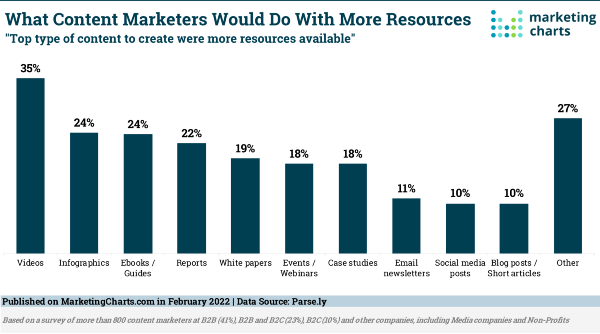
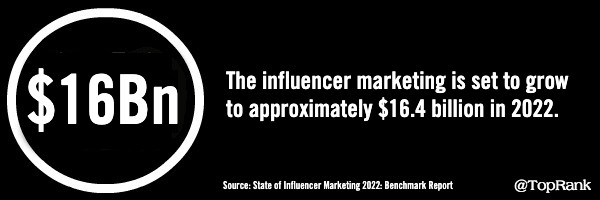
B2B Content Types Bar Graph What types of content would B2B marketers create with more resources? Research from Parse.ly reports that two-thirds of the marketers surveyed say they have created more content over the past year and 48% of respondents say they would like to produce a little more content than they currently create. Top formats include videos, infographics, ebooks, reports, white papers, events/webinars, case studies, email newsletters, social media posts and blog posts. . MarketingCharts The Client: Ukraine. The Brief: Prevent World War III. A group of agency professionals and freelancers from Ukraine’s creative industry has issued a weighty brief to the global creative community: help prevent a third world war. AdWeek Podcast listening has grown 200% in the last five years.  Audio, be it podcasts or music, resonates and builds trust in a way that other media—traditional, social or digital—does not. Here are three key areas of growth for audio advertising in 2022 that impact the tech industry. AdWeek The Next Big Digital Marketing Trends in 2022. To help marketers and digital leaders navigate this new landscape, Digital Marketing Institute interviewed leading industry experts on their podcast to identify key trends in 2022. This comprehensive overview of six key sectors will help you understand developments coming down the line so you can build them into your digital marketing activities. Digital Marketing Institute B2B Influencer Marketing Statistic 16 billion 2022 LinkedIn Launches a Podcast Network. In the initial pilot listeners will have access on LinkedIn to programming and conversations from industry leading creators such as Morra Aarons-Mele, Jonathan Fields, and Mita Mallick and Dee C. Marshall, as well as shows created in-house by LinkedIn News. - LinkedIn The State of Influencer Marketing 2022: Benchmark Report. This new report takes an in-depth look at the influencer marketing industry and summarizes the thoughts of more than 2000 marketing agencies, brands, and other relevant professionals regarding the current state of influencer marketing. Influencer Marketing Hub 3 Ways Top Enterprise Content Marketers Do Things Differently [New Research]. CMI’s newly released Enterprise Content Marketing Benchmarks, Budgets, and Trends: Insights for 2022 sponsored by Imagination reveals those clues for marketers at companies with at least 1,000 employees. In this research, top performers are defined as those who say they consider their organization’s content marketing extremely or very successful. Content Marketing Institute Twitter is Working on a New Podcast Tab to Facilitate Discovery and Engagement. Twitter is about to make a big leap into podcast discovery, which will likely enable podcasters to create direct links to their podcasts in the app, similar to how they’re now able to create active links to their newsletters, enabled by Twitter’s acquisition of Revue last year. Social Media Today
“Whether B2B or B2C, I believe passionately that good marketing essentials are the same. We all are emotional beings looking for relevance, context and connection.” — Beth Comstock 

The Juice Launches Creator Pages Highlighting Marketers Behind B2B Brands. The Juice, a business-to-business (B2B) content discovery and distribution platform, is releasing Creator Pages. After launching in the fall and growing the platform to over 400 B2B brands, The Juice is now announcing a unique space for creators and thought leaders, starting with 20 individual, world-class B2B marketers. MarTechSeries MarketingProfs Launches a New B2B Marketing Training Report for 2022. Only 1 in 5 B2B Marketers FeelsVery Prepared for Their Future in Marketing and only 31% feel their team is very effective in their roles. A third feel burned out. And two-thirds are seeking new job opportunities. Over 700 marketers and marketing leaders shared how they feel about their roles, their teams, their training and education opportunities, their career goals and more. MarketingProfs Fewer people, more ROI: Why smaller, hybrid events are best. Splash surveyed 270 event professionals and more than 3,000 event attendees from various industries in the US in late 2020, and found that smaller, in-person events are the best attended. SmartBrief If you've come across B2B marketing news stories we should know about, please don't hesitate to share in the comments below. Thank you for taking the time to join us for this week's TopRank Marketing B2B marketing news. We hope you'll return again next Friday for another collection of the most relevant research and newsworthy information about the B2B and digital marketing industry. In the meantime, you can follow us on our LinkedIn page, or at @toprank on Twitter for even more timely daily B2B marketing updates.

The post B2B Marketing News: Marketers Prevent World War III, Podcasts Are Booming, The State of Influencer Marketing appeared first on B2B Marketing Blog - TopRank®.


from B2B Marketing Blog – TopRank® https://ift.tt/nY0Nsoy
via IFTTT

Thursday, 3 March 2022

How Operations Can Be Used As A Lever For Compound Growth

How Operations Can Be Used As A Lever For Compound Growth written by John Jantsch read more at Duct Tape Marketing

Marketing Podcast with Jhana Li

In this episode of the Duct Tape Marketing Podcast, I interview Jhana Li. Jhana has over 4 years of experience as a COO and Operations Consultant for digital entrepreneurs. She specializes in executing scalable team, systems infrastructure, and harnessing the true power of operations as a lever for compound growth.

Key Takeaway:

Today, operations is an underutilized lever for growth. Operations is any task or action required within a business to optimize its use of its core resources – time, energy, money, and human potential. In this episode, I talk with Operations Consultant, Jhana Li, about how to harness the power of operations, cultivate a company culture in a way that supports both the individual and an organization’s growth, and create systems and processes for all parts of the business.

Questions I ask Jhana Li:

  • [1:25] What’s your definition of operations when you’re talking to a business owner?
  • [2:41] Does operations still exist as its own department today, and how has the operations department changed?
  • [5:12] What are some things that people are doing to develop their company culture with distributed teams?
  • [10:12] How does a business balance outsourcing talent and hiring freelancers while maintaining and building their team culture?
  • [12:59] Is there a breaking point where having an internal team works better than someone orchestrating a lot of external members?
  • [14:55] How do you operationalize this idea of creating systems and processes for all parts of the business?
  • [17:17] How do you invite innovation when you delegate processes?
  • [20:15] How do you engage with folks with the work that you do?
  • [21:25] How would you define an operator?
  • [22:48] Can this operator or person run a company, or does a company need somebody who has strategic vision as more of their zone of genius?

More About Jhana Li:

Like this show? Click on over and give us a review on iTunes, please!

John Jantsch (00:01): This episode of the duct tape marketing podcast is brought to you by the Gain Grow, Retain podcast, hosted by Jeff Brunsbach and Jay Nathan brought to you by the HubSpot podcast network gain grow retain is built to inspire SAS and technology leaders who are facing day to day. Challenges of scaling Jeff and Jay share conversations about growing and scaling subscription businesses with a customer first approach, check out all the episodes. Recently, they did one on onboarding, such a key thing when you wanna get going, keep and retain those clients. So listen to Dain, Grow, Retain wherever you get your podcast.

John Jantsch (00:50): Hello, and welcome to another episode of the duct tape marketing podcast. This is John Jantsch. My guest today is Jhana Li. She is a COO and operations consultant for digital entrepreneur specializes in executing scalable team and systems infrastructure, and harnessing the true power of operations as a lever for compound growth. So Jhana, and welcome to the show.

Jhana Li (01:16): Thank you so much, John. It's awesome to be here.

John Jantsch (01:18): So I would guess if we ask 10 people, 10 business owners, even what operations is, we would get a number of answers. So what's your defin definition of operations when you're talking to a business owner?

Jhana Li (01:31): That's a fantastic question. And I would agree. I would generally get about 10 answers. I've run that 10. So I have, you know, it's actually funny. If you ask operators, you'll also get different answers. So I have my own, I define operations as, and any task or action required within a business to optimize its use of its core for resources, which is time, energy, money, and human potential. That is the broadest reaching definition that I can make that encompasses everything I believe opts to be. It is just about the efficient and streamlined use of resources, the board,

John Jantsch (02:06): And that definition's probably evolved a lot. Hasn't it? Over the last decade or so, I mean, I remember, you know, old school operation was, you know, managing the facilities and, you know, a lot of things that I suppose for a lot of companies are still relevant, but for a lot of companies sure. Just aren't even a part of the equation, right?

Jhana Li (02:25): Yep. Absolutely. I would say that if you have a physical operation, we would maybe add physical capital as a resource to be managed, but with so many businesses moving online and remote teams and remote work, becoming a new norm, I think the focus of operations has moved towards optimizing that environment.

John Jantsch (02:42): So I wonder too, if, if it's still even a department, if you think of about a company, you know, structure as a department, or is it almost a point of view or a culture or, I mean, how would you kinda say that part has changed?

Jhana Li (02:54): Yeah, that's a great question. I oftentimes say that operations is the only department whose job it is to live between departments. Right? If we look at where the inefficiencies normally crop up in a business, it is in the handoff. It because you have sales fully focused on sales, you have client success fully focused on client success. They should be that's their focus, their lens of the business, but nobody owns the space in between. And so that is always where balls get drawn. That is always where inefficiencies is introduced. And so the job of operations I really see is to look at the company horizontally and to live in between places and optimize for the inefficiencies that you find there.

John Jantsch (03:32): So I've been saying for years, that marketing is everything. And because I really do think that what you just described, you know, marketing to sales to service is really a marketing. I mean, when you drop the ball there, you are performing a marketing function for good or for bad, right. That's right. And so I've spent a lot of time in the last few years, operationalizing, or at least talking about operationalizing marketing because you know, the onboarding process, I mean, a lot of the things that we can quibble over what it's called, but I mean, a lot of the things that, that I'm sure that you end up doing with folks, I mean really do impact for good or bad marketing.

Jhana Li (04:05): Yep, absolutely. And I would say, I agree with you that at the end of the day, I think every role is just a lens, right? It's just a, a selective frame that you're taking of the company. You're looking at that data and you're processing it through that frame. So a marketer could look at the exact same set of data happening within a business and get a totally different analysis and outcome and deliverable from that than the operator then the salesperson. And I think that is the point, right? Like you want people to be focused through a particular lens and towards a particular outcome. And operations just happens to be one where they need to be looking more places than the average role.

John Jantsch (04:40): So culture inside of organizations has, you know, certainly been a buzzword for, you know, the last 10 years or so. But I think a lot of companies really are realizing, Hey, it, it has value to the bottom line. It has value to, you know, the customer experience, all those things, but more and more companies, especially some that were forced to be distributed during, during COVID and mean more and more companies feel like they're losing that, cuz you know, you think of company culture as the picnic and sitting around the sure. You know, at the water cooler and things that it used to be. And so you work with a lot of folks whose entire teams are distributed. So what are some things that people are doing to develop and, or at the very least maintain kind of that sense of I'm on a team?

Jhana Li (05:24): Yeah. That's a fantastic question. And I would agree just to address like kind of the first part here, as far as culture, as something that is necessary. Um, there's a reason that I added human potential as one of those four core resources. I see every company, it, it is this like wellspring that you are either tapping into or not, it's a bank account that you were choosing to get a return on investment for or not. Right. And culture is a very distinct mechanism and lever by which to tap into that resource, optimize it, maximize the return on investment or not cause it's there, whether or not you're using it. Right. And so culture is one of the ways of doing that. And I think that goes for any company remote or in person, right? I think in person, maybe you are able to rely on certain things, just kind of spontaneously happening, certain spark points and team camaraderie and these sorts of things that happen naturally when human beings get in a room together in a remote environment, you just have to be more critical around how you design it, but all of the same best practices apply.

Jhana Li (06:23): I think you just have to be more active in terms of how you cultivate that culture versus allowing for it to just kind of happen naturally in the background. But the reality is is that if you're really trying to maximize this as a lever for growth, you should be designing it either or way, right. Cultures that are allowed to evolve organically probably are not the cultures that are generating the highest levels of performance or the maximum level of alignment across the team. If you look at the world's best cultures remote, or otherwise, there is a critical design there. And I would say as far as best practices, there's a few, it's a very interesting thing, John, but the people that I always point to when it comes to the most amazing culture builders are cult leaders. Hmm. You look at a cult and the behaviors that leaders are able to get out of cult participants, it's astronomical, like the things that people will do, right?

Jhana Li (07:10): Like they will donate their entire life savings or they will move to Guyana and voluntarily drink poisoned. Kool-Aid right. If we are categorized, that is quote unquote performance, like that's the desired behavioral outcome, then what on earth are they doing to generate that kind of performance? And you can learn a lot that comes out of, uh, those leaders specifically shared language, shared ritual. Yeah. Right. I've seen really high quality corporate cultures or just business cultures in general are critically designed where things like the language they put in the core values or the rituals that they use to launch the meetings or wrap the meeting up, uh, wrap the meetings up are really designed and put in place to make people feel like they are part of in us. And if you're part of an us, then I will sacrifice for the us and the us is not them. Right. And so there's this very interesting dynamic where you have to build an identity around what it means to work at your company. Right. That's why Google has Googlers and Zappos has, Zonis like they've done this very intentionally to make being a member of this team actually means something very definable and very concrete. And if you're missing out on that definition, you're not actively cultivating that definition you're missing out.

John Jantsch (08:23): Or I wanna go way back to something you said before we went down that funky, uh, cult, uh, thing,

Jhana Li (08:28): Probably not the answer you were expecting

John Jantsch (08:30): Because I think a lot of people, when they think of culture naturally think about, oh, this is a place people like to work. You know, they like to come in here, it's friendly. It has perks. I mean, that's how people kind of think about, but you, something that I think might be the, one of the best definitions of, of sort of how to develop that and that idea of if you focused all of your energy on maximizing each individual's potential. Yeah. That would be a pretty great place to work. Wouldn't it? It

Jhana Li (08:55): Would be my definition of culture is what happens when you are not looking.

John Jantsch (09:00): Yeah. Right, right.

Jhana Li (09:01): Or at least that's the place that you can look to see what the culture is. Right.

John Jantsch (09:05): But I was gonna say, that's a measurement

Jhana Li (09:07): About you.

John Jantsch (09:07): That's a measurement of it. Right. But what I mean is this idea that, that cuz a lot of times people are like, well, how, and I think that this idea of how is, what if we focused on maximizing everyone's potential. I mean, some people would not, would not grow, would not, you know, but if, instead of, you know, your job performance being, you know, you did what I said you were supposed to do. It was more about did you grow? You know, that, I think that could lead to a lot of how

Jhana Li (09:34): I think the most effective company cultures are ones where it is every individual manager's responsibility to help the employees understand how their company represents a vehicle for that employee's growth when you can align the motivator and the why and the ambition of that individual and the growth capacity of that individual and help of them see that this company is really just like in expression of that. It's just a vehicle for them to show up and get better at something and do their best work every day. And you've cultivated an, an operational infrastructure to support that person in doing their best work every day. Then you get high performance culture.

John Jantsch (10:11): Okay. We just, we just outlined like dream state. But what about all the companies now that you know, are hiring freelancers that have, you know, offshore workers that have people that they're not really invested in the outcome of the company they're invested in doing what they agreed to do. I mean, how do you balance that? Because that is for live companies, that's a great way to get work done. But how do you balance that with keeping a, keeping a company kind of team cultural?

Jhana Li (10:36): That's a fantastic question. I would say it comes down to two things first off, it's the decision making of the company and who they choose to hire and how they choose to hire them. Like I've worked with quote unquote VAs, right? Virtual assistants that are often the Philippines I've never met them. I never will. Who I would say are emblematic of my culture. Like they're the best performers across the company by that standard. Right? And so you can choose as a business, is culture going to be a core facet of this company? If so, are we willing to make hires and fires around it? Are we willing to sacrifice maybe the cheapest labor for the labor that's in alignment with our culture? And that's a decision. I'm not saying there's a right or wrong. It's just a matter of again, how much are you tapping into the human potential within your team?

Jhana Li (11:18): Because the VA that feels aligned and bought in and like their work has purpose is going to generate a higher level of performance and productivity than the VA that shows up has to have every single second of their time tracked because that's how you build 'em and then they go off. Right? Yeah. So it's just, it's, it's a decision. And if you need to selectively bring in contractors, then you're bringing in contractors and they're filling a specific role. And that is kept separate from us. The core culture, the core group, right? We are still us and we can leverage the experts in our field to help us fulfill on certain deliverables without the expectation that those people be a part of us.

John Jantsch (11:55): And now we're from a sponsor, you know, small business owners have a lot on their plate, but luckily you don't have to be a graphic designer, extraordinaire, superstar, creative strategist, or marketing Maven to make your work come to life on social. With Vista Create, you can create beautiful assets without up design experience or needing to delegate to a third party, making it the ultimate hack for creating slick visuals that boost engagement. You can have designs that look like they took hours made in minutes and you can try it out for free @ create.vista.com.

John Jantsch (12:31): One of the things I see been quite often, or I hear a lot of talk about in the digital agency space or in marketing agency space in general, is that it's really easy to be that orchestrator and get a lot of work done without a lot of overhead and a lot of employees until you grow to a certain level. And then the word always is, oh no. Now you need your internal talent. You know, you, you can't really, you know, go beyond that, just with freelancers in, in your working with the types of businesses that you work with. Do you see that there is sort of a breaking point at which, you know, an internal team does better than somebody just kind of orchestrating a bunch of external members?

Jhana Li (13:09): That's an really interesting question. If I thought about it, I would say the breaking point wouldn't happen at a particular revenue level or anything like that, right? It would happen at the moment of growth where the decision making has to be delegated throughout the company where you, as the business owner can no longer be single handedly responsible for every action taken. Every decision made every task met when you have to trust your team, because there is simply too much complexity, creep and scale within the business to do otherwise. Then culture becomes a really important to bring it back around, right. Becomes a really important lever because those core values are the guiding benchmarks by which people make the decisions. And you can only trust the decisions being made and know that they're in alignment with the strategic vision of the company, if you have guidelines around them.

Jhana Li (14:00): And if you have this kind of Frankenstein monster of all of these white labels and vendors and all of these sorts of things, right, right. Those people have to be managed. That alignment has to be, uh, cultivated. It can't evolve organically and it can't be delegated because they don't really know care about the bigger thing that's being built there. And so at that point, it starts to break down and you require a lot of operational intensity at the top of the business like management in order to just make sure that people are constantly being kept in alignment manually because that's never going to happen organically on its own.

John Jantsch (14:32): So when I think about operational efficiency, I immediately think systems and processes, of course, documented systems and processes. In fact, there's a very popular book. People are familiar with atomic habits by James clear that one of my favorite quotes from that book is we don't rise to the level of our goals. We fall to the level of our systems. And I think that is so true from many of the people that, that I've worked with over the years. So how do you think about, and then how do you sort of operationalize this idea of creating systems and processes for, you know, growth for fulfillment, you know, for all the things, all the parts of a business.

Jhana Li (15:08): Yep, absolutely. It's a, I think that at the core systems and processes obviously are essential. Like it is a repeatable process that can have a single trigger and a reliable, desired outcome. And we can process out everything in between. And that creates consistency. It creates reliability. Like there's a reason everybody loves SOPs and that SOPs are, are needed and necessary. Right? The question I put to people when they are designing those systems is through what lens and towards what desired outcome are you building this? So P to tell every single person what to do every single day at every single stage of the business, because that can work. Like you can build a well oiled machine that way, but what you Rob them of is the opportunity to introduce their own creativity, their own innovation. Like if I was your employee, John, and you said, cool, here's the right way to do it.

Jhana Li (15:58): Well, that's the right way to do it. Why would I ever question that it came from John? Like, I'm not gonna put any time towards innovating or improving on this. Right. I don't care. Like it's his job, it's his deal. And so what I see is that if systems are being created from this place of like micromanaging, then you end up losing a lot of the human potential, which comes through in creativity and innovation and like human error. Right. And we have to balance those two things. If you build the systems from the perspective of am I setting my employees up to do their best work every day, right? Like that's the critical question. Am I supporting them to do their best work every single day? And every system that I put in place is either to take something off their plate or to clear a bottleneck in front of them, or to give them a more efficient way of accessing the information that they need to do their work. Those are the systems where you can still allow for them to take ownership for their roles and continuously innovate on them. Because now if it's been framed that way, it's like, cool, Hey boss, I, I need a change to this. So P because it's not allowing me to do my best work. Yeah. Cool. Now we can continue to innovate and move forward from there.

John Jantsch (17:00): Yeah. Cuz I mean the bottom line is, if you let's say you're gonna delegate some process that, you know, works and you're gonna bring somebody in who doesn't know, you know, anything about, you know, how to do it, that roadmap of here's the checklist we'll make them successful. I mean, you've get the result you want it won't be confusing. Right. But then how do you invite that innovation?

Jhana Li (17:19): Yeah, definitely. I think it starts with, again, are you transferring ownership? Yeah. To innovate on that SOP, like I roll out all of my SOPs from my team with the pre-frame that, Hey, I expect this to change and I expect you to be the one to change it. Right. Right. This is just the best practices that we figured out up until now there is nothing about this that is fixed. And in fact, I hired you to be the expert in this role. Yeah. You know, this role way better than I do, or you will in two weeks. So you tell me how can I better optimize this system or process around you to set you up for success.

John Jantsch (17:54): So we need a, we need a new term there. Everybody uses best practices, but it's really just current practices and we're looking for better practices. Right, right. Nobody has best practices or we're done. Right?

Jhana Li (18:04): Yes, absolutely. And I think if you wouldn't mind me going on a little rant here where systems are breaking and falling apart for people and companies right now, because like COVID was the perfect example of this. When you live in a world that is changing that fast, right. Where every single day is bringing a new set of data and the need to respond appropriately to that data. Then a well oiled machine starts to break down because there's not enough time for the people at the top to truly understand what's going on at the front lines, have that like chain of command go all the way up, have a decision made and then all the way back down, right? It's like actually a quite rigid unflexible and inefficient structure. And so where SOPs as this end all be all like desired result fall apart is when, what happens when they break, what happens when there's change.

Jhana Li (18:49): Right? And so in the places I draw the distinction between where is your business complicated? Meaning it's a series of processes that don't change all that much. We can break it down. We can build a machine here. And where is it complex? Meaning it's a dynamic environment that is changing every single day. That information needs to be taken in responded to. And without any kind of like top day, there's no chain of command there. Right? Where is it complex where it's complex? You can't have SOPs. That's like not a thing. Right? You have to rely on these other harder levers, like cultural alignment and strategic vision and transfer of ownership and autonomy to appropriately respond to those areas of the business. Because if you like make this desire for complication everywhere and making sure everything is complicated, those systems are going to fail in the face of complex dynamic environments.

John Jantsch (19:42): I think a lot of times too, because there's so many books out there that you can read on systems. It's like people get overwhelmed because they think, oh, well we have 474, you know, that we need to develop and document and they start developing and documenting stupid meaningless stuff. And it, it really, a lot, most businesses I've worked with, if they just had five or six kind of core things, you know, really locked down that they were always looking at. I mean, how growth happens, you know, how fulfillment happens, things like that, those engines, you know, are really the, the, the key drive, you know, from a process standpoint.

Jhana Li (20:14): Yep. Absolutely.

John Jantsch (20:15): So Jenna, tell us how, how do you engage folks? How do you work with folks? I mean, everything you've said is spot on and I'm sure people are out there going well, how do I get that? You know, as opposed to just it being theory.

Jhana Li (20:26): Yeah, absolutely. So I'm a big component guys that there are people who zone of genius. It is to think about the system and the process and where is it relevant and where is it not, where is it complicating? Where is it complex? Right. And so my big lever point is with those operators, the people who think that way, um, and that looks one of two ways I have direct consulting, right? So I'll come in, do an audit of your business, tell you all of the bottlenecks and challenges lying in the way. And then we can talk about whether it makes sense for me to help you solve those. That's on the consulting side. On the coaching side, I will work directly with your operator. I will train them up to apply, take it away from theory and actually into executable actions and skills that can be taken back and apply to your business. And that's a four month training program. I call it ops academy. So those are essentially the two ways to get in touch, or those are the two services. If you wanted to get in touch, probably the best way to do it at this stage would be email. My website is going live here in just a couple weeks. But as of right now, email would be the best.

John Jantsch (21:22): So we'll have your email and we'll have the website when we publish this. But maybe before we wrap this up, make that distinction of what an operator is. That may be a fairly new term, at least the way you're using it to some people.

Jhana Li (21:34): Sure, absolutely. So there is a single, underlying talent that I assign to somebody who can be really stellar in operations, whether they're in a ops role or not. And I call it level three, thinking it's a essentially just complex systems analysis. It's the ability to say, cool, I see problem a and problem B. And I see how actually neither of those are the problem and the root cause is all the way back here. And I see how that root cause is actually going to have ripple effects six months from now, right? There are certain people that when they look at the world, they break it down. That way. If you have that underlying world view that I underlying talent, that operations is just a set of skills and resources and knowledge and tools that can be layered on top of that to create world class operations in your business, whoever on your team has that world view that lens. That's your highest talent, your highest potential for an amazing operator, again, regardless of the role that they fill. So maybe they're currently employed in operations and they need additional training and support in that role. Maybe this is just how they've like, you'll notice that they're the people who have gone in their role and started fixing things up where they see that they're dirty or broken or like could be better because they just, can't not, that's just how they see the world. Those are the people to elevate into an ops position.

John Jantsch (22:48): Okay, here's the bone question then? Can, can that person be a CEO also, can that person run a company or does a company need somebody who has strategic vision as more of their zone of genius? So to speak

Jhana Li (22:59): Great question. I would say that there are a rare percentage of the population, actually it's about four to 5% of the population that can be both that strong charismatic leader, as well as the behind the scenes integrator. What I would say is that you should, if that's you first off, it's probably not. But if it is run with that, as long as you can, and at some point, your business will still ask you to choose. Because again, it's two different lenses of the same set of data and you need both lenses represented at scale. Both lenses represent a full time job and there's a time amount of work to be done within both. And so when you reach that point, you will have to make that decision. But if you are that rare few, you can get away with being your own integrator, being your own operator for much longer than the average business owner. If you hate systems and processes, you're not that person don't try and be that person you're actually costing your business money. If you try and fill that role,

John Jantsch (23:51): I have no problem telling you. I'm not that person, But I that's an amazing person. I have an amazing person that is that's the real key. There you go. Realize that and then get that person right.

Jhana Li (24:01): That's it? Yep, absolutely.

John Jantsch (24:04): Right. Jhana. It was great having you stop by the duct tape marketing podcast and hopefully we'll run into you one of these days when, uh, I'm out on the road or you're back in Colorado.

Jhana Li (24:13): I love it. Appreciate it. John, quit chatting with you.

John Jantsch (24:15): Hey, and don't forget. Vista Create is a graphic design platform where anyone can easily craft professional and unique content for social media and digital Mar marketing. It's a combination of graphic design editor and an ever growing library of customizable templates to suit any industry or occasion. Check it out @ create.vista.com. You can try it for free, that's create.vista.com.

This episode of the Duct Tape Marketing Podcast is brought to you by the HubSpot Podcast Network and VistaCreate.

HubSpot Podcast Network is the audio destination for business professionals who seek the best education and inspiration on how to grow a business.


Small business owners have a lot on their plate, but luckily you don’t have to be a graphic designer, extraordinary superstar, creative strategist, or marketing maven to make your work come to life on social media. With VistaCreate, you can create beautiful assets without design experience or needing to delegate to a third party – making it the ultimate hack for creating slick visuals that boost engagement. You can have designs that look like they took you hours made in minutes. Try it out for free.


from Duct Tape Marketing https://ift.tt/PQDb4dH
via IFTTT

Wednesday, 2 March 2022

How To Survive And Profit From Radical Change

How To Survive And Profit From Radical Change written by John Jantsch read more at Duct Tape Marketing

Marketing Podcast with Jonathan Brill

In this episode of the Duct Tape Marketing Podcast, I interview Jonathan Brill. Jonathan is a speaker and advisor managing director of Resilient Growth Partners and a board member at Frost & Sullivan. He’s also the author of Rogue Waves: Future-Proof Your Business to Survive and Profit from Radical Change.

Key Takeaway:

There are economic, technological, and social parts of our world that are changing rapidly today more than ever. Jonathan Brill is a renowned expert on resilient growth and decision-making under uncertainty, and in this episode, he shares how to prepare your business to survive and thrive through the most radical upheavals, turn chaos into profit, and set your company on the course for long-term success.

Questions I ask Jonathan Brill:

  • [1:31] Radical change is the word of the day, isn’t it?
  • [4:40] In your book, you identify 10 trends you think are happening right now and potentially in the near future – can you walk through which ones people should be paying attention to right now?
  • [9:30] In your book, you stated that there’s a systematic way of identifying these radical changes to position yourself, and increase your resilience. What do people need to do differently to position themselves?
  • [12:33] Sometimes, people look out externally in their industry and notice that things are changing in a way that is just going to gut the company. Often, some choose to stick their head in the sand to this because they’re retiring soon. What’s the best way to approach this?
  • [14:56] Is there an undertow coming from COVID that is really kind of wreaking havoc on company culture right now?
  • [19:20] It sounds like there’s a need for constant innovation. Does that need to be a department or does that need to be a part of the culture?
  • [20:29] Where can people find a copy of your book and learn more about your work?

More About Jonathan Brill:

More About The Duct Tape Marketing Consultant Network:

Like this show? Click on over and give us a review on iTunes, please!

John Jantsch (00:00): This episode of the Duct Tape Marketing podcast is brought to you by the Gain Grow, Retain podcast, hosted by Jeff Brunsbach and Jay Nathan brought to you by the HubSpot Podcast Network. Gain Grow Retain is built to inspire SAS and technology leaders who are facing day to day. Challenges of scaling Jeff and Jay share conversations about grow, growing and scaling subscription businesses with a customer first approach, check out all the episodes. Recently, they did one on onboarding, such a key thing. When you wanna get going, keep and retain those clients. So listen to Gain, Grow, Retain wherever you get your podcast.

John Jantsch (00:49): Hello, and welcome to another episode of the duct tape marketing podcast. This is John Jantsch and my guest today is Jonathan Brill. He's a speaker and advisor managing director of resilient growth partners and a board at frost and Sullivan. He's also the author of a book we're gonna talk about today called rogue waves. Futureproof your business to survive and profit from radical change. So, Jonathan, thanks for joining us.

Jonathan Brill (01:18): Thank you for having me, John. It's a pleasure to be here.

John Jantsch (01:21): So I've, I try to go like at least every other show without mentioning the word COVID, but unfortunately there's too many topics or too many interviews where it's relevant. I mean, radical change is the, the day, the word of the day, isn't it?

Jonathan Brill (01:35): It, it sure is. I think we look at things like COVID and we say, Hey, this is an edge case. No, no one could have predicted it. That reality is that when I was at HP, my group actually did identify the shifting likelihood of something like a, so respiratory pandemic and recognize that most companies were misidentifying. The likelihood, the point here is even the ones that did eight of 10 large companies, publicly held companies in the United States failed to identify pandemics as a risk. But the two that did one was CVS health at the insurance, right? Obviously they identified it as a risk, but, but the other one was apple. And they said, Hey, you know, it might Jack up our supply chains a little bit. They didn't really consider the, what happened, what the act of the second domino would fall. And I think that we need to start thinking much more about these seemingly unlikely events and how they'll change our companies, because it turns out that well, any one of these might be unlikely and aggregate. They're actually highly likely spent about 27% of the 20th century dealing with them. And, uh, manager spent about 45% of the 20th century bailing out of these sorts of,

John Jantsch (02:54): And I think that that's your point is that there, a lot of times people will see one thing or another thing. It's like a little wave on the ocean, right. And, but it's the, when they come together, you get this freakish thing that nobody probably could properly prepare for. And that's what tips the boat over. I mean, that's your nautical sort of metaphor, isn't it?

Jonathan Brill (03:12): That that's exactly right. There was a, you know, you see these individually manageable wave is a change or whether it's changing demographics, populations are getting older or emerging technologies like artificial intelligence, you know, or maybe there's an economic shift, like, like massively inflationary pressure, right. From money printing. Yeah. The question that I have is have you thought about what happens when all of those come together? Cause that's exactly what's happening this week.

John Jantsch (03:42): Yeah.

Jonathan Brill (03:43): And the shift is going to be massive. It was a knowable thing, but everyone kind of read that the, the headlines in the newspaper instead of considering the whole newspaper.

John Jantsch (03:55): Yeah. And I think that, I think what we've all learned too is, was the event, which to all pointing to as the pandemic really was just an accelerator of some things that were going on anyway, wasn't it,

Jonathan Brill (04:06): That's typically what happens, you know, there's, uh, I haven't been able to actually find the original source, but linen once said there are decades where weeks happen and there are weeks where decades happen. Right. Right. You know, and we're certainly experiencing the latter right now.

John Jantsch (04:25): Well, and one of my favorites is a Hemingway, uh, quote. I think it's in the sun also rises. The character says I went bankrupt slowly. And then all it's all of a sudden, you know, or something, you know, kind of the same idea. It's like, we don't see the little things that are happening till boom, you know, we're bankrupt. So, um, I love trends. Most people love trends. You identify at least 10, um, in this book that you think are some things that are happening right now. And maybe in the near future, you obviously, we can't unpack the entire 10, but you wanna point to maybe a couple that you think people really should be paying attention to right now.

Jonathan Brill (05:00): Yeah. So was the global futurist at HP and over a number of years, as we were restructuring the firm, we had to figure out what are the things we know will happen over the next decade, over the 2020s. And we identified, we did maybe 15 million of research, not just in this, but in the impacts for us. And we identified 10 major trends that are shaping the next decade. And so we talked a little bit about, you know, changing demographics, you know, and, and these things are like, they're obvious, you know, they're like, they're news headlines now three years ago. They weren't, but they're news headlines now, many of them. So we talked about changing demographic, right. And, and how it's gonna impact labor. Yeah. You know, the cost of labor, but also consumption. You know, if you think about, as people get older, they tend to buy less stuff.

Jonathan Brill (05:52): And they tend to, you know, for the people who inherit, they tend to accumulate capital. So it changes the consumption patterns. We see the explosion of the data economy. So we're seeing, you know, companies like Amazon, right. Generating tremendous amounts of capital, enabling, uh, platform companies on top of them. And the question we need to really be asking is, are they creating new value or are they extracting value? So a good example is like Uber versus Airbnb. Well, Uber has actually made new things possible in cities, new business models possible, uh, new businesses possible. Whereas when you take a look at a company like Airbnb, if they've taken housing off the market, they haven't replaced it with a new product. And so they've transferred value in a lot of cases from the hotel industry into their business. And so the question becomes, you know, are you creating versus extracting value?

Jonathan Brill (06:46): I think that's a really important question in the next decade for a bunch of reasons. Um, the closing innovation window, I'm just kind of choosing, we have kind of this model, like there are 10 things, but you can't keep 'em all in your mind. So, right. I think about what's social, what's economic, what's technological. Those are big buckets. So I'll pick one from each second. One is the closing innovation window. So we're seeing research and development move faster, right? That the life of the, in which you can monetize, uh, a new piece of IP shrinking. And so we're seeing faster product cycles at a certain point that decreases the amount of originality. It changes the way that you innovate. And we're seeing that a lot of industries, uh, pharma right now is, is one that's about to see massive acceleration. And then social change is the, the third of those three big buckets.

Jonathan Brill (07:38): And it, I think we're having a real question when we look out at the future is what is the social contract, right? What is a right versus what is a regulation? So crazy example a year ago, if you'd said, Hey, my, you know, here's my data, it's my right. I own that data. I generated it. Like, I would've agreed with you, but in thinking about in the age of something like COVID right. If my data can save a million lives, should it really be mom? It's a really interesting question. And, and it's one that's gonna play out in a million different ways, you know, over the next decade, should we have, you know, universal, basic income, you know, should that be a right? Should, should I be able to take money from a wealthy person and give it to the poor? Well, we have said, you kind of can't do that increasingly over the last 40 years, but it might really flip in the United States, certainly in Europe.

John Jantsch (08:33): And now let's hear from a sponsor, whether you're looking to sell your business in the near future, or just wanna make it more scalable and profitable WorkBetterNow's Al's virtual assistance can help you get there. Adding a virtual assistant to your team can help you focus on high value activities like business development to boost your bottom line work better. Now, clients say that their virtual executive assistants have made an impact on their business. Well beyond their expectations for only $1,900 a month, you get a full-time assistant who is 100% dedicated to your business. There are no contracts, no additional cost based in Latin America with incredible English, proficiency and business experience work better. Now, assistance undergo a rigorous screening and a onboarding process work better now is currently offering duct tape marketing readers and listeners $150 off per month for three months, just mentioning duct tape to learn more, visit workbetternow.com.

John Jantsch (09:30): Now we're getting into, uh, philosophical and ethics debates. Aren't we, uh, um, you state in the book, there's a systematic way of identifying these radical changes and position yourself, you know, increasing resilience. What, obviously that's a giant topic, but just the thumbnail sketch. What do people need to start doing differently to, to, you know, identify position the themselves?

Jonathan Brill (09:56): Yeah. So first of all, start thinking about like, what are those big topics? What are those big trends? Uh, a number of good ones, useful ones are in the book. They're, they're clearly playing themselves out right now. And that research was done several years ago. So, so we know that there's some validity to them. Start there, ask what would happen if as they overlap, what would be the impact for me? And then what would be the earliest and the latest that they would impact me. Right. So that's kind of horizon scanning is what we call it in kind of strategy, world business strategy world, and then ask, what are the steps I need to take to increase my optionality and to increase my potential by the earliest and the latest time that, that they would impact me. The, the interesting thing that I hear a lot is, well, yeah, sure.

Jonathan Brill (10:47): These are all unlikely events. We can't prepare for everything, but I think the more important question is do these events cluster in terms of their impact on us and yes, they do. So when you take a look at the major causes and decrease in firm value, and once again, I'm talking fortune 2000 firms, but I think it attracts to smaller businesses too. You know, the question is, you know, what are those? And they fit into four buckets, financial, operational, external change and strategic change. So, so our demand forecasts are off the most common one. Well, we spend upwards of 90% of our brain cycles and companies focusing on finances and operations, right? The things we can control, but 75% is that decreases in firm value are a result of external change, right? Are strategic change. And so we need to have our people digging down, looking at what's going on in terms of our finances and operations, for sure. But we need to have them looking out, you know, we've gotta be using the microscope as well as the telescope looking out to see what's going on the horizon. And so I, about

John Jantsch (11:56): That, go ahead.

Jonathan Brill (11:58): I, I think that's a really important kind of concept to, to look at like structurally, what would these changes do to our finances or operations or our external environment and our strategy because typically kind of, there's certain shapes that they there's certain shapes of stress for companies and how do we increase our resilience? You know, and, and I know you, this is really marketing and external focused. How do we do that for our customers? How do we create products that increase resilience for our customers in the same sort of way? So it's a, both a process and a product innovation concept.

John Jantsch (12:33): So what do you, I mean, I know what you say, but to this, but you know, some people look out there and externally in their industry, things are changing in a way that is just gonna gut the company. You know, it's just, but yet I'm a 60 year old board member. Am I going to say, okay, we have to stop selling classified ads now and give them for free because otherwise, you know, we're gonna, that business is going away and then we'll be irrelevant as a newspaper. I mean, how do you know, I'm sure there are people out there that look at that and say, well, we're just gonna stick our head in the sand because I'm outta here in a few years.

Jonathan Brill (13:06): Sure, sure. A lot of professional services businesses are having that problem this year, like dentistry businesses, right. That you tend dentists tend to be demographically older and you're seeing a lot of that change going on right now. I, I think the question to be asking, you know, is whether the goal is acquisition or whether it's shaping, right. Do we want to build out work within a new ecosystem or, or is our goal to be acquired in, in a situation like that, uh, where we can't optimize to profitability or we can't pivot to profitability. Yeah. We need to figure out some new ecosystem relationship and that sort of thing's been happening in all of the, all of the small, medium business areas. Uh, oddly in, in the mortuary business, you know, where we've seen aging populations, demographic shifts, consolidation of materials, brands, Costco, selling coffins, I was

John Jantsch (14:09): Gonna say, even societal find

Jonathan Brill (14:11): Those new relationships,

John Jantsch (14:12): Even societal change about funerals and right.

Jonathan Brill (14:16): Yeah. Yeah. And so that's good. The top question is, is like, do a, you know, is the goal to be you to hold on. If we say we can't hold on, is the goal to be acquired or is the goal to build some kind of partnership ecosystem relationship with kind of a platform provider? Yeah.

John Jantsch (14:33): So all,

Jonathan Brill (14:33): All of those aren't options, I would emotionally want as a get where you're going, but that's kind of the strategic palette.

John Jantsch (14:40): Yeah. So over the last decade or so, you know, culture's become such a buzzword in, you know, in the corporate environment and, and not just that people have realized it has real value to, you know, to the company, to the customer in using your metaphor. Is there a, is there an under to coming from, you know, COVID that, that is really kinda wreaking havoc on company culture right now.

Jonathan Brill (15:05): So within what we're talking about, I think these a larger frame within the book, which is, you know, when you have to deal with the first thing everyone does is stick their head in the ground, right? And so you need to generate awareness. And whoever starts saying that the sky is falling, you know, people are gonna take out the Spears and start throwing on them and, and I'm gonna start mixing metaphors as well. So, so you have the ABCs of resilient change of resilient growth. So you have a awareness, you have behavior change. If people don't have the skillsets to make sense of the future, right. It doesn't really matter that you have awareness. It's just chicken. Little, if you get ahead of it early enough, if you make those small steps to increase your optionality and potential over time, then we'll talk about what those are.

Jonathan Brill (15:49): You can get ahead of it, increase your flex building. And then the third is culture, right? How do you create a culture where those behaviors are acceptable? Because a lot of the time we're talking about, you know, adapting to change, as opposed to trying to, to keep things, keep the ship righted, right. How, how to be a kayak instead of, uh, an air aircraft carrier. Right, right. Um, because an craft carrier can make it down any storm, but you know, only in the ocean, not in a class four rapid kayak is a much more flexible vehicle, but you know, much less stable and, and our volatile times that we're moving into, I think we need to really rethink whether our goal is to be, you know, uh, impervious to any thing or ready for a changing sea, a changing environment, because that's, the more likely disruptor is a change in the environment than, you know, than competing against a more aggressive situation that we already know.

Jonathan Brill (16:46): So in, in terms of behavior, there's something I call the rogue method where, you know, basically what you wanna be doing the, as a board member, as a strategy person within your organization is saying, okay, R and the rogue method is, is reality. Testing is our baseline assumption about what is going to remain the same. The second is observing the system, right? Can, can you understand independent of knowing all of the details, what the components are of the ecosystem you work in, and with using that technique, understand if there's a change in the upper left hand corner of your model, how it impacts the lower right hand corner of the rub Goldberg, right? And, and that's a skillset, that's something you can build. The third is generating the range of futures. And so this is the thing that I think was a big challenge in 2020 is everybody said, Hey, we're gonna do 6% better or worse next year.

Jonathan Brill (17:42): But then you had situations where AMC, the movie theater company took on a billion dollars and still make go bankrupt or situations like zoom, where they did 26 times growth. Right. In, in our volatile world, you can't do traditional strategic planning and have it work. Right? Yeah. So you've gotta plan for the range of possible futures, not the ones you want and then think about, you know, okay. Like what would cause you to, to get to one outcome? What would cause you the best outcome? What would cause you to get to the, the worst outcome and what are the small decisions you can make today, you know, in terms of how you do contracts in terms of whether you make decisions earlier, late, like simple things that will shift the probabilities of success for your company, and then how do you experiment? So most companies, they really just try and do one thing again and again, better and better and better and better and hope that the world still needs that solution in the future. Right. Right. Like that's not a viable solution world where you have radical change. Right. The environment changes. It's not just the, it's not just your competition. It's not a feature based competition. It's a platform, you know, it's really about how do you deal with radical change? How do you deal with a change in the environment? Can your aircraft carrier survive on a class four rapid, or are you really better off in a kayak?

John Jantsch (19:10): You're really talking about constant innovation, of course. And so does that, I mean, does that need to be a department or does that need to be culture?

Jonathan Brill (19:20): I, it can be a department, but it has to be culture, right? Yeah. Like you, you know, the army, no matter how big your, your army is, it has an infantry and it has special forces. Right? Right. Like you want, you probably want both, but the question is really whether your culture can absorb the innovation, whether your culture is set up to, to listen to people who say, I have a future, I cannot yet prove I see a future. I cannot yet prove. Right. And, and can you support those types of people in your organization that type of thinking in your organization, and then go through the validation process of, you know, is this the right scale of risk, right. Is this too lower risk, too high risk for us to take, can you have that conversation? Or are you just going and saying, Hey, we want you to be, but we won't protect you if you fail. And by the way, we will protect you if you take no risk.

John Jantsch (20:18): Yeah. Yeah. I mean, that's

Jonathan Brill (20:20): In, in

John Jantsch (20:21): Nutshell that explains most leadership, true businesses.

Jonathan Brill (20:23): Right? Like you see a lot

John Jantsch (20:25): Of

Jonathan Brill (20:26): Yeah. Especially in mental management.

John Jantsch (20:27): Yeah. Yeah. Right. Jonathan tell people where they can, uh, find out more about obviously the, but, but your work, if they'd like to check out some of what you're working on.

Jonathan Brill (20:36): Yeah. I have a website, Jonathanbrill.com. The book, you should get it on Amazon. It's called rogue waves. And please follow me on LinkedIn. I try and drop something useful every day. Awesome.

John Jantsch (20:49): Well, again, thanks for sub by the duct tape marketing, uh, podcast. And, uh, hopefully we'll run into you one of these days out there on the road, John, then

Jonathan Brill (20:55): Looking forward to it, John.

John Jantsch (20:57): All right. So that wraps up another episode. I wanna thank you so much for tuning in and, you know, we love those reviews and comments. And just generally tell me what you think also did you know that you could offer the duct tape marketing system, our system to your clients, and build a complete marketing consulting coaching business, or maybe level up an agency with some additional services. That's right. Check out the duct tape marketing consultant network. You can find it at duct tape, marketing.com and just scroll down out a little and find that offer our system to your client's tab.

This episode of the Duct Tape Marketing Podcast is brought to you by the HubSpot Podcast Network and WorkBetterNow.

HubSpot Podcast Network is the audio destination for business professionals who seek the best education and inspiration on how to grow a business.


Whether you are looking to sell your business in the near future or just want to make it more scalable and profitable, Work Better Now’s virtual assistants can help you get there.

Work Better Now clients say that their Virtual Executive Assistants have made an impact on their businesses well beyond their expectations. For only $1900/month, you get a full-time assistant who is 100% dedicated to your business. There are no contracts and no additional costs. Based in Latin America with incredible English proficiency and business experience, Work Better Now Assistants undergo a rigorous screening and on-boarding process.

Get $150.00 off per month for 3 months just by mentioning “Duct Tape”. Learn more here.


from Duct Tape Marketing https://ift.tt/PMe3B9y
via IFTTT

The “What If?” Way Of Thinking Creatively To Wow Your Clients

The “What If?” Way Of Thinking Creatively To Wow Your Clients written by Sara Nay read more at Duct Tape Marketing


About the show:

The Agency Spark Podcast, hosted by Sara Nay, is a collection of short-form interviews from thought leaders in the marketing consultancy and agency space. Each episode focuses on a single topic with actionable insights you can apply today. Check out the new Spark Lab Consulting website here!

About this episode:

In this episode of the Agency Spark Podcast, Sara talks with Mike Manganillo on the “What If?” way of thinking creatively to wow your clients.

Mike “Mango” Manganillo is the VP of Marketing at Walk West, proud husband, and father to two young boys. Mango always pushes the boundaries of what’s possible while finding time to laugh, learn, and listen throughout the process.

More from Mike Manganillo:


Like this show? Please leave us a review on Apple Podcasts here!


This episode of the Agency Spark Podcast is brought to you by Monday.com, a powerful project management platform. Monday.com helps teams easily build, run, and scale their dream workflows on one platform.  I personally am a user and big fan of Monday.com – I start my workday pulling up the platform and spend my day working within it for everything from task management to running client engagements. Learn more about Monday.com at ducttape.me/monday


from Duct Tape Marketing https://ift.tt/igwvm5Q
via IFTTT

Faster Frontiers: How Does 5G Technology Affect B2B Marketers?

Businesswoman B2B marketer speaks phone image. How will 5G technology change the way B2B marketers tell brand stories, and what new opportunities will the speedier forthcoming mobile standard offer? With impacts that will range from slight in some areas to deeply significant in others, the upcoming rollout of 5G cellular network technology is poised to change how the world of B2B marketing operates. “5G will unlock a raft of new applications: IoT, process management, and utility metering for enterprise; and augmented reality (AR) and virtual reality (VR), immersive haptic and 3D holographic experiences for consumers,” Kevin L. Jackson, CEO at GC GlobalNet, recently observed. Let’s take a brief look at what these changes are, and what B2B marketers can expect as we enter a new frontier of freedom from speed limitations in a world that’s more mobile than ever. [bctt tweet="“5G will unlock a raft of new applications: IoT, process management, and utility metering for enterprise; and augmented reality (AR) and virtual reality (VR), immersive haptic and 3D holographic experiences for consumers.” — @Kevin_Jackson" username="toprank"]

1 — New Frontiers Through Freedom From Speed Concerns

via GIPHY Continuing a decades-long evolution in mobile device speed, when the 5G cellular data transmission standard is widely available, it will allow B2B marketers and professionals of all sorts to worry less about limitations imposed by the file size of digital assets — including today’s 4K-and-beyond video and virtual reality (VR) and augmented reality (AR)-related data — and instead spend more time focusing on the creative process of digital storytelling. The speed increase 5G brings is a significant one, and will finally remove some of the last remaining hurdles digital marketers have faced as they craft ever more compelling and immersive online experiences – and the accompanying growth in file sizes and required data transfer times. I’ve been involved in digital communications for over 38 years, and have watched online speeds grow from 110 and 300 baud modems to ever-faster technologies, and with each click up on the transfer speed dial, what can be achieved has also grown. Looking at some of the milestones along the way can help put into perspective just what type of speed increases B2B marketers can expect from 5G offerings coming out from major telecommunications firms in the near future. Here’s a rough overview of the estimated percentage in speed increase seen with some of the changes that have taken place in online data transfer rates since I first went online in 1984 when I began operating a computer bulletin board system (BBS):
  • 110 baud to 300 baud: 172.7% increase
  • 300 baud to 1200 baud: 300% increase
  • 1200 baud to 2400 baud: 100% increase
  • 2400 baud to 9600 baud: 300% increase
  • 9600 baud to 14.4K baud: 50% increase
  • 14.4K baud to 19.6K baud: 36.1% increase
  • 19.6K baud to early ADSL: 3981.6% increase
  • ASDL to HDSL: 92.5% increase
  • HDSL to 2G: 97.4% decrease
  • 2G to early 3G: 260% increase
  • Early 3G to later 3G:19344% increase
  • Later 3G to 4G: 257% increase
  • 4G to 5G: 9900% increase
Among these decidedly simplified calculations of basic speed changes over the years, the eventual implementation of 5G technology will represent one of the biggest jumps in download speeds. For the curious, the speed increase we’ve seen from 110 baud in 1984 to 5G in 2022 is a whopping 9,259,260,000 percent boost. [bctt tweet="“The speed increase 5G brings is a significant one, and will finally remove some of the last remaining hurdles digital marketers have faced as they craft ever more compelling and immersive online experiences.” — Lane R. Ellis @lanerellis" username="toprank"]

2 — Ushering In Even More Mobile Migration

Another key aspect that 5G technology will bring to B2B marketing is its power to shift even more people to making more of their online lives based on a mobile cellular foundation. 5G is certainly poised to usher in new migration from reliance on land-based data transmission technologies including traditional Internet Service Provider (ISP) fiber, cable, DSL, and other non-mobile formats, to greater adoption of purely cellular communications. When it is eventually implemented to the full capacity of the standard, 5G technology will finally overcome one of the bigger hurdles in humankind's use and reliance on traditional wired connections, with wireless transfer rates swift enough to conquer the needs of the vast majority of B2B marketers.

3 — Greater Mobile-First Search Advantages

For years Google and to a lesser extent other search engine firms have espoused the importance of tailoring online experiences specifically for mobile audiences, and with the rollout of 5G, the B2B landscape may soon find itself in a truly mobile-first position. When this happens, B2B brands may find a quicker path to some of the mobile-first search advantages than many had envisioned. For B2B marketers, the search engine optimization (SEO) advantages of being compliant with Google's mobile-first initiatives form a naturally harmonious pairing with the benefits of 5G technology and what it will bring to the table. Google's nudge to get website owners to implement a mobile-first mindset has been a work in progress for many years now, and the migration continues. Along the way it's led to some noteworthy changes in how we use the web and communicate. "The ranking advantage gained by mobile-optimized sites spurred the adoption of responsive web design on a larger scale," Matt G. Southern, lead news writer at Search Engine Journal, recently noted in a look at the role mobile considerations still play when it comes to Google. [bctt tweet="“The ranking advantage gained by mobile-optimized sites spurred the adoption of responsive web design on a larger scale.” — Matt G. Southern @mattgsouthern" username="toprank"]

What Does It All Mean For B2B Marketers In A 5G World?

via GIPHY With more speed, greater numbers of mobile users, and a swifter route to mobile-first search advantages, 5G technology is set to deliver important new opportunities to B2B marketers. While configuring my rudimentary 300 baud modem back in 1984 to try eking out an extra few bits per second through the phone lines, I never would have guessed that in 2022 the world would be set to blaze through mountains of data with the speeds that 5G brings. Worlds of new creative possibilities for B2B marketers open up when previous technical limitations can be set aside, thanks to advantages such as those that 5G is set to bring — and although it's only one step along the way, it's a mammoth one. Crafting gold medal caliber B2B marketing that elevates, gives voice to talent, and humanizes with authenticity takes considerable time and effort, which is why an increasing number of firms are choosing to work with a top digital marketing agency such as TopRank Marketing. Contact us to learn how we can help, as we’ve done for over 20 years for businesses ranging from LinkedIn, Dell and 3M to Adobe, Oracle, monday.com and others.

The post Faster Frontiers: How Does 5G Technology Affect B2B Marketers? appeared first on B2B Marketing Blog - TopRank®.


from B2B Marketing Blog – TopRank® https://ift.tt/eA4PJkC
via IFTTT