Thursday, 5 October 2023

Beyond the Full-Time CMO: How Companies are Opting for a Fractional Future

Beyond the Full-Time CMO: How Companies are Opting for a Fractional Future written by John Jantsch read more at Duct Tape Marketing

0

The Duct Tape Marketing Podcast with Nicole Bernard

The Duct Tape Marketing Podcast hosted by John Jantsch and featuring Nicole Bernard

In this episode of the Duct Tape Marketing Podcast, I interviewed Nicole Bernard, a seasoned marketing professional with an impressive legacy that includes stints at Microsoft and collaborations with big names like REMAX and Venus Williams. We dive deep into the transformative realm of the Fractional CMO, uncovering the nuances and potential it holds for modern businesses. With Nicole’s first-hand experiences and insights, we explored how this Fractional CMO trend is not just a fleeting fad but a strategic maneuver that’s reshaping the contours of business leadership in today’s dynamic landscape.

Key Takeaway:

The rise of the Fractional CMO marks a significant shift in the way businesses perceive leadership roles. Companies, by opting for a Fractional CMO, are not just seeking to cut costs but are keen on leveraging the diverse expertise and perspectives these professionals bring. Operating across varied industries, Fractional CMOs offer a fresh, tailored approach, helping businesses to be more agile, adaptive, and strategic in their planning

Questions I ask Nicole Bernard

  • [00:46] What exactly is a fractional CMO? How would you briefly describe this role to someone unfamiliar with it?
  • [01:28] In your opinion, what type of business is the ideal fit for a Fractional CMO? Specifically, what might be missing in such a company that you can fulfill?
  • [02:36] Do you find that the market is starting to wake up to both the need for strategy?
  • [03:42] Can you define the specific responsibilities and boundaries of a Fractional CMO?
  • [04:40] In your role, how often do you find yourself involved in the actual implementation?
  • [05:20] Could you shed some light on your business model? How do you handle tasks that might go beyond what you personally offer? Do you collaborate with a team or partners?
  • [06:14] One challenge of the Fractional CMO model is essentially selling your time. How do you avoid this?
  • [07:30] Is it challenging to define a clear scope for clients regarding what they can expect from a Fractional CMO?
  • [09:25] What are some potential pitfalls associated with this model?
  • [10:43] How has adopting the Fractional CMO title influenced your relationship with clients?
  • [11:50] Have you noticed any changes in client relationships over time, perhaps in terms of duration or their reliance on you?
  • [12:48] Upon starting with a new client, are there specific initial steps you consistently follow?
  • [14:11] In terms of educating clients, how does this role differ from traditional agency models?
  • [15:10] A traditional CMO often has the task of building a team. In your experience, do you often work with companies lacking strategic hires, and do you assist in team building?

More About Nicole:

  • See how you can work with Nicole – Here
  • Listen to the Bubbles and Biz Podcast – Here
  • Connect with Nicole Bernard on LinkedIn

Get Your Free AI Prompts To Build A Marketing Strategy:

Like this show? Click on over and give us a review on iTunes, please!

Connect with John Jantsch on LinkedIn

John Jantsch (00:08): Hello, and welcome to another episode of the Duct Tape Marketing Podcast. This is John Jantsch. My guest today is Nicole Bernard. She began her career with Microsoft over 17 years ago, and since that time has owned and operated two successful businesses, as well as worked with other major brands, including Max and Venus Williams. She also hosts a popular podcast called Bubbles and Biz and is a contributing writer to entrepreneur. We're going to talk about her fractional CMO experience. As you know, I'm doing a few shows specifically on that topic. So Nicole, welcome to the show.

Nicole Bernard (00:44): Thanks for having me. I'm excited to connect and chat today.

John Jantsch (00:46): So the term fractional C M o, while it's become I think more mainstream still has a lot of people confused, if somebody asked you, you're at a party and you said, I'm a fractional C M O, and they said, what the heck is that? How would you briefly give a description of what that is? Yeah,

Nicole Bernard (01:04): I think the word fractional just throws people off, whether it's like C O O or c e o, any of that. But yeah, I explained that it is. I help what companies and businesses I work with their teams, but for not full-time. So just a fraction of what they would need because they're not quite in the capacity to have a full-time C M O. So I come in and I'm able to support them in their teams with their budget and the time that they have.

John Jantsch (01:29): I always like to ask, who do you think? What's the perfect business that needs one of those? You talk about a company with a team, theoretically they're getting marketing done, so what's missing in the right perfect business for you to work with?

Nicole Bernard (01:42): Yeah, so yeah, the few that I have worked with and consulted with over the years that were just prime for the spot, they've been in business for a while, they're building their teams. A few are architectural design companies. One was a big staffing company and they had the team in place. They had actually a social media director and marketing director, but they didn't have that one piece to tie them all together to start looking at the 20,000 foot level as well as keep them on track to execute the day-to-day and week to week. So that's kind of where I've seen it. They've been in business for a while, they're doing well, but something's missing and they're looking for that one piece to take it to the next level.

John Jantsch (02:18): Do you find that the market is recognizing that term? I mean, I've essentially been doing fractional C M L model for probably 15, 20 years, but 15, 20 years ago if I'd a total business that they would've looked at me like I was crazy. Right. But I think the whole fractional model itself is leaking into a lot of areas. So do you find that the market is starting to wake up to both the need for strategy and the concept of outside strategic help? I

Nicole Bernard (02:44): Think so. I mean, I feel like I'm seeing the word fractional again in front of different executive level titles a lot more and more. And even when people hear it, it's still kind of that confused look, but they're able to grasp it a lot quicker than I think they would've not too long ago. And I don't know if that covid helped with it either, or was it just kind of around the same time that a lot of these different kind of positions came available?

John Jantsch (03:12): Yeah, I think Covid helped in two ways. Frankly, I think a lot of businesses got caught off guard and realized what, we don't have a strategy. So I think that was part of it, and I think there's a whole lot of CMOs out there that said, I'm going to go start my own thing. And so I think you had this convergence of supply and demand increasing at the same time.

Nicole Bernard (03:30): Yeah, totally. Yeah, that's kind of where my experience of being a fractional cmmo kind of took off. It was right before, and then Covid kind of bumped it up and over.

John Jantsch (03:40): Yeah, so here's what a fractional C M O does. Here's what we don't do. I mean, do you have this fine line of here's what you're going to get from me?

Nicole Bernard (03:52): But I think every business is so different. So it still has to be so adaptable to that specific business and what their goals are and all of that. But you have a general, we start in the beginning with your foundation, what they're looking for, what they're missing, and then again, identify where their people are, their buyer personas, and then start to build out that strategy of what would work the best for them. And then depending if they do have a team or not, or how big they are, just what those expectations are and what the reporting, all of those things. So

John Jantsch (04:21): I think in this model, in a perfect world, there's a whole lot of people that would like to come in and say, here's everything you need to do, see you later. But most businesses, I mean that I've worked with anyway over the years have said, wait, who's going to do all this now? Or will you stick around and at very least help us orchestrate? Do you find that you are increasingly getting either drug into or having to push back on actual implementation?

Nicole Bernard (04:48): So I think when they start to understand it, and those initial first meetings, they're like, oh, this is amazing. But they start to get a little overwhelmed, like, oh, we need to be doing all of this and we need to track all of this. So that has ended up being longer term relationships, and I probably thought that they would, but it's been great. And I think also the accountability. So since they're not 100% sure they want someone to guide them and or have their team answer to them. So yeah, definitely a little bit longer probably than I

John Jantsch (05:20): Thought. So tell me a little bit about your particular business model, organization wise. Are you doing this kind of on your own? Because you can, do you have a team of implementers or if somebody does need more than say you personally can provide, do you bring in partners? What's kind of been your model?

Nicole Bernard (05:38): Yeah, so I started as a marketing agency back in 2016, after we closed our first business and just did strictly done for you services. And then again, kind of branched out in 2019 with this. So I have a team, like a graphic designer, I have writers, I have a marketing assistant, so that's able to take that part of the business. And then for fractional cmo, that's just all me, but if they do need help, we're able to, which is kind of nice to dual service them if they're not wanting to do all of the marketing tasks. So kind of two different models, but just parallel with each other.

John Jantsch (06:14): So here's the big question that I run up against with a lot of people that have either want to do this model or have actually jumped out in doing this model of fractional C M O. In some ways, you're just kind of selling your time. I mean, it's like I can divide myself in three ways. You get this and you get that and you get that. Do you find that's a little bit of the challenge of this model is that, I mean, you may be well paid for your time, but you only have so much time,

Nicole Bernard (06:43): Right? Yes, because definitely a cap on how much you can do as far as selling your time, and then too, even not just being on the meetings or the calls, there's other admin and things to take care of. So that is definitely, I think we all need more clones of each other or something to solve that.

John Jantsch (07:01): Do you work from a framework? The reason I ask that particular question is actually, I mean, we actually have a fractional C M O system that we license to people. And what makes it work is it has scope. It's like, here's what we're going to do. Whereas I think a lot of times business owners don't really know what they need, but they're willing to tell you what they need. And so if you just kind of go, okay, yeah, we can do that, and we'll be in this meetings on Tuesdays, and next thing you know get sort of sucked in to the business, do you find that, have you found it hard to put a scope around what they're going to get from you as a fractional sema?

Nicole Bernard (07:38): Yeah, and I think at the beginning I didn't as well, and I didn't set boundaries super well, so I'd be answering emails at 11 o'clock at night. So yeah, so there's definitely a

John Jantsch (07:49): Framework. You're an employee even though you're not. Yes, exactly.

Nicole Bernard (07:52): Definitely a framework and boundaries that clear on in our kickoff call, so everybody's just on the same page and understands what is expected and where we're going and things like that. But definitely I did not in the beginning, and that was a little hard to overcome. Hey,

John Jantsch (08:06): Have you ever tried to hire freelancers and found that the quality of work was lacking or you got all the outsourcing excuses as to why the work didn't get done on time? Well, DeskTeam360 has revolutionized the outsourcing game with their insourcing program that eliminates all those frustrations and excuses. You get unlimited graphic designs, website funnels, C R M, email automation integrations, automations, really anything that requires you to log into software. Imagine all the time and frustrations you can save from trying to get your tech work done properly. We use DeskTeam360 every day in our business, and so I've negotiated you a 10% deal. That's right. Just go to a deskteam360.info, book a discovery call, and you'll receive the special duct tape marketing 10% off because hey, your pal John always takes care of you. So that's it. Go to DeskTeam360 info and book your call today.

(09:06): Did you know that with HelloFresh you get Farm Fresh pre-portioned ingredients and seasonal recipes delivered right to your doorstep, skip trips to the grocery store and count on HelloFresh to make home cooking easy, fun and affordable. That's why it's America's number one meal kit. Look, as a busy entrepreneur, I know your schedule doesn't always leave time to spare. And with HelloFresh, you don't need to spend all evening in the kitchen to whip up the wholesome meal with their quick and easy recipes and 15 minute meals. You can get a tasty dinner on the table in less time than it takes to get takeout or delivery. So you can then focus on what really matters. And when you get Hello Fresh, you're also getting top-notch produce since it travels from the farm to your door in less than seven days. My wife and I are vegetarians, and one of the things I love is that we still have great selection picking our meals.

(10:06): Look, go to hellofresh.com/50duct, that's D U C T, and use the code 50 duct, and you're going to get 50% off plus another 15% off the next two months. So that's https://ift.tt/cE8XM6m . And again, don't forget to use that code 50 duct D U C t, and you're going to get 50% off and another 15% off for your next two months. I'm sure that every one of your engagements has been amazing, but tell me where you assume potentially now where have been some real pitfalls. You didn't do this and so it turned into that, or you didn't identify something or the expectations were wrong. Where are the potential, we've started to allude to a little bit, but where do you find some of the potential pitfalls with this model can be?

Nicole Bernard (11:02): Yeah, so I think it kind of ties in with that the first, or just the question a second ago of really setting those expectations because I don't think business owners realize how long marketing can take to start really seeing results, especially if they're not doing paid media or anything like that, which a lot of 'em that I've worked with to have a little bit of both, but you're going to wait a little while for SS e o to kick in. And I think they're wanting results extremely fast, and we are getting results, but not kind of what they have, I think, in their mind of what should be happening. So just setting, again, those expectations of this might, depending on the strategies that we're working on, this might take a little bit longer, and I didn't do the best job explaining that in the beginning as well, but now I definitely do.

John Jantsch (11:49): Yeah, I mean, you could make a case for saying you avoid those problems choosing the right client. Right, exactly. Which obviously until you have a little experience doing this, that sounds good, but it's sort of hard to figure out, right?

Nicole Bernard (12:03): Yeah, definitely.

John Jantsch (12:04): So when you had your agency, and in many cases agency model is even though you're going to do some strategic work, a lot of it's thought of like, no, you're brought in to do this project, then this project. Did you find that when you went to the fractional C M O positioning at least that it changed or it created a different relationship with the client?

Nicole Bernard (12:25): Yeah, it definitely did because my agency clients, they're great, had 'em for years, but there's a little bit of a different kind of relationship that you have as the fraction C M O. It's a lot more hands-on, more meetings. We have meetings in the agency world, but we send reports, so it's a little bit more disconnected than getting really in their rolling your sleeves up and the fractional C M O with the business and their team for sure.

John Jantsch (12:52): Here's what I've noticed too, because we've done the same thing over the years, is that I think businesses tend to view their agency partners as more vendors, whereas in the fractional, especially when somebody comes in, I mean you get close to the business, you're probably getting into areas that they didn't think were even marketing with them eventually. And you become this trusted advisor for them, don't you? And I think that change is a great deal, and in fact, you talked a little bit about client relationships going on maybe longer than you originally thought they would. Do you feel that there's any aspect of they just want you around?

Nicole Bernard (13:27): Yeah, maybe. Yeah, it's funny. You really do develop a deeper relationship than just businesswise. Like you see, they'll tell you about your fit, their family and things like that. And so it's just that trusted relationship and wanting that to keep going. Plus, I think the accountability factor has been huge too. That has been one of the biggest things I've seen that people really do want, and that also just sometimes I feel like you're okay, you're ready. Everything you need to do, you're ready to graduate, you don't need me anymore. And some of them are, well, no, I kind of still do. So it's been just kind of figuring that out. You're ready to graduate.

John Jantsch (14:07): I have a client that I've had since 2004, and they really literally just want a monthly check in with me. I mean, they just want to, here's what we're doing, everything's going good. Do you see anything? And I think there is a bit of that. They've just gotten used to it.

Nicole Bernard (14:21): Definitely.

John Jantsch (14:22): So when somebody first hires you in this role, do you have, here's what we have to do first. I mean, we have to go analyze and we have to go talk to your, tell me what your first 30 days looks like.

Nicole Bernard (14:35): Yeah, so I definitely start with a pretty good audit of what they're doing and then run some different tests on my own and see where our baseline is at, what they're struggling with, what their goals are, their positioning. B two C is way different than B two B marketing. So just starting at that baseline, getting all of these, and it's funny too, a lot of times when I start doing that, the business owners are like, oh, I don't even know where that's at. Or I'm not sure. They start peeling all of these layers of the onion that they didn't even really know that they had to. But then they're also so relieved now they're looking at the broad picture, okay, this is everything. And they feel a little bit more in control finally starting to take control of it. And then, yeah, I've got a whole workbook that we start with, again, their buyer persona, their dates, things like that, their smart goals, and they have a kickoff call and then then we start meeting and implementing. And then from there, reporting, just seeing what's working, what we need to fix, things like that. But that 30 days is, it's a lot quickly, but then, yeah, kind start that cadence of meeting expectations.

John Jantsch (15:44): How much training or teaching do you feel like this involves over, say, a traditional kind of agency model?

Nicole Bernard (15:52): Yeah, I think it's a good bit because they are wanting to understand, whereas a vendor, they just want you to take care of it. As a marketing agency, I am not really sure. I don't really care. They don't care, but they just want it to be done. In this model, I find that they want to know what's happening and why it's happening so they can better understand, which has been great. It's been really fun, and I've learned that I actually really teaching them as we're going along. And it's kind of neat too for them to be like, oh, that's why we're doing that.

John Jantsch (16:24): So one of the accountabilities of a traditional C M O is to build the department or the team. Do you find you end up working with folks that they don't have a strategic hire, maybe they've hired a couple people, like everybody, they're young so they can do social media or whatever kind of the typical structures. Do you find that, do you come into roles ever and help people build a team?

Nicole Bernard (16:46): Yeah, I've done that as well. Yeah, sometimes it's usually they'll hire a social media person and then kind of think that's all of marketing, and we're like, no, there's a whole bunch of other aspects. But yes, and I really enjoy that too, kind of, because I think that's also, sometimes it's a big step of hiring someone to bring onto your team. So again, getting that feedback, they like to confide and figure out what their hire looks like. So yeah, that's been really fun too.

John Jantsch (17:11): Well, and in many cases, they don't have a strategic marketing hire because they really don't understand marketing that fully themselves. So I think having somebody who can help 'em define a role, what that role would do, maybe even manage, I know in cases we've really done a lot of the managing of some of the roles because they didn't have 'em because they didn't want to do that part. So I think there's a lot of growth that can happen now from

Nicole Bernard (17:36): Yes, definitely. And I'm going to, in the beginning too, a lot of times it's the owner or higher up, then they're kind of on the calls and then they hire the right people, and then they kind of fall off. They're still wanting to be in the mix a little here and there, and they'll hop on. But then once they hire that person, that's what they actually need, not just like a social media marketer then. Yeah.

John Jantsch (17:58): Awesome. Well, Nicole, I appreciate you stopping by the Duct Tape Marketing Podcast to share a little bit about this evolving role you want to, is there anywhere you want to invite people to find more about your work or connect with you?

Nicole Bernard (18:09): Yeah, you can head to my website. It's just NB.Marketing, so it does talk about the agency and also the fractional C M O services. And from there you'll find the link to the podcast too and articles that I write. So that's a great place to go.

John Jantsch (18:23): Tell me a little about your podcast. Just are you doing solo shows or you do interviews or

Nicole Bernard (18:27): No, I do interviews. You'll have to come on. Yeah. I ship champagne to my guests and we sit there and we pop open the bottle and we talk about our entrepreneurial journeys and different tools. They like, what marketing works for their business, different things like that.

John Jantsch (18:43): It's been a lot of fun. So that's the bubbles and biz. Okay, I get it now. Yep. Awesome. Well, again, I appreciate you stopping by and the next time, hopefully I'm in Hood River, Oregon. We can connect in real life.

Nicole Bernard (18:55): Yes, that would be great. Thanks for having me.


This episode of the Duct Tape Marketing Podcast is brought to you by the DeskTeam360

DeskTeam360 Logo

Desk team 360 is the #1, flat-rate, digital marketing integration team, that helps small businesses and marketing agencies with graphic, web design, and on-page marketing services.


from Duct Tape Marketing https://ift.tt/FjD8MG6
via IFTTT

Top 25 B2B Marketing Influencers and Experts To Follow #MPB2B 2023

MarketingProfs B2B Forum 2023 is taking place this week on October 4 – 6 both in-person in Boston and online, and as one of the strongest B2B marketing conferences in the world, #MPB2B annually brings together a fantastic group of top-notch professionals sharing their curiosity for future trends, marketing insight, and aspirations for elevating the industry.

The business landscape of 2023 includes a wealth of B2B influencers who are shaping and elevating the future of marketing for 2024 and beyond.

To celebrate and honor our industry’s B2B marketing subject matter experts speaking at this week’s MarketingProfs B2B Forum event, we’re delighted to publish our annual list of some of the world’s leading B2B marketing influencers.

Each year MarketingProfs B2B Forum is chock full of the latest insightful B2B marketing tactics and strategies presented by a stellar lineup of exceptional B2B influencers, and this year is no different.

In the spirit of helping B2B marketing professionals learn more and connect with new voices, we’ve compiled our newest list of B2B marketing influencers — all who will be speaking at #MPB2B — to follow and learn from in 2023 and beyond.

List Methodology: For this list we utilized the Traackr influencer marketing platform to measure resonance surrounding the topic of B2B marketing.

CMWorld 2019 Influencer network

Many thanks go to all the people who are actively sharing knowledge about B2B marketing in 2023 by engaging and working to elevate others with insight and expertise on the social web. This list is just a jumping off point to help expand your own content marketing learning.

In this year’s list there are plenty of familiar faces along with many new additions. We expect to learn new lessons from each of these 25 B2B marketing influencers, and hope that you’ll do the same throughout the rest of the year and into 2024 and beyond.

Now let’s jump right in with this year’s list of 25 top B2B marketers to follow and learn from.

Top 25 B2B Marketing Influencers To Follow

Of course, we need to kick off the list with the “Queen of B2B Marketing” herself, MarketingProfs’ own #MPB2B host and keynote speaker Ann Handley.

Ann Handley
Ann Handley @marketingprofs
Chief Content Officer, MarketingProfs


Andy Crestodina
Andy Crestodina @crestodina
Chief Marketing Officer and Co-Founder, Orbit Media Studios

Michael Barber
Michael Barber @michaeljbarber
Vice President of Marketing, Charter School Capital

Christopher S. Penn
Christopher Penn @cspenn
Chief Data Scientist, Trust Insights

Lee Odden
Lee Odden @LeeOdden
Founder and Board Advisor, TopRank Marketing

Joe Pulizzi
Joe Pulizzi @JoePulizzi
Founder, The Tilt

Cathy McPhillips
Cathy McPhillips @cmcphillips
Chief Growth Officer, Marketing AI Institute

Justin Levy
Justin Levy @justinlevy
Senior Director, Influencer Marketing & Head of Community, Demandbase

Paul Roetzer
Paul Roetzer @paulroetzer
Founder and CEO, Marketing AI Institute

Mark Schaefer
Mark Schaefer @markwschaefer
Executive Director, Schaefer Marketing Solutions

Laura Ramos
Laura Ramos @lauraramos
Vice President, Principal Analyst, Forrester Research

Ann Handley
Ann Handley @marketingprofs
Chief Content Officer, MarketingProfs

Jay Acunzo
Jay Acunzo @jayacunzo
Co-Founder, Creator Kitchen

Ashley Zeckman
Ashley Zeckman @azeckman
Co-CEO, Onalytica

Pam Didner
Pam Didner @pamdidner
B2B Marketing Consultant, Relentless Pursuit

Nancy Harhut
Nancy Harhut @nharhut
Co-Founder and Chief Creative Officer, HBT Marketing

Erika Heald
Erika Heald @SFerika
Founder, Erika Heald Marketing Consulting

AJ Wilcox
AJ Wilcox @wilcoxaj
Founder and CEO, B2Linked

Carlos Hidalgo
Carlos Hidalgo @cahidalgo
Co-Founder and CEO, Digital Exhaust

Ahava Leibtag
Ahava Leibtag @ahaval
President, Aha Media Group

Michael Brenner
Michael Brenner @Brennermichael
CEO, Marketing Insider Group

A. Lee Judge
A. Lee Judge @ALeeJudge
Co-Founder and CMO, Content Monsta

Ryan Brock
Ryan Brock @demandjump
Chief Solution Officer, DemandJump

Jill Roberson
Jill Roberson @jgrozalsky
Vice President, Velir

Tony Gnau
Tony Gnau @t60productions
Founder and Chief Storytelling Officer, T60 Productions

Christine Gritmon
Christine Gritmon @cgritmon
Personal Brand Consultant, Christine Gritmon Inc.

We Hope To See You At MarketingProfs B2B Forum 2023

Using the most detailed statistical analysis — no matter how comprehensive and well-researched — can only take you so far in finding the people who you’ll consider the most relevant and influential in your own daily professional marketing lives, which is why we’d love it if you’d share the names of other B2B marketers that influence you in the comments section below or on our social media accounts on LinkedIn, Twitter/X, Instagram, Facebook, and YouTube.

To further your own marketing expertise, here’s a bonus list of the additional #MPB2B resources we’ve published surrounding this year’s big event:

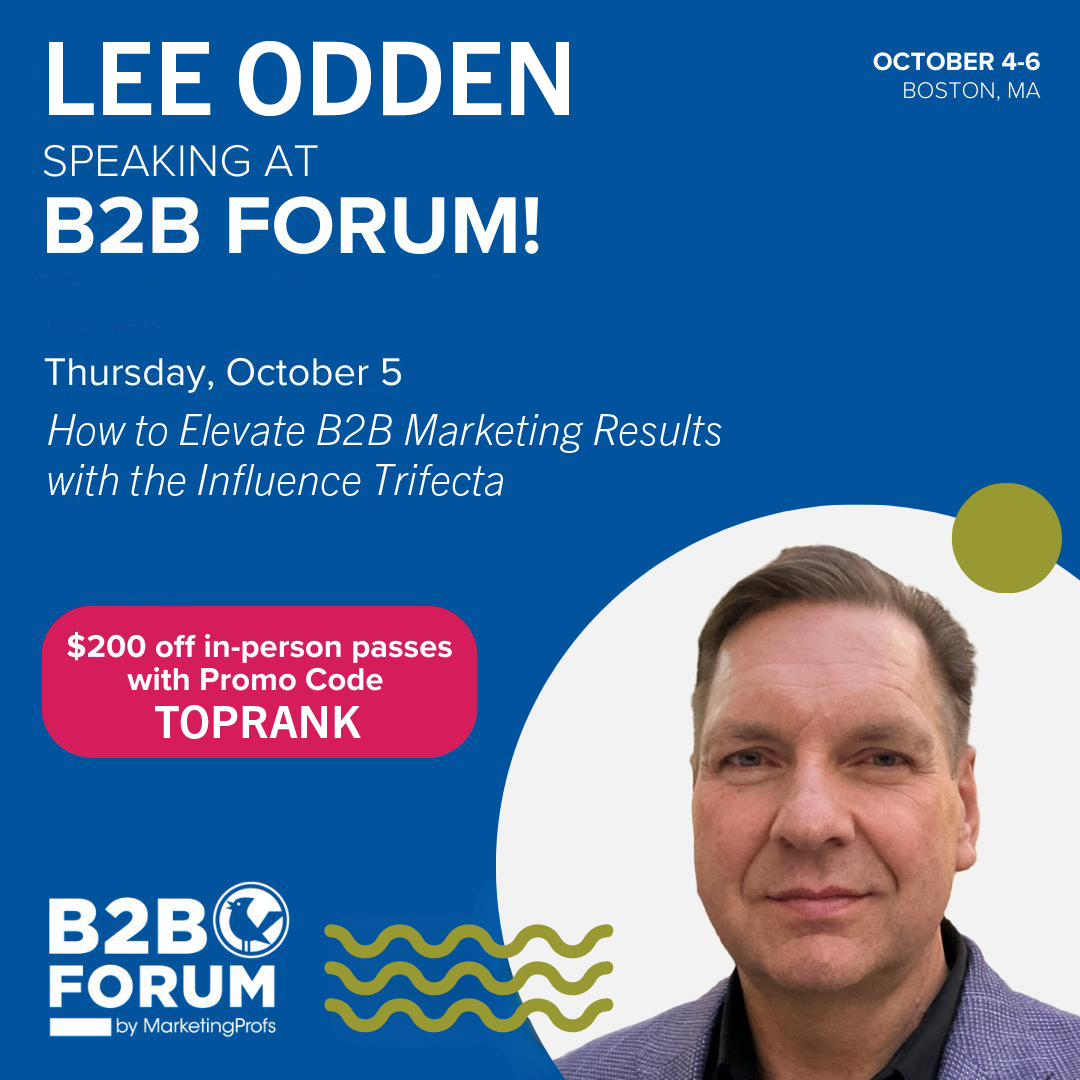
If you’d like to learn more about elevating your B2B marketing, you’re in luck, as our founder Lee Odden will be presenting at #MPB2B on the topic. Here are the details about Lee’s session:

Thursday, October 5 – 4:05pm Eastern
Session with Lee Odden
Presenting: How to Elevate B2B Marketing Results With the Influence Trifecta.

Lee Odden speaking at MarketingProfs B2B Forum 2023 image

We hope to see you either in-person or virtually at the exciting MarketingProfs B2B Forum 2023 conference, and be sure to follow us on Twitter at @TopRank for real-time updates during the conference using the #MPB2B hashtag.

The post Top 25 B2B Marketing Influencers and Experts To Follow #MPB2B 2023 appeared first on B2B Marketing Blog - TopRank®.


from B2B Marketing Blog – TopRank® https://ift.tt/I0nvhU6
via IFTTT

Wednesday, 4 October 2023

Beyond the Buzzwords: Learn How to Develop Your Writing Voice

Beyond the Buzzwords: Learn How to Develop Your Writing Voice written by John Jantsch read more at Duct Tape Marketing

Marketing Podcast with Anne Janzer

In this episode of the Duct Tape Marketing Podcast, I interviewed ​​Anne Janzer, a nonfiction book coach and author of multiple books on writing and marketing. Human behavior and cognitive science fascinate her, and she is always searching for clues to improve our communications.

Her newest book The Writer’s Voice: Techniques for Tuning Your Tone and Style; helps you Master the art and science of writing voice. This is a comprehensive, hands-on guide to this little-understood aspect of writing, brand voice, ghostwriting, and other aspects of marketing.

Key Takeaway:

In this conversation with Anne Janzer, we delve into the captivating world of writing, marketing, and the intriguing intersection of human behavior and cognitive science. Anne’s latest book, “The Writer’s Voice,” is a treasure trove of insights, offering a comprehensive guide to mastering the art and science of writing voice. Through our discussion, we uncover the secrets behind crafting a distinct brand voice, explore the nuances of ghostwriting, and gain a deeper understanding of the multifaceted realm of marketing. Join us on this enlightening journey to enhance your writing and marketing prowess, armed with the wisdom Anne shares from her extensive experience as a nonfiction book coach and author.

Questions I ask

  • [00:40] What made you fascinated with the idea of voice in writing?
  • [02:56] Does the voice in writing changes over time?
  • [03:29] What are the most common mistakes people make when they are trying to find their voice?
  • [06:25] Are people able to choose and develop different writing voices?
  • [07:23] How much responsibility do we have with the reader?
  • [12:55] Could you help us define what’s the difference between tone and voice?
  • [14:05] Tell us more about your latest book.
  • [16:18] Can you recommend some exercises for people to do?


Get Your Free AI Prompts To Build A Marketing Strategy:

Like this show? Click on over and give us a review on iTunes, please!

John (00:09): Hello, and welcome to another episode of the Duct Tape Marketing Podcast. This is John Jantsch. My guest today is Ann Janzer. She's a non-fiction book coach and author of multiple books on writing and marketing, human behavior and cognitive science fascinate her and she is always searching for clues to improve our communication. We're going to talk about our newest book, the Writer's Voice Techniques for Tuning Your Tone and Style. So Ann, welcome back to the show.

Ann (00:38): Thanks for having me back, John. It's great being here.

John (00:40): So let's talk a little bit, obviously voice and style, tone and style, writer's voice. I know prior to you writing your own books, you started writing other people's books, basically writing in other people's voices, right? And tones. Would you say that that kind of developed your fascination with this idea of voice?

Ann (00:58): It was actually. So I haven't done ghostwriting for books. I've done one book, but it was my marketing career. I was a freelance marketer and every week I'd pop over to a new company and try to figure out how to write in their brand voice. And sometimes actually fairly often with the small companies, I would define the brand voice for them. And then as blogs came out, I started ghost writing for executives, blog posts and interviews and all kinds of stuff. So that definitely piqued my interest in writing voice and it taught me a lot and it got me interested in the topic. I think it's the most neglected and misunderstood part of the writing craft, but there are four groups of people that pay a lot of attention. Ghost writers, obviously poets care a lot about voice fiction writers because they're trying to get their characters voices and marketers, marketers because they really care how they show up to their customer as part of that relationship with is the brand voice.

John (01:56): So would you say that you feel like, yes, I have a voice, I know what it is, maybe I haven't perfected it, but I mean I know when I'm doing it,

Ann (02:06): I feel there's a lot of talk about finding your authentic voice and I think voices are like shoes. There are shoes that fit us really, really well, but I wouldn't wear my hiking shoes to the opera. I think we should be able to pull on the right one for the right occasion, and we almost know how to do that instinctively if we're intentional about it. So yeah, when I first set out to write my first book, all of a sudden I was writing in my own voice and not the customers and the first draft started coming out just too much like a corporate it. There was some. So I had to keep going back and it wasn't really until I got the second and the third edition of that book that I really got comfortable in. What's my writing voice for a book? What part of me do I want to be? How do I want to show up for people there? What do they need to hear from me?

John (02:56): And just as a writer, would you say that that's something that matures in people? I know I started really first writing seriously 30 years ago, and I look back at some of that now and it's awful. And not to say that my writing is brilliant today, but it's certainly changed.

Ann (03:16): I do. I think even if you were writing in a voice that feels authentic and comfortable for the situation, we change, we develop our speaking voices age over time. So why wouldn't our writing voices change as well? Yeah, I do think so.

John (03:29): For me, I'll just use myself as an example. I became more authentic when I became more confident in my writing because I wasn't as worried about using big words or whatever it was I was trying to do. So let's talk a little bit about some of the early mistakes somebody might make when they're trying to find a voice.

Ann (03:45): Sure. Yeah. So one thing we do is we try to write the people around us and then we're not really comfortable. It's like wearing shoes that don't fit quite right. I think other people can tell we're walking funny because our shoes aren't fitting quite right. So I keep going back to the shoe metaphor. I don't know why. But yeah, so people think, well, I want to be an expert, so I'm going to show up with the big words. That's the most common thing I see. And that just backfires so badly with the reader if they're not familiar with those words or you're just making them do extra cognitive work. And I'd rather have them focused on my ideas and not my sentence structures or not my vocabulary. So that's a really common mistake. I think too often people think, oh, I'm going to write a book now, or I'm going to write this important essay and I'm going to put on my serious writer hat and I'm going to try to think back to what I did in college and I'm going to do long sentences and I'm going to really try to uplevel it.

(04:40): And that almost always backfires. It's not comfortable. It's hard for the reader and it doesn't give them really good sense of who you are because you're putting on something that may not feel legit to who you are,

John (04:53): Right or wrong. There's a lot of advice out there, particularly in writing for business circles that talks about writing at the eighth grade level or something like that, whatever the level is supposed to be, somewhere less than you might write your college essay type of work. Does that show up in voice, first off? Is that valid? And secondly, does that show up as part of voice?

Ann (05:13): So first, I think it is valid in the sense that most marketing writing, it's not that your customers are dumb or don't have college degrees, but they're reading it on their phone while they're in line for a Starbucks, for heaven sakes, how

John (05:24): Much don't make me work,

Ann (05:26): Don't make them work too much. And this is so true. If you're writing an email, my goodness, just highlight the things you want people to do with it. So yes, so I think the eighth grade thing is valid. The really interesting thing, and there's a chapter in the book on this, is that most of those grade level things are based on two factors and two factors only. How long your words are, how many syllables there are in a word, and how many words there are per sentence. And so if you just go to some shorter words and shorter sentences, your grade level goes, and so you think, well, is that a legitimate measure? But I think it is because longer sentences make us keep more working memory involved in a sentence before we can close it and compute the idea. So I think that's legit. So that was part

John (06:08): One. Anyone who's edited my work over the years, I use a lot of parenthetical phrases and they just are always cutting those out. Darn it.

Ann (06:17): I am also a huge fan of the parenthetical and you know what, you do what you need to do in your first draft and then you can tune it and revision.

John (06:25): So I'm curious about this idea of selecting voice. I tend to think I write the same voice no matter what I'm writing, but that may or may not be true. But is there kind of like I'm going to choose this voice today, I'm going to choose this voice today dependent upon the situation, or are we really that flexible?

Ann (06:41): Well, we are flexible to some degree. I mean, if you were writing something to a third grade classroom, I'm going to say you would write it differently a little bit. I mean, our relationship with the people we're communicating with voice is just, writing is just another kind of human communication, and we have some native skills for that. What I want people to do is think about being intentional about the choices they make about how they're showing up just because this is comfortable way for you to write and it's the way you've always written. Is this what the reader needs from you in this situation? Do they maybe need more encouragement and less expertise or vice versa? I mean, what does the reader need? And then you can lean into that part of your natural human communication skills.

John (07:23): I was going to talk about the reader. Obviously every reader would probably interpret voice differently. I mean, somebody reads Cormick McCarthy, for example, differently. Probably not everybody gets the same thing out of that. So how much responsibility do we have to start with the reader?

Ann (07:38): Yeah, well if we think about it, the voice is reconstructed in the reader's head. It doesn't really live in the page. It only lives when it lands in the reader. And to some extent, that's a little bit out of our control. Someone can show up in a really bad mood and just say, your voice sounds like this or that, and we've all had bad reviews of something. Maybe it's like, wow, okay, I never saw that in there, but okay, you did. So we can be intentional and try to help the reader find it in the way that we hope that they will, that will be most helpful to them. I cited a study in the book, which I think is really, really interesting and it would be interesting to reflect on is when you read silently, a lot of people, they kind of have a little inner reading voice. They're actually narrating to themselves silently and quickly, but they're narrating. And I've talked to people about this and some people are like, oh yeah, I think it's my voice. Or if I know the author, it's their voice. But people kind of hear a voice. So your voice in writing doesn't really belong to you. It belongs to the reader, which is a crazy thought. And

John (08:41): It is interesting. I know sort of along the lines, reading your own writing out loud changes or maybe you put the inflection that you meant to be there, but it certainly can change or it's a good test almost, right? Does this sound like what I want it to sound like? Because that's maybe how the readers or the listener's going to experience it.

Ann (08:59): Yeah, reading your own out loud, reading other people's writing out loud can tell you something about what they're doing, which is always really fun. And then getting the computer to read your work out loud because they don't know what you were trying to say. And you might find out where somebody perhaps won't put the emphasis where you thought, and maybe you want to reconstruct that sentence to make sure that it's crystal crystal clear. So those are all good techniques to get at how the voice lands.

John (09:24): You want an interesting experience? I've done this over the years, read a book and listen to the author at the same time. And that is a really immersive way to hear voice. Yeah,

Ann (09:35): Yeah, I'll bet it is. Yeah, that's a great idea.

John (09:40): Hey, have you ever tried to hire freelancers and found that the quality of work was lacking or you got all the outsourcing excuses as to why the work didn't get done on time? Well, desk Team 360 has revolutionized the outsourcing game with their insourcing program that eliminates all those frustrations and excuses. You get unlimited graphic designs, website funnels, C R M, email automation, integrations, automations, really anything that requires you to log into software. Imagine all the time and frustrations you can save from trying to get your tech work done properly. We use Desk Team 360 every day in our business, and so I've negotiated you a 10% deal. That's right. Just go to a desk, team 360 info, book a discovery call, and you'll receive the special duct tape Marketing 10% off because hey, your pal John always takes care of you. So that's it. Go to desk team 360 info and book your call today. Try that. So there we have personality traits. Are there writing voice attributes that we can identify, that we can practice, that we can try to hone?

Ann (10:50): Yeah, absolutely. There's a bunch of things that we can do. There's stylistic choices that we make that we can use and experiment with in the book The Writer's Voice, I have people experiment at the extremes. Sometimes try to write something using only one syllable words so hard, but really fun because it makes you think about the words that you choose. We can also try to plug into an emotion or we can try to plug into an intention that is not our normal one and really experiment. I think that most people find that their range of writing voice is much larger than they actually use most of the time. And they may find that as they push out to one side or the other, they find something really fun that they can bring in or that might be a nice addition to the way that they normally write.

John (11:37): Should you fight for some of your voice and style decisions? I know that one of the things that I think it's intentional now in my writing is I will list three things and I will leave out. And so instead of this and this, I'll say this, this, this, and it's intentional, but it drives your Chicago style guide editor crazy. So are there things that once you know they're intentional, and I'm not saying that you always just say it my way or not, but I mean are there things that you might do that are a part of your voice that you say no? That's just like a little trait.

Ann (12:12): Absolutely. Think people use, that's something that you do. People can use punctuation. We can legitimately use sentence fragments if we are using them well and know what we're doing. So a good editor should never smooth out your voice, should never eliminate your voice. They might clear things that are in the way of people hearing the voice and that's legit. But if in your case, if you were submitting to a publisher and this is your thing, just say, this is part of my style guide. This is the John Chach style, this is what I do with list the three. Deal

John (12:43): With that. Okay. You heard it. You heard it here first and said I can stop. I can start sentences with a preposition. Okay, so there,

Ann (12:51): Yeah, absolutely. Go for it. Just say it's intentional. This is my personal style.

John (12:55): Alright, so you use both these words, tone and style, and I'm curious if you could help us define those or at least differentiate those.

Ann (13:03): Yeah. So style to me, and they're so often used interchangeably. The style to me is actually the set of tools that we use to put things on the page. So I have the Chicago manual style. The addition I have is like four inches thick or something. So many style decisions, right? Semicolons not

John (13:24): Get drunk and white.

Ann (13:25): Yes. Yeah,

John (13:26): Much shorter.

Ann (13:27): Well, it doesn't tell you what order things need to go in a book. I mean, this is the bible of stylistic decisions. So there's thousands of decisions and we do most of them without thinking about them. And that's fine, but it's the tools that we have and tone is what those tools create. So style is maybe the painter's brushstrokes tone is the picture right, and the picture is perceived by the viewer tone of your reading. Is that the tone as interpreted by the reader? So I use stylistic things to project a certain tone and hope that it worked, cross my fingers and hope it works.

John (14:05): So we're going to get into the format of the book itself, but I'm curious, I know you did some research kind of led you to your decisions about what went in the book. Tell me a little bit about that project.

Ann (14:15): So I did two things. One is that I interviewed a bunch of people about how they felt about their writing voice and what they thought about it. And I really found this again, sense that it's something that most writers just don't really give that much thought to. And yet when you ask them questions about what they would change, they all have things that they would want to change about their writing, which I think is interesting. And then I was working on this book and I started creating exercises to play with the different ideas. And I got a group of people, bless their hearts, let me send them these exercises once a week. Crazy things to do. Some of 'em I really found out were way too hard or too involved. So I dialed them back and I just tested them on people as well as myself of course.

(14:56): And that it was interesting because John, I said out to write a traditional book, it was going to be a book and maybe there would be an accompanying work. And I was halfway through it, all this research, I may have maybe 23,000 words of a draft. I mean, I was really in the book and I said, you know what? Reading a book about writing voice and hoping to be a better writer is reading a cookbook and thinking that's going to make you a better cook. It is not. You got to actually do the cooking, you have to actually do the writing. So midway through, I just abandoned it and I merged the workbook and the book together, cut a lot of the traditional parts of a book out, put in a lot of the exercises in the book, said write in this here. I made it really welcoming for people to pick up a pen and write. And I'm really,

John (15:44): Because showing a picture, it's big old workbook, right? It's

Ann (15:47): Big. It's workbook format. I really want to just get that idea that my gosh, you better pick up a pen when you get this thing and it's okay to write in it because that's how you're going to get the value from it is doing the ideas in it.

John (16:00): Yeah, actually, one of the books I wrote had prompts in it every day and you were supposed to write, and I can't tell you how many people wrote back to me and said, oh no, I can't write in the book. You need to produce a workbook.

Ann (16:10): Precisely. I'm one of those people. It's like, I must've gotten my hand slapped for writing a book when I was a child because it's like, even if there's prompts, it's like I'm not going to write in that. What are you nuts?

John (16:18): So talk a little bit about some of the exercises maybe. I mean, there are many, many exercises. So maybe pick out a handful and say, well, here's what you'll encounter on this exercise just to give people a flavor.

Ann (16:31): Yeah, so sure. So I'll give you two really radically different ones. One of them, which I really enjoy, is just to strip out everything except the punctuation. And it's something that you've written and it's so interesting because it tells you something about your sentence structures.

John (16:45): Wait a minute. So we're just left with periods and commas, is that what you're saying?

Ann (16:48): Periods, commas, semicolons, dashes, just the punctuation kinds

John (16:52): Of exclamation points for me,

Ann (16:54): Exclamation points you get to see. It's like, wow, I really do use a lot of exclamation points. And I did this and then I did the same thing for other writers that I admire in different genres. So for a literary writer author who I'm on his email list, I did it for one of his posts and his punctuation was much more free flowing than mine. It was very interesting. So that was kind of fun. And then on another extreme, one of these exercises where I asked people to test their extremes. I have an exercise called fancy or folksy, and to take the same thing and write it in asite or obscure or fancy, just, I mean set the dial to 11 on that. I mean, just go be crazy, be nutsy. Just do something super out there. And then to do something that's super folksy or slimy or just way more than you would ever do. And I had so much fun doing these, first of all. So it's like a warmup. It loosens things out and it also makes you think, wait, there was that thing there. My metaphors got looser when I got folksy. Or, it's very interesting. You test the extremes and then you find maybe your center could be a little one way or the other. So those are two of the kinds of exercises. That's fine.

John (18:03): Alright. Because nobody's going to listen unless I mention AI today.

Ann (18:06): Yes, yes.

John (18:07): Where do you think will, I mean there's lots of opinions about AI and writing in general, but where do you think we land with style and tone and voice?

Ann (18:16): So this is so interesting because as I was writing and working and researching, AI was really chat. G P T was evolving in crazy ways. And a part of me first thought, oh my gosh, if you can just ask chatt to make your writing funny, it's going to do it and maybe no one needs this book. And I've completely switched. I think that AI actually is making us think about voice more than we did. So it's very interesting. I think the book is timely in a way I didn't expect with that, which is we read something first and we go, oh, that was written by ai. There's no human there. So we're aware of when voice is off or missing or generic, and I think we recognize the value that there is in a real human voice connection. What's really who we are, that human connection

John (19:05): Theoretically. Wouldn't machine learning be able to read enough hemmingway to produce hemmingway voice?

Ann (19:10): Sure. I mean, you can ask it to write something like this author, that author Hemmingway and people are, so if that's what you want to do, if you want to upload everything yours and say, write in my style, you could do that for little transactional writing and things. But I think that the reason that we connect with someone, if you're writing as a solo printer or small business owner, I think your value is yourself, is your personality. And I abdicate that, is to give up something that is important to your brand. I think that AI could be an incredible tool as part of the writing process. And I'm working still on how I integrate it into my writing process. Yeah,

John (19:52): It's a great assistant, but I'm with you. I think where the real edges of voice or I might say something like, well, that was a load of crap. I mean, I might write something like that. I don't think AI would ever write that. And I think that's the edges of our voice that it'll never be able to pick up because it might be how we're feeling that day.

Ann (20:12): That's right. It's not. It's for the most part, trending to the middle, trending to the norm, language patterns, that's what i's looking for is language patterns. So I don't want to advocate that. And I think when I read something from you, John, I can see your voice. I can see your written, I can picture you, and I don't want to lose that. So if AI helps more people get things out into the world that are authentically their ideas and their thoughts, then it's great. But I just would be really careful about asking it to write for you,

John (20:42): Have it write metadata on your webpages all day long. Title tags, go for it.

Ann (20:48): Please, please. And it's a lovely non-judgmental brainstorming buddy. You can give it an idea. It comes back with ideas and you're like, yeah, that's okay. Actually, that metaphor is kind of lame, but it made me think of this other one, which I think is better. So I use it for those kinds of things. There's a lot of uses, like I said, it's a tool. We can use it well, we can use it poorly. I think the great writers will learn how to use it well and be more effective and

John (21:11): Efficient. And that's a great point. I mean, I think even for marketers, it's not going to replace marketers, but somebody who is strategically focused, who is using AI might replace marketers. That's the key. It's like you almost have to be using these, but you have to be using them in the right way.

Ann (21:30): That's true. And so that's a learning curve. We're all climbing still.

John (21:34): And of course a year from now you and I'll be having a totally different conversation about too. Right? Exactly. That's part of the climb, right? And you want to tell people where they might connect with you and obviously pick up a copy of the writer's voice or any of your other works.

Ann (21:48): Sure. The easiest thing is just to look for my website, which is my name Anne with a silent e janer.com. I have an email list that I share writing practices every other week, and once a month I do a drawing for writing related book. And it's just entertaining if you want to be part of that. And the book is available in any place you can buy books. If they don't carry it, you can order it from them. But it's called the Writer's Voice.

John (22:13): This seems like a good workshop. Are you doing a workshop with this?

Ann (22:16): That is in my fall thing to figure out because yeah, it is practically that workshop built into it, right?

John (22:23): Yeah. But doing it with a cohort I think would be kind of fun.

Ann (22:26): I think it would be a lot of fun to share those exercises with people. So I think you're

John (22:30): Right. Well, Anne, it was great catching up with you and having you spend a few moments at the Duct Tape Marketing Podcast. And hopefully we'll run into you one of these days soon out there on the road.

Ann (22:38): Yes, thanks a lot, John. It's great being back.


from Duct Tape Marketing https://ift.tt/U9OYVH2
via IFTTT

12 Can’t Miss Sessions at MarketingProfs B2B Forum #MPB2B

Remember that scene in the Matrix where Neo downloads dozens of new skills in just a few hours? 

You know: “Whoa. I know Kung Fu.”

via GIPHY


That’s basically what happens at a marketing conference. It’s a concentrated download of the latest marketing trends, best practices and practical advice. So it’s always exciting when conference season comes around again.

This year, B2B Forum by MarketingProfs (#MPB2B) is blowing the doors off with a killer lineup of B2B superstars. Some of these folks are practically synonymous with great B2B marketing, and they’re all in one place for three full days!

Here are the sessions you absolutely shouldn’t miss, who’s hosting them, and why I’m excited for each one. This isn’t every great session, of course, but it’s a good place to start.

Here’s the best part: If you can’t make it to Boston, most of these are available via livestream, too.

12 Can’t Miss Sessions at #MPB2B

Thursday, Oct 5th

Session: AI, Sales Enablement, SEO, Strategy & Planning Round Table

Time: 7:30am-8:15pm

Speakers: Ahava Leibtag, Allen Weiss, Andy Crestodina, Carlos Hidalgo, Christopher S. Penn, George B. Thomas

Livestream? No.

Why we’re excited:

This eclectic mix of topics and experts is worth getting up early for. Ahava Leibtag is the president of Aha Media Group; Allen Weiss is the founder and CEO of Marketing Profs; Andy Crestodina and Carlos Hidalgo are sales and marketing thought leaders; Chris Penn is more data wizard than data scientist, and George B. Thomas is a consultant and HubSpot expert. Any marketer looking to integrate their tactics and take a more holistic approach should rush to this one.


Session: 6 Steps to Show Content Marketing ROI to Your Boss

Time: 10:45am-11:30am ET

Speaker: Michael Brenner

Livestream? Yes

Why we’re excited:

Michael Brenner has decades of experience in marketing. He’s become a champion for quality content that drives measurable business results. Proving the ROI of content marketing is essential in a time when budgets are shrinking and every dollar counts, and Michael’s uniquely qualified to help you do it.


Session: Thought Leadership and Story-Finding: How to Generate a Constant Stream of Story Ideas to Engage Your Audience

Time: 11:40am-12:25pm ET

Speaker: Rhea Wessel

Livestream? Yes

Why we’re excited:

The AI boom is going to flood the content landscape with robotic, uninspired content. The only way to stand out is to be creative, genuine and human. This session promises to help thought leaders tell more compelling stories, whether it’s your story or writing on behalf of the C-suite in your organization.


Session: 5 Unconventional Content Marketing Approaches

Time: 2:50pm-3:35pm ET

Speaker: Joe Pulizzi

Livestream? Yes

Why we’re excited:

Never pass up an opportunity to hear Joe Pulizzi talk about content marketing. As the founder of Content Marketing Institute, he was instrumental in making content a measurable, strategic and profitable business practice. Now he’s bringing new ideas about social content, more efficient content creation, and even monetizing content. I can’t wait to see what he does next.


Session: How to Elevate B2B Marketing Results With the Influence Trifecta

Time: 4:05pm-4:50pm ET

Speaker: Lee Odden

Livestream? Yes

Why we’re excited:

Our founder Lee is to B2B influencer marketing what Joe Pulizzi is to content marketing. Lee and the TopRank Marketing team have seen incredible success with a holistic, strategic approach to B2B influence that doesn’t just copy what works in B2C. This session will feature a sneak preview of this year’s B2B Influencer Marketing Report, with data from over 400 marketing professionals.


Session: The Marketing Singularity: How Marketers Should Prepare for AI

Time: 5:00pm-5:45pm ET

Speaker: Christopher Penn

Livestream? Yes

Why we’re excited:

There’s no hotter topic for modern marketers than generative AI. Most of us are already using it in our day-to-day, but what will we do with it tomorrow? How can we make sure the AI is working for us, not replacing us? Chris Penn is the right person to ask.


Session: Mastering the Art of Cultivating an Engaged Private Community: A Step-By-Step Guide

Time: 5:00pm-5:45pm ET

Speaker: Justin Levy

Livestream? No

Why we’re excited:

I had the pleasure of working with Justin on the super cool and insanely successful Demandbase Smarter GTM campaign. Beneath his laid-back exterior is the mind of a superb marketer — he’s always entertaining and interesting to listen to.  As the social media environment gets more fragmented, building a private community is a great asset for any B2B brand, so this subject matter couldn’t be more topical.


Friday, October 6th

Session: Lead From Behind: Ways to Lead When You’re Not in Charge

Time: 8:30am-9:15am ET

Speaker: Moni Oloyede

Livestream? Yes

Why we’re excited:

It can be a sobering experience to come back to work after a conference. You’re brimming with new ideas, but you might not have the authority or resources to start trying them out. This session promises to help the non-CMOs among us get our ideas heard and build fruitful relationships with leaders to get things done.


Session: Recession-Proof Your B2B Marketing Strategy

Time: 9:25am-10:10am ET

Speaker: Samantha Stone

Livestream? Yes

Why we’re excited:

Samantha is a champion of “results-driven marketing,” a skill that is in high demand in an uncertain economic climate. This session promises a smorgasbord of techniques to help weather the storm, including prioritizing investments, leveraging AI to increase efficiency, and using proven ways to shorten buying cycles.


Session: Cut the BS: B2B Influencer Marketing Strategies that Actually Work

Time: 9:25-10:10am ET

Speaker: Ashley Zeckman

Livestream? No

Why we’re excited:

Ashley is a TopRank Marketing alumnus and I had the distinct pleasure of working with her for nearly five years. Now she’s the freshly-minted co-CEO of Onalytica, with even more valuable experience ready to share with the marketing community. If you’re in-person at MPB2B, see her in a small group now. Because in a few years, she’ll be doing the keynote.


Session: Using Data and AI to Foster Engagement Along the Full Customer Journey

Time: 12:40pm-1:25pm ET

Speaker: Carlos Hidalgo

Livestream? Yes

Why we’re excited:

If I had a nickel for every time someone promised to explain the new customer journey, I’d have enough to buy all the Martech solutions to get it done. But Carlos has got the inside line — he’s got the know-how and experience to help you make a genuine difference. The future of marketing will depend on smart use of AI to make sense of mountains of data. Now’s the time to get ready.


Session: Navigating the Labyrinth: Three Steps That Lead Every GTM Strategy and Buyer to Great Content

Time: 1:35pm-2:20pm ET

Speaker: Randy Frisch

Livestream? Yes

Why we’re excited:

Randy takes a no-nonsense approach to marketing — as evidenced by his book “F*ck Content Marketing.” He’s also the Co-Founder of Uberflip, so he knows a thing or seven about how to deliver the right content to the right person at the right time. This session promises to show you how to streamline your GTM strategy with the judicious application of data, and how to create content experiences that engage your targets.

Keep up your marketing momentum after MPB2B

I remember coming home from my first marketing conference in 2015 — it was Content Marketing World. I had so many new ideas buzzing around my head that it nearly made me dizzy. At that point, there are two possibilities: Slowly return to business as usual, or use those ideas as a catalyst for change. I did my best to take the second option.

The TopRank Marketing team is here to help you turn your great ideas into reality. Whether it’s a new influencer marketing program, more effective content, or a custom strategy all you’re own, we can help you make it happen.

Contact us to get started today, and also check out our additional MarketingProfs B2B Forum resources:

The post 12 Can’t Miss Sessions at MarketingProfs B2B Forum #MPB2B appeared first on B2B Marketing Blog - TopRank®.


from B2B Marketing Blog – TopRank® https://ift.tt/oxuJVLn
via IFTTT
Monday, 2 October 2023

Elevate B2B Marketing News Weekly Roundup: Influencer Spending To Rise In 2024 & LinkedIn’s New Accessibility Features

B2B digital ad spend lags post-pandemic, hinting at prolonged recovery
U.S. B2B advertising spending is expected to reach $31.72 billion during 2023, with 37.4 percent accounted for by LinkedIn and Meta alone, while almost half of U.S. digital B2B ad spending will go towards mobile — three of numerous findings of interest to B2B marketers contained in recently-published forecast data. Insider Intelligence

Emerging B2B Trends You Need to Know [Survey / Infographic]
68 percent of B2B business professionals have said that they have utilized AI to improve their organization’s operational efficiency so far during 2023, while the fastest-growing expectations of B2B consumers over the past three years were personalized experiences, always-on customer service, and social responsibility and sustainability, according to newly-released B2B industry survey data. MarketingProfs

Manufacturing, B2B ready for AI overhaul [Study]
When it comes to professionals at manufacturing and B2B companies, 93 percent have said that they plan to increase investments in AI during the coming 12 months, with the most common generative AI area expected to see an impact being business operations, while 42 percent of survey participants said they had positive sentiment about AI, according to recently-published B2B survey data. Supply Chain Quarterly

What’s the Outlook for Media Budgets Next Year? [Report]
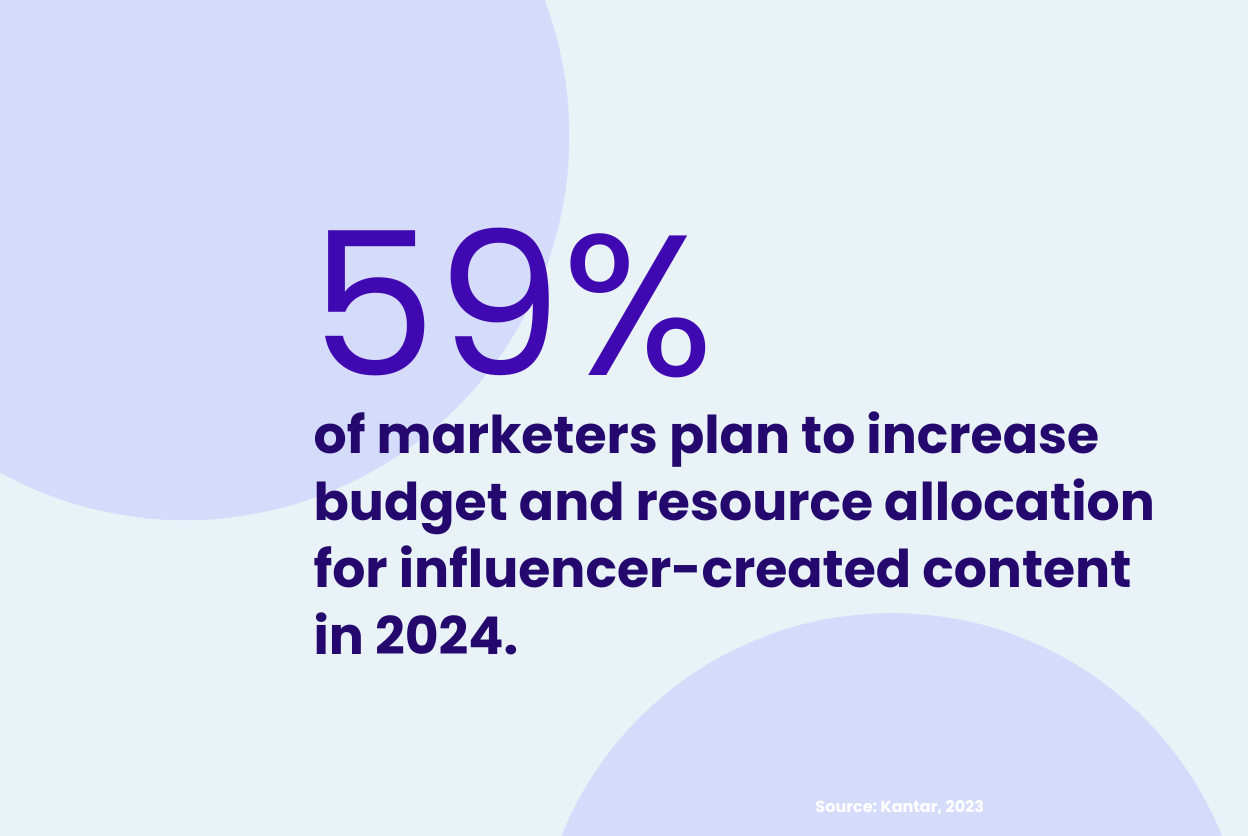
59 percent of marketing professionals have said that they plan to increase budget and resource allocation for influencer-created content in 2024, behind only online video and video streaming on the list of media channels expected to grow the most next year, while 59 percent expect greater spending for social media stories, according to newly-published Kantar report data of interest to digital marketers. MarketingCharts

LinkedIn Adds New Text Accessibility Options for LinkedIn Publisher Posts
Microsoft-owned LinkedIn has rolled out an array of accessibility features bringing text-to-speech, real-time translation, and other new communications options to the professional social platform, all tied in to newly-implemented integration with its Immersive Reader product, LinkedIn (client) recently announced. Social Media Today

The 2023 State of Marketing AI Report
22 percent of marketers have said that they had generative AI policies in place, with CEOs and CMOs the offices most likely to own AI initiatives at organizations, while 64 percent of marketers have noted that they view AI as either very important or critically important to business success during the coming 12 months — three of many findings of interest to B2B marketers included in newly-released marketing AI report data. Marketing AI Institute


“More marketers than every aren’t just paying attention to AI. They know it matters to THEIR success.” — @MikeKaput of @MktgAi
Click To Tweet


Facebook Will Now Allow Users to Create Multiple Profiles to Explore Different Interests
Users of Meta’s Facebook will be able to create up to four additional personal profiles with the social platform’s latest feature rollout, which will bring addition opportunities for marketing influencers and creators no longer limited to publishing content from a single account, Meta recently announced. Social Media Today

Most Enterprise Marketers Are Using AI in Their Email Campaigns
57 percent of marketers at enterprise-level organizations have said that they were already using AI in their email campaigns, with some 25 percent planning to do so, while just 14 percent indicated that they haven’t used AI technology for email initiatives and had no plans to do so, according to newly-published survey data. MarketingCharts

2023 September 29 statistics image

Brand interactions evolve on social media: Here’s what the numbers say [Report]
51 percent of consumers have indicated that responding to customers was the top way for brands to make an impact, as 53 percent said that they had spent more time on social media platforms during the past two years than during the preceding two — some of the findings contained in recently-released social media usage survey data. Marketing Dive

Martech Replacement Trends for 2023 [Survey]
When it comes time to replace marketing technology, marketing automation tools, search engine optimization (SEO) software, and work management solutions were those most likely to go, with the leading reasons for switching to new marketing software being better customer experiences, lower cost, and more streamlined integration with existing systems, according to newly-published survey data of interest to B2B marketers. MarketingProfs

ON THE LIGHTER SIDE:

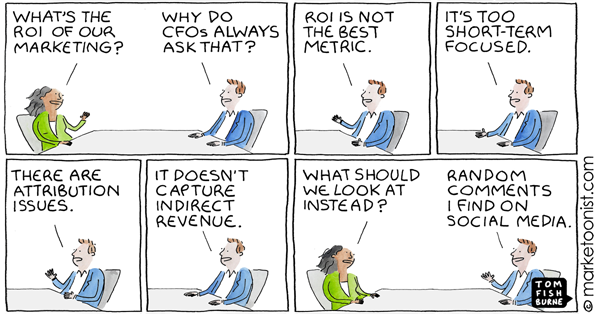
2023 September 29 Marketoonist Comic

A lighthearted look at “What’s the Marketing ROI?” by Marketoonist Tom Fishburne — Marketoonist

Spotify uses AI to clone and translate podcaster voices in new pilot program — Ars Technica

TOPRANK MARKETING & CLIENTS IN THE NEWS:

  • TopRank Marketing — How to Use B2B Influencers to Increase Web Traffic — madison/miles media
  • LinkedIn Marketing Solutions/Adobe — These B2B Innovation Award Winners Are Breathing New Life Into B2B Marketing — Adweek
  • Lee Odden / TopRank Marketing — Feeling B2B with Pam Didner: A B2B Marketing Expert Interview — MarketingProfs

FRIDAY FIVE B2B MARKETING FAVORITES TO FOLLOW:

Stephanie Losee @slosee
Kelly Hungerford @KDHungerford
Shashi Bellamkonda @shashib
Mark Alves @markalves
Michelle Garrett @PRisUs

Learn more about TopRank Marketing‘s mission to help elevate the B2B marketing industry.

Have you found a key B2B marketing news item we haven’t yet covered? If so, please don’t hesitate to drop us a line in the comments below.

Thanks for taking the time to be with us for this week’s Elevate B2B Marketing News, and we hope you’ll come back next Friday for another selection of the most up-to-date and relevant B2B and digital marketing industry news. In the meantime, you can follow us on our LinkedIn page, or at @toprank on Twitter for even more timely daily news.

The post Elevate B2B Marketing News Weekly Roundup: Influencer Spending To Rise In 2024 & LinkedIn’s New Accessibility Features appeared first on B2B Marketing Blog - TopRank®.


from B2B Marketing Blog – TopRank® https://ift.tt/CuUqGsc
via IFTTT