Wednesday, 26 September 2018

Is Anybody Out There? How to Get More Eyes On Your Blog Content

Tips for Better Blog Content Promotion

Tips for Better Blog Content Promotion What’s more important than creating great blog content? What’s more important than writing with empathy, storytelling, and research? What’s more important than even knowing your audience better than they know themselves? Amplification. Stay with me. If you’re a content marketing writer like me, amplification is the less sexy part of the job. The rewarding part, the part that matters, is writing that amazing, useful content. I’d much rather build glittering cathedrals of words that compel people to read by the sheer power of my prose. The trouble is, there are thousands of people out there writing amazing blogs. There is a ton of wonderful, beautiful pieces of content out there. And the only way people will find your blog is if you bring them to it. Without amplification built into your content marketing strategy, your blog is a diamond buried five miles beneath the surface of the earth. It’s pretty! It’s valuable! But it’s not doing anyone any good. So, how are we content marketers doing with blog amplification? Are we using every channel? Getting the most mileage out of every paid service? Bringing in beaucoup eyeballs for the content we spend so much time creating? Well, no. According to a recent report from Outreach Plus, we all have some room for improvement. Of the 500 business they surveyed, at least half are leaving money on the table. Here’s how to amp up your blog amplification.

How to Unleash the Potential of Your Blog Content

#1: Put Your Social Promotion on Repeat. Also, Put Your Social Promotion on Repeat.

Repetition on social media is key, but it looks like the majority of marketers are holding back. Less than half of those surveyed posted the same blog post link more than twice on Facebook, LinkedIn, Instagram, or Pinterest. Most marketers are posting to Twitter more than twice, but that platform is the outlier. How Often Marketers Promote Blog Content on Social Photo Credit: Outreach Plus It’s important to remember two key points about every social media site:
  1. Your post’s organic amplification is heavily throttled.
  2. Your audience’s feeds are full and move fast.
So, don’t be shy about posting your content more than once. You’re not going to overload your audience. Odds are they didn’t see the first one, for either of the reasons mentioned above. Do some testing to figure out the right cadence for reposting on each channel. In addition, vary your text and creative each time. But definitely start thinking beyond a one-and-done. Repetition on social media is key. [bctt tweet="When it comes to promoting your blog content on #socialmedia, repetition is key. Also, repetition is key. - @NiteWrites #ContentPromotion" username="toprank"]

#2: Explore More Paid Channels

The survey also shows that marketers could stand to explore more paid promotion options. Sixty-three percent said they promote some posts on Facebook, while only 29% said they used Google Ads. Less than 2% said they used promoted tweets or LinkedIn ads. Our experience as an agency has shown it’s wise to at least test on every channel. The results might surprise you. For B2B, LinkedIn* is one to bring to the top of the testing list, both through paid ads and as a spot for native-published content. The CPC on LinkedIn can be higher than other channels, but the quality of leads tend to be higher. It’s worth experimenting to see if your most valued audience is there; if you’re B2B, they likely are. But remember, the success of your paid efforts is rooted in your content. The blog content that you promote has to be good, it has to be relevant, and it has to resonate. [bctt tweet="Remember, any blog content that you pay to promote has to be good, it has to be relevant, and it has to resonate. #ContentPromotion" username="toprank"]

#3: Invest in Email

Some 39% of marketers surveyed promote every blog post to their email list. A whopping 22% either don’t have a list or don’t ever use it to promote content, while 39% promote sometimes. In other words, the majority of marketers are missing out. Email marketing is the Helen Mirren of marketing tactics. Yes, it’s older than most of our other tactics, but it’s somehow better than it was even a decade ago. via GIPHY Every marketer with blog content to promote should be building a subscriber list and serving it great, preferably personalized, content. As social media gets more and more stingy about letting you talk to your audience, that subscriber list is crucial. Focus on converting your traffic to subscribers; get them opted-in, invested, and onto your blog.

#4: Get Proactive with Outreach

Nineteen percent of marketers said they never reach out to people or websites mentioned in a post. Repetition is key, so let me type that again, bold it, and italicize it. I’m in awe of the fact that one-fifth of marketers are missing so big of an opportunity. Nineteen percent of marketers said they NEVER reach out to people or websites mentioned in a post. In addition, 41% said they only outreach sometimes. That leaves only 41% who are doing their due diligence with outreach. First, you need to mention people and websites in your post. Use them for third-party verification, credibility, and to highlight the contributions they’re making in your industry. Use inspiring quotes you’ve curated from thought leaders. Maybe, I don’t know, write a blog post about an insightful industry report someone did. ? Once your content goes live, let those people know. You’re paying them a compliment, helping promote their work, and showcasing their expertise. Of course they’ll want to know about your content. Not only might they help promote the post, you might also be starting a relationship that leads to an opportunity to co-create content with an influencer.

#5: Measure & Optimize

Here’s another statistic that should give you a stomachache: 10% of marketers are not tracking their promotion efforts at all. Not even the most cursory glance at Google Analytics. That’s right, one in 10 marketers has no idea how their content is doing. The majority of marketers are only looking at top-level metrics like traffic and social media shares to determine effectiveness. How Marketers Track Content Photo Credit: Outreach Plus There is some value in these so-called “vanity metrics,” especially compared to not tracking at all. But there’s far more value to be had from measuring against meaningful KPIs and optimizing over time. Measure your influencer shares. Use tracking URLs to measure how each influencer’s shares perform. Measure shares from different platforms. Compare paid versus organic. Go deeper than traffic and measure the signals that affect your search engine ranking, like time on page and bounce rate. Measure and report, but don’t stop there. Optimize your blog content that’s not meeting your KPIs. Is the bounce rate high? Adjust your title and meta description to more accurately describe the post. Time on page low? Front-load your content with the good stuff, add a mid-piece CTA, and make sure it’s optimized to pull readers through to the end. Measurement and optimization are not optional. For our team, they’re one of the most critical parts of the process. We want to continually sharpen our marketing, honing in on the combination of tactics, channels, content and audience that gets the best results. Without measurement — and measuring the right things — that kind of improvement is impossible. [bctt tweet="Measure and report, but don’t stop there. Optimize your blog content that’s not meeting your KPIs. - @NiteWrites #ContentPromotion #Blogging" username="toprank"]

Maximize the Potential of Your Blog Content

Despite the content crunch, your organization’s blog is still a valuable place to engage potential customers. But it’s not enough to write great stuff and call it a day. If you’re doing it right, you will likely spend more time amplifying a post than you did writing it. That’s as it should be. With the right promotion, one piece of content can do the work of 10 unamplified posts, educating your audience, building thought leadership, and nurturing prospects throughout their buying journey. Need more ways to make sure your content gets seen? Check out these 50 content promotion tactics from a content marketing master. *Disclosure: LinkedIn is a TopRank Marketing client.

The post Is Anybody Out There? How to Get More Eyes On Your Blog Content appeared first on Online Marketing Blog - TopRank®.


from Online Marketing Blog – TopRank® https://ift.tt/2QXN8Kx
via IFTTT

Tuesday, 25 September 2018

Sales Training Options to Help Your Small Business Succeed

Sales Training Options to Help Your Small Business Succeed written by John Jantsch read more at Duct Tape Marketing

Having an effective and engaged sales team is one of the keys to guaranteeing your business’s success. Some people are natural sales men or women—they have the gift of gab, the ability to easily connect with others and win their trust, and are adept at juggling leads and following up with prospects and existing customers alike.

For most of us, though, sales skills need to be developed. Things like cold calling, making an effective pitch, and understanding prospecting strategy are not always intuitive, and so it’s critical that you offer your team training in various areas so that they can become the confident, well-rounded, skilled salespeople that will perform best for your business.

Cater to Your Team’s Strengths and Weaknesses

The first step here, of course, is to understand your sales team’s strengths and weaknesses. Now, these may be different for each person on your team. Maybe you have one person who doesn’t have any trouble picking up the phone and chatting with strangers multiple times a day, but who lets follow-up requests sit in his inbox. Meanwhile, you have another team member who’s skilled at managing relationships with existing customers and making up-sells, but who struggles with her demo presentations to prospects.

A good jumping off point is finding a sales training program that can cater each team member’s individual needs. Hubspot has a great list of sales training courses that cover a wide range of topics and are accessible at a variety of price points.

Providing your team with access to a generic course that can help them brush up on the skill or skills that need the most work is a great way to start getting everyone on equal footing.

Create Your Own Course

While having a general understanding of sales techniques is important, you’ll also want to create a course specifically for your business’s sales team. Each business has its own approach, and you’ll want to share tips and tricks, plus help them avoid pitfalls, that are unique to your business.

The first step here is to ensure that your team understands your value proposition. This is the driving force behind why you started your business, and it’s the reason that your salespeople are selling the good or service you offer. Trumpeting your value proposition empowers your team to motivate every action they take with that “big picture” idea always in mind.

From there, you want to make sure your salespeople understand your process and approach to sales. Is there a specific CRM tool you use and a way that you want information recorded? Do you have a script for cold calling or emailing? Do you have a set list of answers to questions frequently raised by prospects? Is there a system in place for alerting managers to potential issues that crop up with unhappy leads or customers? And how does your set approach incorporate the marketing team in the sales process?

When you have a clear and established set of systems and processes in place for your team, you provide them with a context in which to work, which then frees them up to focus on the art of selling and closing the deal.

Act It Out

One of the most daunting things about interacting with prospects or customers is that a salesperson can never predict how exactly the conversation will go. Experienced salespeople have seen and heard it all, but if your sales team is newer to the game (or just unfamiliar with sales at your particular company) they may feel intimidated by the unknown.

Much like a new airplane pilot starts out in a flight simulator before getting behind the wheel of an actual plane, you can start the greener members of your sales team out with role playing. Put together a list of the types of tricky prospects your salespeople might encounter: The one with lots of questions, the one who doesn’t want to pay full price, the one who declares they hate the product. Create a rough outline of a script for each scenario that details the points you want the “prospective customer” to hit. Then, get the whole team together and pair up members of the team, having more senior salespeople playing the customer and the newer team members acting as the salesperson.

When the role play wraps up, ask colleagues to weigh in on what the salesperson handled well and what they could have done better. Then have the pair reverse roles and replay the scenario, so that everyone can see firsthand how the salesperson incorporates the suggestions from their colleagues and artfully dodges those common pitfalls.

Start a Book Club

There is a lot of value in a great business book. Sometimes courses get monotonous, but a well-written book with compelling arguments and case studies can help a concept jump right off the page, and it can inspire the reader to try a new approach or tackle a new challenge.

Consider putting together a reading list for your team that includes titles by some sales experts you really admire. If someone on your team is excited about a particular book, hop on Amazon and order it for them. Make it as easy as possible for them to encounter fresh, new ideas that can revitalize their sales approach.

You might even take things a step further and set up an actual in-office book club. Select a title for everyone to read, and then gather the group together a month later to discuss. Come with your own questions and topics to help guide the discussion, and allow your employees to share their impressions, what they learned, and how they think they can implement some of the tactics or approaches covered in the book in their day-to-day work life.

If you’re looking for a good read to get your started, I’d recommend the following:

Make Mentors

One of the best ways to learn sales techniques is to watch someone else do it skillfully. If you have a team with some more seasoned salespeople and some other who are less experienced, creating a mentorship program can be a great approach.

Pair each novice up with a mentor. Allow them to listen in on their mentor’s sales calls and to tag along for in-person meetings and pitches. Learning from a pro in the field is one of the fastest ways to help develop a rookie’s technique. Also ask your mentor to provide feedback to their mentee; have them establish a monthly sit-down over coffee that encourages an open dialogue between the veteran and the beginner.

Studies have shown that mentorship programs have benefits for both the mentors and the mentees. Your novice gets to learn new skills, and your veteran gets to develop leadership skills that prepare them for even greater career growth.

You have plenty of options when it comes to sales training. From the preexisting courses on particular topics to more customized, in-house training programs, you should be able to strike the right balance and create an environment that empowers your team to succeed.


from Duct Tape Marketing https://ift.tt/2zsgKJf
via IFTTT

My New SEO Tool: Ubersuggest 2.0

ubersuggest 2.0

I promised you months back that I was going to release a newer, better version of Ubersuggest for free.

And can you guess what?

I just released it! 🙂

Before I go into the features of the new Ubersuggest and how it works, I just want to tell you that not all of the features have been released yet.

For the first release, I focused on keyword research.

So let’s dive into the new Ubersuggest.

Keyword Overview

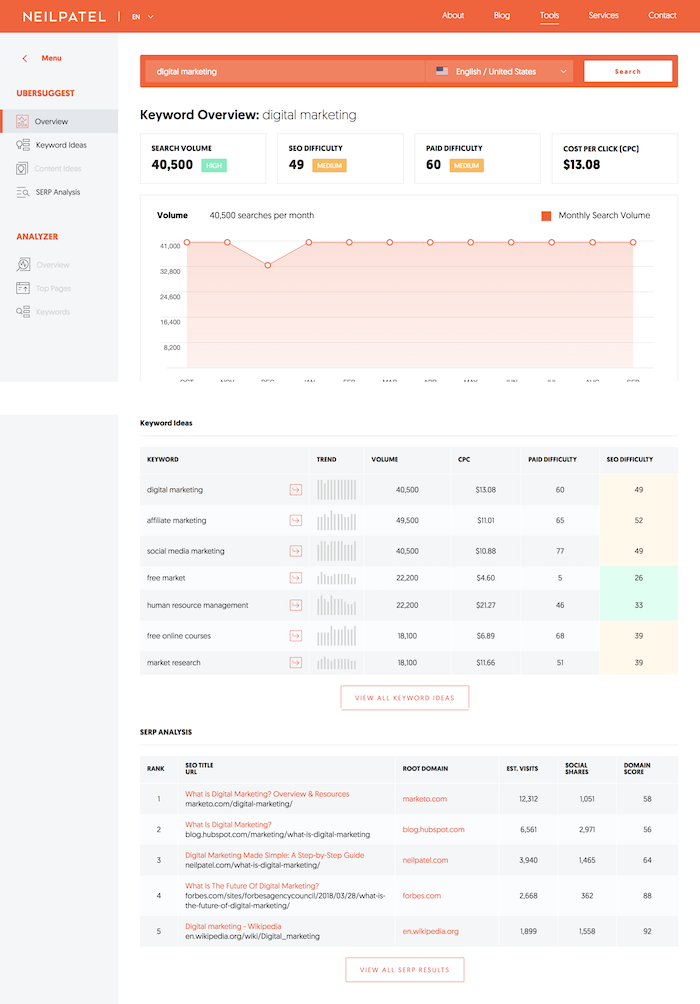
The keyword research is broken down into 3 main sections: overview, keyword ideas, and SERP analysis.

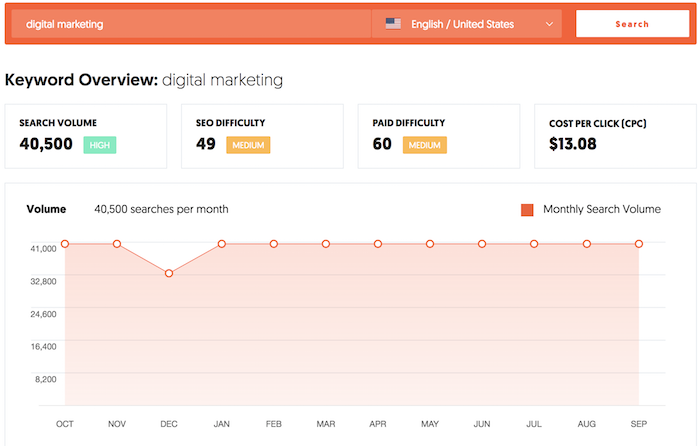
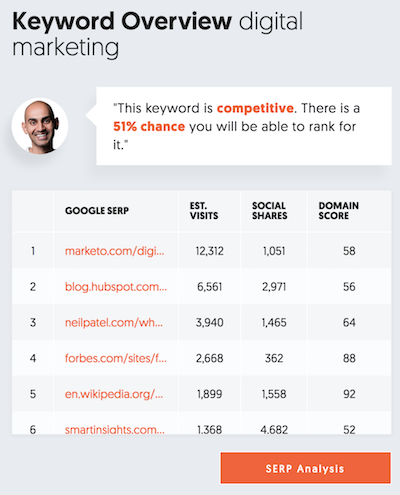
The overview looks like this:

keyword overview

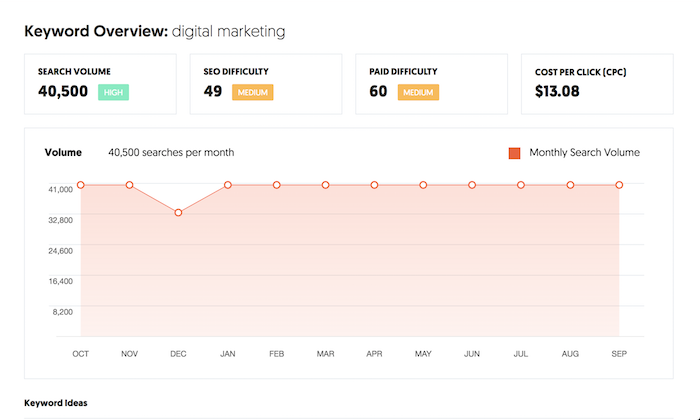
The first section is a graph that breaks down the search volume over time.

keyword graph

You can see the search volume for any keyword in any country and language over the course of the last 12 months.

The graph will show you if the keyword is gaining or declining in popularity or if it has seasonality.

In addition to that, it breaks down the cost per click, the SEO difficulty, and the paid difficulty.

The difficulty scores are from 1 to 100. The higher the number the harder it will be to compete for that keyword. And the lower the number the easier it is to compete.

Keyword Ideas

The second part of the keyword research is the ideas section.

This is the section that is most similar to the prior Ubersuggest but with a few more features.

keyword ideas

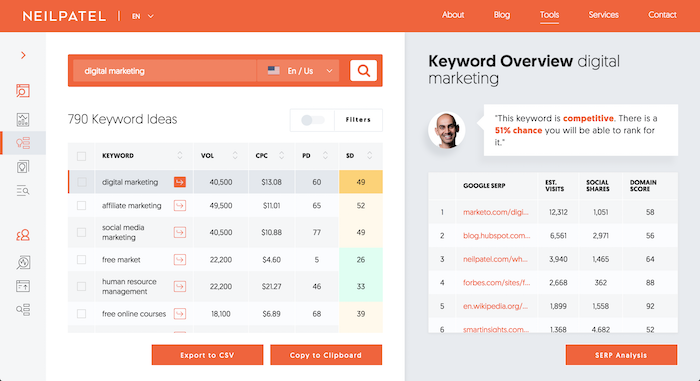
You’ll see a list of keyword ideas.

The keywords are pulled using both Google Suggest and AdWords recommendations. This way you can get a comprehensive list of potential keywords you may want to rank for.

And similar to the overview section, you’ll also be able to see volume data for each keyword as well as cost per click (CPC), paid difficulty (PD), and SEO difficulty (SD) data.

Now on the right side of the keyword ideas report you’ll see all of the sites that rank in the top 100 for that term.

keyword ideas serp

This is my favorite part of the keyword ideas report because you can easily see the estimated visit count based on rankings.

This metric looks at whether a keyword has seasonality and if there are any rich snippets or paid listings for the term.

In addition to showing you the estimated visits based on rank, you’ll also see how many social shares each URL has and its domain score.

Domain score is a metric between 1 and 100. The higher the number, the more authoritative a domain is and the harder it will be to beat that site.

As for the social shares, this will tell you how much people loved that particular web page. If more people are sharing it, they must have really enjoyed it.

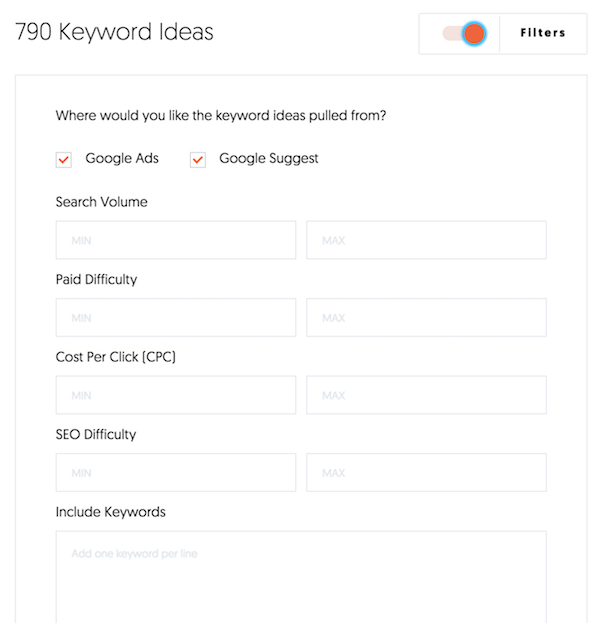
The last feature in the keywords idea report (other than the exporting to CSV feature which doesn’t need much of an explanation) is the filtering.

filters

This is where you can filter the keyword results based on any data point you want. From limiting the results to just Google Suggest or AdWords or by filtering keywords based on their popularity and competition.

If there are also too many results like the screenshot above, you can exclude or include certain terms or phrases. This will help you filter the results even faster.

And if you want to focus on long tail terms, just “uncheck” the “Google Ads” option and you will see all of the long tail terms.

SERP Analysis

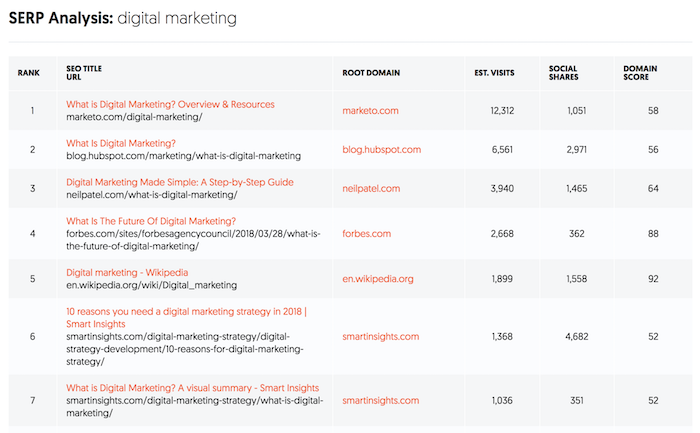
The last section, SERP analysis, shows you a simple view of the top 100 sites that rank for any given term.

serp analysis

I know many of you are doing keyword research in different languages and regions and you’ll be able to do that with all of the reports, including the SERP analysis.

Eventually, I’ll showcase rich snippets and paid advertising data in this report.

We are already taking those two things into account when we run our calculations on estimated visits.

And of course, you’ll also see social share data and domain score.

So, what’s next?

I wish I was able to release everything at once, but development is never easy or fast. I have an amazing team… but good things just take time.

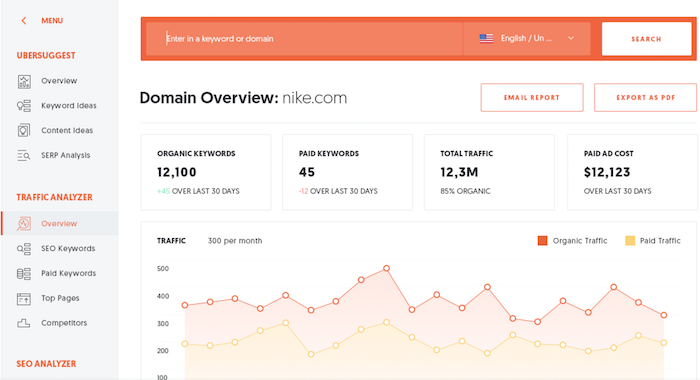
A few of the features I want to release over the next few months include a traffic analyzer report, which shows how much traffic a domain receives from Google.

traffic overview

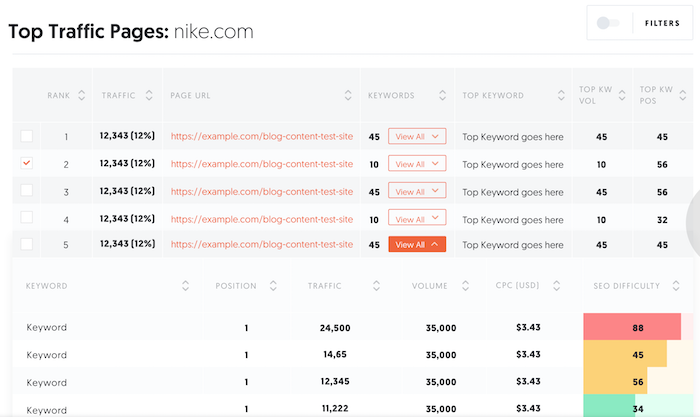
Another feature I will release will be a report that showcases top pages for any given website and the search terms that each of those pages rank for.

top pages

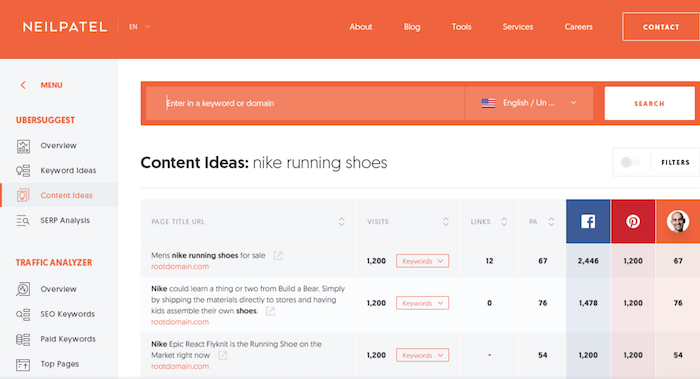
Once I release the traffic analyzer report, the team will be focusing on the content ideas report.

content ideas

The content ideas will be part of the keyword research section.

When you research any keywords, you’ll be able to see the most popular articles on that subject based on search traffic and social shares (similar to Buzzsumo).

Conclusion

What do you think about the new Ubersuggest? If you haven’t used it, go check it out.

And if you find any bugs, please email them to support@neilpatel.com so my team and I can work on fixing them.

Like I mentioned earlier, this is a work in progress and other amazing features are already being worked on for future release. A lot of these ideas come from you guys so, please, the more feedback the better.

So, what do you think about the new Ubersuggest?

The post My New SEO Tool: Ubersuggest 2.0 appeared first on Neil Patel.


from Blog – Neil Patel https://ift.tt/2OT8E1L
via IFTTT

How to Boost Your Content Marketing Efforts By Planning Ahead

Collective Wisdom Series Part 1 Planning Ahead Chess Image

Collective Wisdom Series Part 1 Planning Ahead Chess Image They say two heads are better than one, but we say the more the merrier — especially when it comes to bringing you actionable tips and insights to fuel your digital marketing efforts. That's why we're proud to announce our “Collective Wisdom” series. Throughout the series, we'll be bringing you insights, tips, and perspectives from some of the top marketing minds to help guide your content marketing strategy. With each entry, you’ll quickly learn proven methods, taking you from the very beginning of the content planning cycle to post-publication amplification and optimization. Where should we start? At the beginning, of course. In this piece, we explore the crucial planning stage that essential for content marketing success.

Planning Your Content — Get A Jump Ahead By Stepping Back

Having a solid plan in place is the foundation of any successful content marketing journey. There are several considerations you'll want to consider before jumping into creation, helping ensure that you have a well-thought-out and meaningful plan from beginning to end already in place. via GIPHY

Tactic 1: Commit to Having a Plan

As the old saying goes, "A journey of 1,000 miles begins with a single step." For marketers, that single, first step is committing to developing and documenting your content editorial plan, even if it's not super sophisticated to begin with. Unfortunately, some digital marketers often skip this step entirely. And with 32% of marketers staying organized is a top content planning challenge. Documenting a content plan that you can consistently refer back to will most certainly help. If you don't know where to start, start with reading the DivvyHQ and TopRank Marketing report, which features marketers Michael Brenner, Tamsen Webster, Carla Johnson, Robert Rose, and others sharing methods for creating proper content calendars and involving team members in the content planning process. DivvyHQ 2018 Content Planning Report Image

Tactic 2: Build and Ask a List of Sharers Before Publication

You know that once you release your content into the wild, you need to promote it. But do you spend time upfront locking down who could help you spread the word? If not, the upfront effort is worth it. You'll have a key next step built in your process, rather than scrambling last minute. Building a list of target sharers is a two-step process: 1) Reviewing your known contacts 2) Researching and qualifying others who would find your content relevant and share-worthy. When it comes to researching newbies to add to your list, EmailField’s Aman Thakur likes to use BuzzSumo to discover people who have a history of sharing content similar to what you plan to publish, by searching for keywords related to your piece. Thakur then recommends looking for relevant BuzzSumo articles that have over 200 or so Twitter shares, filtering the list by people, and exporting them to your sharer-contact spreadsheet or document, a technique he outlined for CMI. BuzzSumo Sharer List Image Moz contributor Isla McKetta is a fan of using Followerwonk to search through Twitter profile biographies to help build a list of influencers in your niche who may be well-suited to sharing your content, as she details in the Moz guide to content marketing. Followerwork Twitter Bio Search Image

Tactic 3: Plan Post Reuse In Advance

Actionable Marketing Guide’s Chief Content Officer Heidi Cohen takes the time to plan out content reuse and even the creation of ancillary works. She suggests:
When you write your post, craft related, tailored pieces at the same time. Present a different aspect of the same topic with each piece. Write two complete posts rather than having a single post in two parts.
Consider where your content will be most likely to fill the needs of those viewing it, and how that will best work when it comes time to reuse and rework your initial messaging. Doing this in the planning stage can both save time in the long run, and ensure that content reuse is done in a well-thought-out manner, instead of possibly being forgotten altogether. Cohen and others recommend fashioning a measured pace for doling out new versions of your initial content over time, each incorporating a new element or perspective on your original content, or perhaps using updated statistical data, all the while considering where new audiences for your work may exist. Our own Caitlin Burgess also explores the advantages of experimentation and the role of creativity when planning content reuse, in her helpful "A Tasty, Strategic Addition to the Content Marketing Table: ‘Repurposed Content Cobbler’."
"If there’s one thing that every content marketer has in spades, it’s a fully stocked content pantry," she says. "From white papers and eBooks to blog posts and original or third-party research, all of that robust and niche content has the potential to be sliced, diced, and repurposed into something new and fresh."

Tactic 4: Use Target Audience Personas to Supercharge Your Content Calendar

Understanding the pain points, needs, and attitudes of your target audience is critical if you want to develop a content strategy that wholly resonates. After all, how can you be the best answer for your audience if you don’t understand what questions they’re asking or what problems they’re trying to solve. Social Media Today Community Manager Emma Wiltshire knows how important it is to create marketing personas well before launching content. Knowing the search queries you want to show up for and how they align with the needs of your target audience should be fully understood before you begin creating new content. Audience Personas Image

Tactic 5: Find Your Best Distribution Options

Savvy marketers understand that the job has scarcely begun once they've hit publish on a piece of content, and recognize that amplification is crucial. Those who don't build distribution and sharing into the planning process risk losing out on a key element in the planning cycle. As Cathy McPhillips, Vice President of Marketing at Content Marketing Institute (CMI), said:
"You spend so much time creating epic content, so why not spend that same amount of time coming up with a plan for distribution and promotion? It can be a down and dirty spreadsheet — fill in dates, audience, messaging, and what you’re trying to achieve."
But where should you plan to share your content? Heidi Cohen also recognizes the advantages of finding the best distribution options for your content, and the time to make these decisions is before content has been completed. Owned, social, and third-party media all have specific uses, and finding out whether your campaign is best suited to using just one or all three is an important step in the content planning process, outlined nicely by Cohen in her “60+ Ways To Maximize Your Content Distribution” guide. Distribution Network Image Weigh the value of each publishing platform and channel, and when you’ve chosen those best-suited to your content, it’s helpful to document the plan and share it with all your team-members, so everyone knows what’s expected, including which key performance indicators (KPIs) and metrics will be used throughout the lifetime of the campaign to reach your goals.

Don't Just Wish — Gain A Major Advantage By Planning Ahead

As Eleanor Roosevelt once said: "It takes as much energy to wish as it does to plan." Take her famous advice to heart, and focus your wishes and goals into creating an actionable content plan. By taking the time to follow these steps — documenting your plan, building a sharer list, incorporating reuse ahead of time, using audience personas, and finding your best distribution options — you'll gain a major advantage over those who skip over some or all of the planning stage. When you're confident in your content planning process, you can move on to the crafting and creation portion of your campaign, and we'll take a closer look at that stage in the next part of our Collective Wisdom series. Stay tuned! Ready to learn more? See Lee Odden present the latest best-answer marketing strategies at Pubcon Las Vegas 2018 on October 16 - 18, and MarketingProfs' B2B Marketing Forum in San Francisco on November 13 - 16, where Ashley Zeckman will also be sharing her digital marketing insight.

The post How to Boost Your Content Marketing Efforts By Planning Ahead appeared first on Online Marketing Blog - TopRank®.


from Online Marketing Blog – TopRank® https://ift.tt/2OQvwij
via IFTTT

Monday, 24 September 2018

Marketing in the Age of the Connected Customer Experience - 3 Questions Marketers Must Answer

1. Every vendor claims to provide a data-driven marketing solution. What’s changed in the marketing landscape, and how can you stay competitive? 

Within the last decade, marketing has evolved to become one of the most data-driven professions anywhere. Savvy marketers are championing rich data as the foundation to executing personalization at scale. Personalizing the customer experience is the key to delivering higher ROI from your marketing investments, and building lasting relationships with your customers. So, with the need for scalable personalization, and with a dynamic marketplace, what would be the best strategy for building the most useful and competitive marketing automation solution?  

The key starting point to building great, data-driven marketing campaigns is having access to the right data to understand and target your customers. A Data Management Platform (DMP) is one of the first pieces to consider adding to your toolkit. DMPs provide the means to conduct audience targeting and data unification, while simultaneously delivering audience insights and analytics. 91% of marketers have or plan to adopt a DMP to enable a unified view of the customer. 

However, marketers shouldn’t stop there. They also need data strategies that transcend data silos and connect online, offline, 1st, 2ndand 3rdparty data to accurately select their audiences. Bringing all this data together is a big challenge. Oracle is leading the way to solving these issues through its acquisitions and integrations of DataLogix, BlueKai, and Moat. The Oracle Data Cloud makes it possible for marketers to leverage Oracle’s comprehensive data strategy in order to deliver personalization at scale to their customers. While many other companies offer DMP capabilities, it’s important to know how complete their views of the customer really are. A limited view of customer data only enables limited personalization. Several DMP solutions in the market focus on only online data and lack data ownership capabilities, providing a partial and often inconsistent view of the customer. 

Marketing leaders will benefit greatly by investing in a comprehensive data strategy.  Building marketing campaigns that include segmentation, targeting and customer analytics effectively enable a rich, singular view of the customer through data, helping to deliver the highly personalized customer experiences demanded by today’s consumers.

2. Customer journeys have changed. They are now infinitely unpredictable. Since marketing solutions need to manage the entire customer journey, what is mission critical, and how can I get this right? 

Customers switch channels effortlessly as they skip around sites and devices, double back and pause – each person taking their own unique path to purchase. Accenture revealed that 78% of customers receive a fragmented experience as they move from channel-to-channel. Among the biggest culprits are marketing technologies that specialize on providing a great experience on one channel, but fail to deliver that same high-quality experience across other channels of engagement. To address this challenge head-on, marketers need to leverage cross-channel orchestration tools that manage customer interactions across multiple channels such as email, SMS, MMS, push notification, in-app messages, display ads, web and mobile web campaigns. Only with the right tools can a marketer deliver the richest, most personalized experience across the widest variety of engagement channels. 

Picking the right vendor to enable high-quality and consistent cross-channel engagement requires examining several factors:

  • Is cross-channel orchestration a key strength of the vendor? 
  • Can the vendor continue to support your growth as you scale your campaigns? 
  • Does their product roadmap continue to invest in cross-channel orchestration as a key capability? 
  • Does the vendor have a reputation for supporting customers and working with them closely to strategize and solve problems?


Oracle Responsys has long been recognized as a leader in the market for cross-channel orchestration tools. It has a history of innovation and a roadmap looking towards the future to stay ahead of the need to reach customers with highly personalized interactions at scale across the important channels of engagement. Aside from a history of producing great technologies, Responsys also has the service and support to ensure you are successful in building winning customer engagements that serve your customer with the right answer on any device, any time and every time. 

3. Is your organization prepared for the expanding role of the CMO? 

Traditionally, CMOs have primarily been tasked with brand-building as their key metric of success. But today, that picture has changed as more than 70% of CEOs now hold CMOs accountable for top line revenue growth.

For CMOs to keep their job, they must think more broadly about customer acquisition, cross-sell and upsell opportunities, and increase the lifetime value of each and every customer. Putting the customer at the center of the marketing focus and building superior end-to-end customer experiences is now a table stakes requirement for being a successful CMO.

The good news, according to Gartner, is that the CMO is well positioned and uniquely qualified to own and drive strategy around the customer experience. The marketer has the holistic purview of the brand-to-consumer, and brand-to-prospect relationship, more so than anyone else in the organization. Building high-quality customer experiences is the new marketing currency to win and retain customers.

In this never-ending challenge to own and improve the customer experience, marketing, and other business units must adapt their processes, practices, and technology to connect marketing, sales, services and loyalty programs. 

Oracle’s Customer Experience platform is a trusted partner in helping organizations deliver a seamless, high-quality, experience for every customer as they move on their journey from a prospect to a customer to a vocal supporter. In business transformation, customer experience is the new battlefront. Does your company have the right weapons?

Deliver a seamless customer experience across a multichannel landscape with our helpful guides.


from Oracle Blogs | Oracle Marketing Cloud https://ift.tt/2DswcZT
via IFTTT

Enterprise B2B Influencer Marketing Interview: Dr Konstanze Alex, Dell

Influencer Marketing Interview with Konstanze Alex

Influencer Marketing Interview with Konstanze Alex Within the world of B2B influencer marketing, there are a handful of brand experts who have been charting a course within large enterprise organizations for the rest of us to follow. One of those pathfinders is Dr. Konstanze Alex (@konstanze), Head of Corporate Influencer Relations at Dell. My first experience with Konnie was several years ago when TopRank Marketing was working with Dell to develop relationships with IT influencers as part of an online publication initiative. Since then, we've worked with Dell to help develop an influencer marketing playbook, support influencer engagement at events and through content, but her relationship focus on working with influencers has stuck with me through it all. In this interview, we'll learn about the uniqueness of B2B influencer marketing, practical tips, a few of Konnie's favorite influencer programs and where influencer marketing for the enterprise is headed. What brought you to the world of Influencer Marketing? Konstanze AlexAbout 5 years ago I stepped into a new role in Social Media Marketing and one of my first projects had me investigate social selling experts for who understood the social media from a social business and sales perspective, specifically for a large global organization like Dell. One important aspect for us at the time was to educate our marketing leadership on social analytics and insights to help build programs for our marketing teams that would in turn lay the foundation for successful social selling programs and campaigns. How is influencer marketing different for B2B than B2C? In my experience B2B and B2C influencer marketing are not even siblings in the same family. They might be distant cousins at best. B2B influencer marketing has a much slower and longer lifecycle. It is truly a long-term relationship business in which trust and mutual value creation are built over a long time via ongoing engagements and constant knowledge sharing. B2C influencer marketing, in general, is focused on capturing the attention of large online consumer audiences which makes sense given the more transactional nature of the business.

Cutting edge B2B influencer marketing focuses on both, online and offline engagements.

Cutting edge B2B influencer marketing focuses on both, online and offline engagements by the influencers with their highly targeted, smaller business and IT decision maker audiences. The understanding of the off-line aspects of B2B influencer marketing is evolving as long-term relationships mature, trust grows and an alignment of values has been clearly established. For example, strategic partnerships with influencers can lead to the very natural incorporation of brand content into the influencer’s event and conference keynotes, personal and professional conversations, strategic writings, etc. At that point a B2B influencer relationship resembles traditional relationships with industry analysts.

In B2B influencer marketing it is not the audience size of an influencer but the trust level an influencer has built with his/her audience that matters.

In B2B influencer marketing it is not the audience size of an influencer but the trust level an influencer has built with his/her audience that matters, especially when it comes to high value purchase decisions and long-term commitments a customer makes with a brand. For a brand, the stakes lie in constantly briefing and engaging the influencer on a strategic vision and technical level. What are 2-3 of the main benefits of collaborating with influencers for B2B companies? Working with B2B influencers allows our brand to have a constant pulse check with purchase decision makers. Informed influencers who share our vision of the future based on their own experience and expertise provide for independent, third party validation.

Strategic partnerships with influencers provide for an outside in view when creating content for our customers.

Strategic partnerships with influencers provide for an outside in view when creating content for our customers. We need to constantly ensure that, as a brand, we don’t start talking to ourselves, but keep a keen focus on the evolving challenges our customers have and on language they use to express these challenges. How is influencer marketing positioned within your company? Ex: independent department that serves the brand and departments / business unites or is it more decentralized? What are the advantages of that structure? At Dell, relationship building and maintenance with influencers, media, press and analysts is housed in corporate communications. We firmly believe that relationships based on trust, aligned values, independence of opinion and mutual value creation are key to successful collaboration between brands and influencers. What tips can you share about being more effective about influencer identification, qualification and recruitment? You have to invest time and due diligence to the identification process. A sophisticated influencer program doesn’t rely on a single identification method or one-time vetting process of to start and maintain a relationship with an influencer but rather develops a scorecard that gets constantly reviewed and, most importantly, evolves as this emerging field matures. At this point, we review strategy, methods, tactics and measurement on an ongoing basis. Are there specific B2B influencers that you keep going back to because they are so amazing? Yes, of course, we have a number of strategic partners who never stop evolving or expanding their expertise. We value them highly and feel that they represent a reflection of our brand’s values and long term vision. Do you have a favorite B2B influencer marketing campaign that you can share? What made it successful? There are numerous, but a couple stand out for me: A year and a half ago we started an influencer hosted business podcast called Luminaries – talking to the brightest minds in tech where we focus on technology visionaries and the very human face of innovation. Our hosts are phenomenal digital storytellers and bring the outside-in view into every episode, every conversation with every guest with a deep commitment to and appreciation of our combined audiences. We built successful long term influencer engagement around our Realizing 2030 research reports that explore and examine the impact of new technologies on life and work in the year 2030. In strategic partnerships we are able to illuminate the report results from a number of distinct perspectives to make them accessible and relevant to our diverse audiences.

Successful (influencer marketing) programs will continue to lead from a human perspective and understand that technology remains only a tool for humans to achieve progress.

How do you think influencer marketing will have evolved in the next year or two? What will it look like in 2020? We will leverage new technologies such as AI for increasingly nuanced influencer identification, especially for micro targeting of audiences. We will use intelligent tools to find new ways of measuring results and new roles will have been defined within an influencer marketing team. But successful programs will continue to lead from a human perspective and understand that technology remains only a tool for humans to achieve progress. B2B Forum 2018 If you would like to learn more about B2B influencer marketing from a panel of brand experts, be sure to check out our sesssion at MarketingProfs B2B Forum November 13-15th featuring Konstanze Brown from Dell, Amisha Gandhi from SAP Ariba and Lucianna Moran from Dun & Bradstreet. Here are the details: The Confluence Equation: How Content & Influencers Drive B2B Marketing Success Content and influencer marketing are hot topics for B2B marketers all over the world as two of the most promising strategies for attracting, engaging and converting ideal customers. What many marketers don’t realize is how collaborating with influencers can create even more credible, relevant, and optimized experiences for target accounts. Join moderator Lee Odden and an expert panel of B2B brand influencer marketing executives from SAP, Dell and Dun & Bradstreet to learn how working with influencers and their communities can help scale quality B2B content that gets results.  You'll learn:
  • The variety of benefits from B2B influencer collaboration
  • How major B2B brands plan, implement and measure influencer content
  • About processes and technologies that support influencer marketing success
We hope to see you there!

The post Enterprise B2B Influencer Marketing Interview: Dr Konstanze Alex, Dell appeared first on Online Marketing Blog - TopRank®.


from Online Marketing Blog – TopRank® https://ift.tt/2OQSvtG
via IFTTT

Saturday, 22 September 2018

Weekend Favs September 22

Weekend Favs September 22 written by John Jantsch read more at Duct Tape Marketing

My weekend blog post routine includes posting links to a handful of tools or great content I ran across during the week.

I don’t go into depth about the finds, but encourage you to check them out if they sound interesting. The photo in the post is a favorite for the week from an online source or one that I took out there on the road.

  • Boom’s App Keyboard Shortcuts – Save time navigating your many marketing apps with keyboard shortcuts.
  • ShopifyAR – Empower your customers to have an immersive interaction with your products online.
  • Contento – Offer your articles to a network of media/blogs to expand your visibility.

These are my weekend favs, I would love to hear about some of yours – Tweet me @ducttape


from Duct Tape Marketing https://ift.tt/2Ia9Efi
via IFTTT