Tuesday, 29 January 2019

How to Incorporate Marketing Automation Into Your Existing Strategy

How to Incorporate Marketing Automation Into Your Existing Strategy written by John Jantsch read more at Duct Tape Marketing

When you started your business, you had a smaller customer base and it was easier to keep in touch with everyone. However, as your business has expanded, customer base has grown, and prospect pool has widened, you have more and more people that you’re hoping to reach with personalized messaging.

Fortunately, marketing automation tools can help you get all of that done. Many of the marketing tasks that you do now can be automated in a way that allows you to be targeted in your messaging and frees up time in your day to get other work done.

But if you haven’t used a marketing automation tool in the past, you might be overwhelmed by your options or not quite sure where to start. Today, we’re going to take a look at how to incorporate marketing automation into your existing strategy to ensure that you get the best results out of the tool.

Understand Where You Need Help

There are a lot of marketing automation tools out there on the market. Some are comprehensive, offering features for email, social media, and websites. Others are more niche and are focused on only one or two channels.

The first step to settling on the right tool for you is understanding the gaps in your current approach. This means turning back to your existing strategy. If you had big plans for your social media marketing but are consistently struggling to keep up with a regular posting schedule, that’s a sign that automation of scheduling and publishing to your social feeds might be useful for you.

If you’re having trouble growing your newsletter mailing list, then that might indicate that your lead capturing approach on your website could use some help. If you find that lead conversion is not as strong as you would like, an automated email follow up campaign might help you to keep pace with incoming requests from prospects.

Focus on the Tools that Work for You

Once you have a handle on where the weak points are in your marketing approach, you can then start to hone in on the tools that make the most sense for you. This will also, of course, be dependent on your budget and team’s level of tech-savvy.

If you’re looking for a tool that solves a narrow part of the marketing automation issue, it’s possible to find a low- or no-cost option. If strengthening your social media approach is a goal, a tool like Buffer or Hootsuite can help you to manage your social media post schedule and better engage with your audience.

If you want to improve your email marketing approach, a tool like MailChimp offers all of the basic features you could look for in managing a mailing list.

However, if you’re looking for a more comprehensive tool that brings together site tracking, email automation, sales and CRM, plus other features like SMS messaging, you’ll want to consider a platform like ActiveCampaign, Ontraport, or InfusionSoft.

These all-ecompassing tools have manageable subscription fees for small businesses, and if you have the budget and bandwidth to implement a full-scale automated system now, it might save you from having to migrate from individual tools to something larger in the future.

Prepare Your Data for the Switch

If you’ve been managing your customer list in a spreadsheet or sending out your newsletter through your Gmail account, chances are your data is not in its most organized state.

Part of the power of marketing automation is its ability to communicate with specific subsets of your population based on their attributes or actions. However, in order to take full advantage of email segmentation, you need to teach your marketing automation tool how you want it to communicate with your audience.

As you prepare to migrate your data into a marketing automation tool, begin thinking about how you want to slice and dice your list. This exercise should be driven by how you define your ideal customer. Are there certain features your ideal customer has like age, gender, location, or job title?

You’ll want to be sure that you have all of the relevant data on your existing customers that will make it easy for you to implement an effective segmentation approach. So take the time before you implement the system to scrub your data: get rid of stale contacts, fill gaps in relevant information, and make sure you’re starting your new system with a clean data set.

Once you get your marketing automation tool up and running, you’ll be able to undertake behavior lead scoring to understand the actions that typically lead to conversions, which will allow you to create an even more detailed profile of your dream customer.

Define Your Goals for the New System

Whenever you implement a new tool, you want to be sure you’re getting the most out of it. The best way to do that is to set concrete goals for what you intend to accomplish with your newly automated approach.

When defining those goals, be specific. Rather than, “I hope we’ll get some more interest in our mailing list,” try for something like, “I want to increase our open rate by 5 percent.” This kind of specificity will help you to understand what you need to do to give your automation approach its greatest shot at success.

Help Your Team Get Up and Running

If your sales and marketing teams are used to the old way of doing things, getting used to a new marketing automation system will take a little bit of time. And while a marketing automation tool can take a lot of work off your team’s plate in the long run, it’s only able to do that if it’s being used correctly.

You can help to ease the transition by first clearly communicating the changes. Give your team a head’s up about your intention to implement a new system. If you have employees who have used a marketing automation tool elsewhere in their career, get their advice before you make your final selection. Getting buy-in early on is one of the keys to successful implementation.

Once the new tool has been selected, clearly communicate your goals for the new tool, and make it clear how these goals align with your existing strategy. How will email follow up campaigns help you to increase sales? What will site tracking do for the way you behavior score your leads?

Finally, once you’ve shared your goals and approach, you want to provide adequate training and support during the transition process. Check in regularly with the teams who use the tool to see if they have any feedback or issues, and work to address concerns that might pose a problem in implementing your strategy.

When you’re used to running your marketing efforts without the help of a marketing automation tool, the thought of making the switch can be daunting. But when you’re thoughtful about selecting a tool that complements your existing strategy, you can set you and your team up for even greater success with less busy work.


from Duct Tape Marketing http://bit.ly/2CShpE9
via IFTTT

The Ultimate SEO Tool: Ubersuggest 3.0

ubersuggest

In 2018, I promised you I would release a better version of Ubersuggest for free, and I did that.

But there was one big issue: Ubersuggest only worked on a keyword level. When you put in a keyword, you get a list of more keyword ideas and content ideas.

And then when you put in a URL, nothing happened.

Well, that was before.

You can now get domain level metrics!!!!

So let’s dive into the new Ubersuggest.

Traffic Analyzer Overview

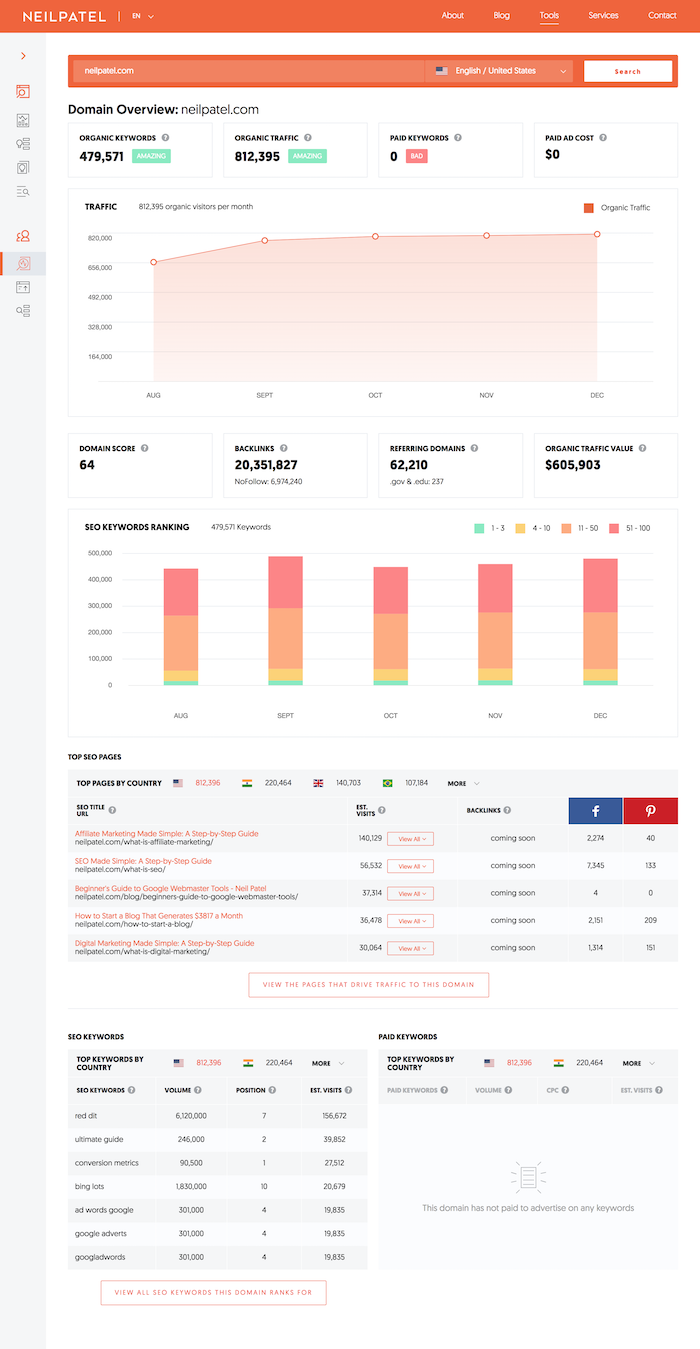
The traffic analyzer is broken down into 3 main sections: overview, top pages, and keywords.

The overview looks like this:

overview

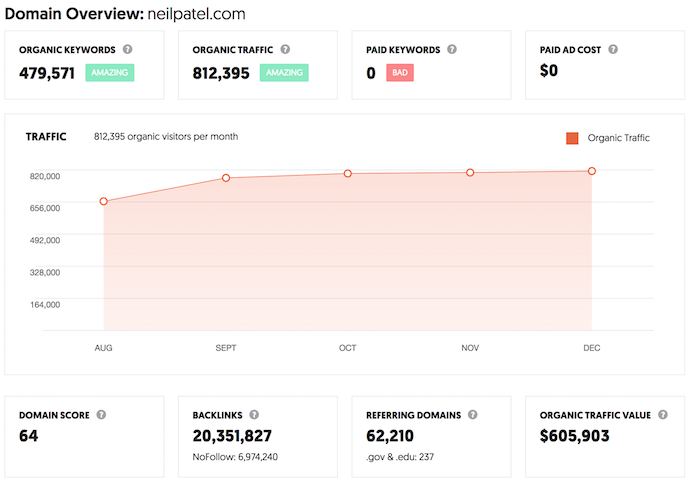
The first section breaks some basic stats and a graph of the domain’s search traffic.

domain metrics

As you can see from the screenshot above, you’ll see how many keywords a domain ranks for, the total estimated search traffic from that region, the number of paid keywords a site is bidding on, and how much they are spending on Google Ads.

In addition to that, you’ll see a traffic graph that shows estimated search traffic a site receives over time.

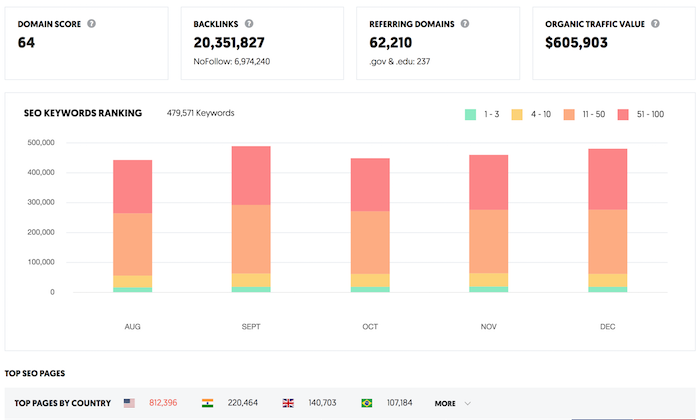
And of course, a domain level overview won’t be complete without data such as backlinks, referring domains, the number of .edu and .gov links, and how much the organic traffic is worth if you had to pay for it.

Now, before you head over to Ubersuggest and type in a domain, there is one thing you need to keep in mind… Ubersuggest treats subdomains as a separate site. So if you enter in store.nike.com you will get different results than if you typed in nike.com. By typing in nike.com, you would NOT see any of the data from their store unless you typed in store.nike.com.

We did this on purpose as it allows you to analyze sites more thoroughly.

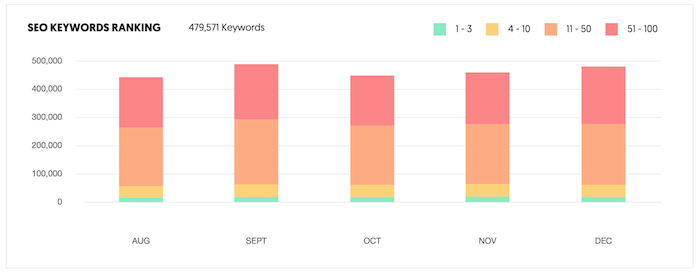
Also, within the traffic analyzer, you’ll see bar graphs that contain the overall positioning of the keywords you rank for over time.

keyword rankings

The chart above shows how many keywords a domain ranks for that are in the top 3 positions in Google, the top 10 positions, the top 50 positions, and the top 100 positions.

You already know no one clicks beyond page one, but over time you’ll want to see your site climbing the ranks. Hence, we track how many keywords are ranking in the first 100 positions.

Now let’s get into my favorite feature of the traffic analyzer.

Top SEO Pages

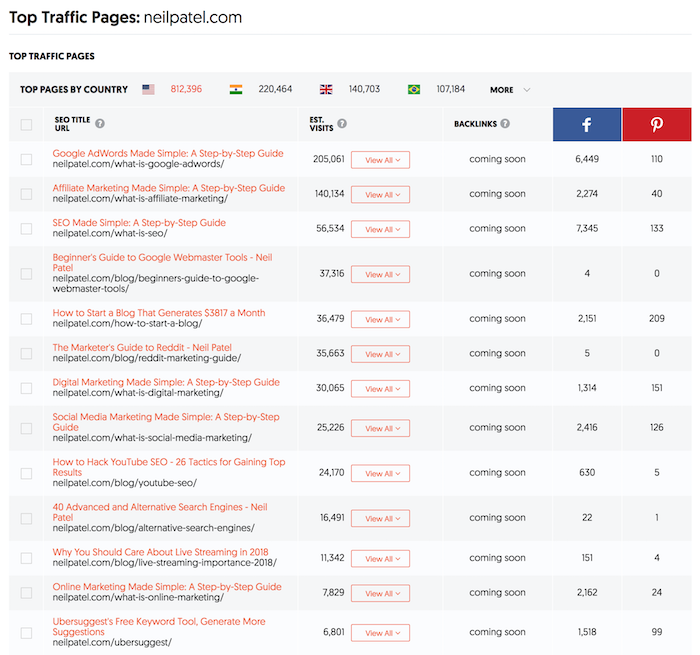
The second part of the traffic analyzer is a list of the most popular pages for a given domain.

top pages

For each page, you are given the title, URL, the number of visits a page receives from Google on a monthly basis, and the number of times the URL has been shared on the social web.

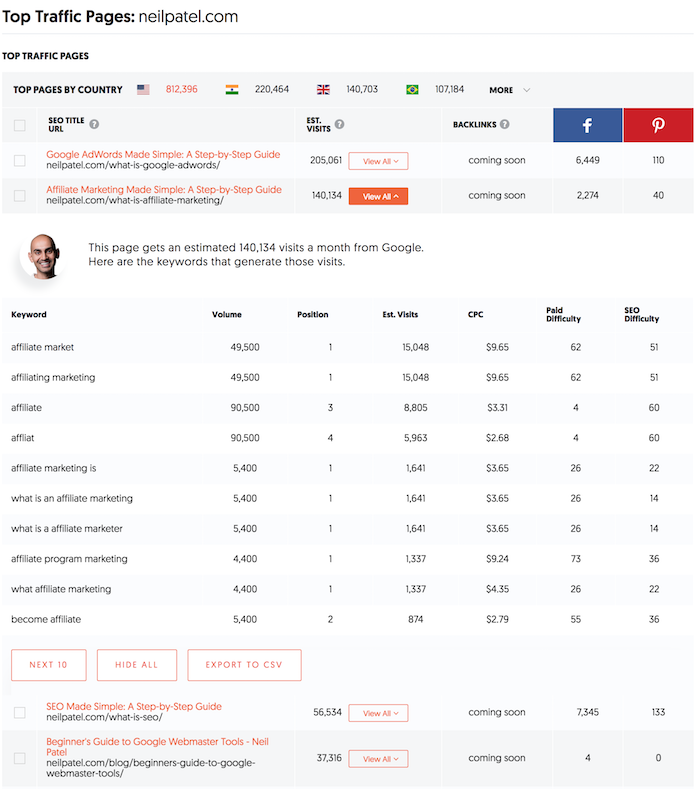
My favorite part about the top SEO pages report is when you click on “view all” you’ll see a list of keywords a page ranks for.

top pages

This one report will not only list out each keyword a webpage ranks for, but the position, estimated visits, cost per click data if you paid for that keyword, and how difficult it would be to rank for it.

What I love about this report is that I can put in a competing URL and see what’s working really well for my competition and then copy them. Or even better, create a more in-depth page than my competition.

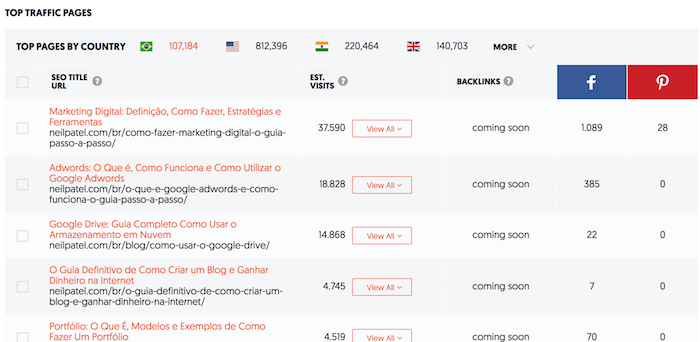
Plus, if you have clients who are global, you can click on the flag at the top and see the top pages for any domain in all of the major countries.

For example, here are my most popular pages in Brazil.

top pages brazil

Top Keywords

The last section in the new Ubersuggest is top keywords.

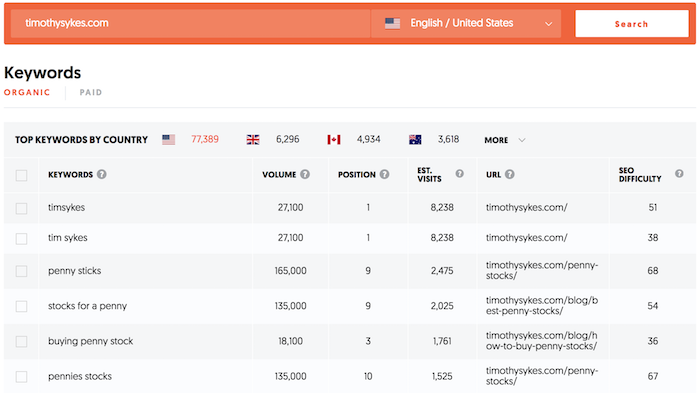
Whether you put in your own domain or competitors, you’ll be able to see all of the organic keywords and paid keywords a site is going after.

organic keywords

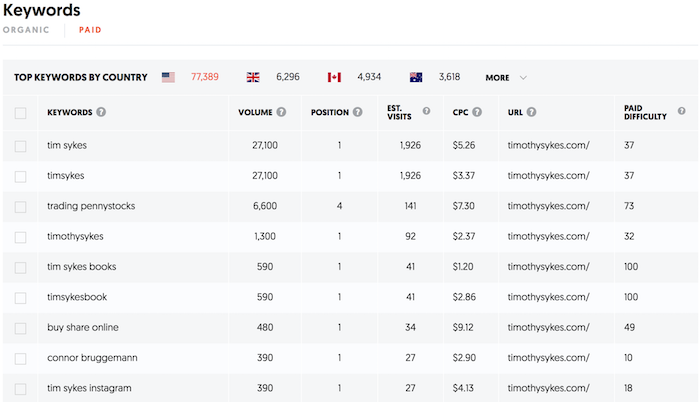
When you click on the “paid” button you’ll see the list of paid keywords as well.

paid keywords

And just like the keyword research reports within Ubersuggest, you’ll have data on URLs, paid difficulty and SEO difficulty.

Conclusion

I hope you enjoy the new version of Ubersuggest. I know there are still some bugs in which the reports don’t load as fast as you want (Top SEO Pages can take up to 20 seconds to load) and you may have to clear your cache to see the new features, but hopefully, you enjoy the updates.

There are also some issues with duplicate keywords and misspellings. The engineering team is continually looking to fix this.

We do know there are many issues with duplicate keywords and misspellings in our Japan database, but we are working on fixing this as soon as possible.

So overall, I know it’s not perfect, but what do you think so far?

And if you haven’t tried it, head over to Ubersuggest and type in a domain.

PS: If you find any bugs, please email carlos@neilpatel.com

The post The Ultimate SEO Tool: Ubersuggest 3.0 appeared first on Neil Patel.


from Blog – Neil Patel http://bit.ly/2MDtSQO
via IFTTT

Monday, 28 January 2019

A Simple Three-Point Checklist for Documenting Your B2B Content Strategy Right Now

On the first day of 2019, I laid out a series of New Year’s resolutions for content marketers. At the top of the list was creating a documented content strategy. Maybe you came across the post. Maybe you nodded your head while reading that particular item and said, “Yup, I’m gonna do that.” But most likely, you still haven’t yet. I’m not trying to be presumptive, just speaking in probabilities: research tells us that documenting a content strategy has been the subject of pervasive and perpetual procrastination across our field for some time. What gives? Why do we keep putting it off? “Usually procrastination happens because the task seems too difficult,” according to psychiatrist A. Chris Heath, MD (via PsyCom). Makes sense, based on my personal experience. In this case, I think the difficulty and complexity seem a lot greater than they actually are. So, B2B content marketers, today I’m going to try and make both the “why” and “how” of this matter as simple and straightforward as possible. We’ll start with the first part.

Why is a Documented B2B Content Strategy So Important?

There are two primary reasons. First of all, neuroscience has found that we are more likely to accomplish our goals if we write them down. According to an article on Forbes last year from Mark Murphy, there are a couple of psychological factors driving this:
  • External storage: When your goals are written down, in a tangible and visible form (whether a physical piece of paper or even a digital document) they are harder to ignore. This is why Post-it Notes exist.
  • Encoding: The actual process of writing something down makes it far more ingrained in our memories. This owes to the generation effect, “a phenomenon where information is better remembered if it is generated from one's own mind rather than simply read.”
So that’s a big part of it. The second component is tangentially related, but has more to do with the collaborative nature of a marketing operation. When you’re trying to keep numerous individuals aligned around the same vision, it’s essential to have a single source of truth that’s accessible to everyone. The above psychological principles come into play from a team aspect — your colleagues will better adhere to a strategy if they can actually see it, and the process of encoding will take place if everyone is collectively involved with documentation — but there are also more basic and practical elements. When your content strategy is documented, you don’t have to re-explain things to people over and over again. You have a central point of reference for various freelancers, contractors, new hires, clients, external business partners, and so forth. It provides a concrete and objective basis for decision-making. You also might spot flaws in your strategy more quickly (for example, an SEO specialist may see something amiss in the documentation and say, “We’ve gotta fix that,” whereas it may have gone unnoticed). Are we all agreed on the value of a documented content strategy? Good. Let’s get one put together.

A Three-Point Checklist for Documenting Your B2B Content Strategy

In the interest of keeping things simple, we’ll flesh this out in high-level fashion. When you cut through all the variables and moving parts, content marketing strategy almost universally nests under three buyer stages: Discovery, Consumption, Action. If our content is going to accomplish anything, it needs to be discovered, it needs to be consumed, and it needs to ultimately drive action (all with the right audiences, of course). Discovery: Who is your target audience and how will they find your content? That first part is arguably the most important in this entire discussion. Who is your audience? What makes them tick? The more specific you can get, the better. When you gain a firm and comprehensive understanding of the people you want to reach — the challenges they’re trying to solve, the questions they’re trying to answer, the channels they tend to use — it can and should guide your entire strategy. This is one foundational area where the documentation process is particularly valuable. Going through the exercise of articulating details about your audience can expose gaps in your knowledge, and force you to challenge existing assumptions. The “Discovery” phase of your content strategy should account for the following:
  • Who is our buying audience?
  • What differentiates the various segments and buyer personas?
  • How can we develop an SEO strategy that aligns with their search behavior?
  • Which channels do they use?
  • Who do they listen to and respect in the industry or niche?
  • What topic clusters or editorial themes will dictate our content direction?
From here, you can build out your editorial plan and start focusing on consumption. Consumption: How and why will people engage and interact with your content? Once you’ve fleshed out a mix of channels and topics that align with your audience, the next step is focusing on engagement. Creating a bunch of content — even if it’s relevant and strategically aligned — won’t do you any good if people aren’t consuming it. Documenting your approach for making this happen will help keep everyone on the same page, while tying consumption to discovery. The “Consumption” phase of your content strategy should account for the following:
  • How will our content stand out from competitors?
  • Are we optimizing on all fronts for mobile users?
  • How will we compel clicks with our headlines, meta descriptions and social messaging?What will be the timing and cadence for publishing?
  • What tools and technology will you use to plan, publish, and track your content?
  • How will you respond and interact to audience engagement? Whose responsibility?
  • Where do organic, paid, and influencers fit in?
With consumption covered, you’re to focus on action. Action: What are your end goals, and how does your tactical mix connect to them? Strategy is defined as “a plan of action or policy designed to achieve a major or overall aim,” so ultimately it all comes down to the outcome. We’ve listed this part last, to keep things chronological, but really you’ll want to start with your objectives and work backward. Your content strategy is a bridge between your purpose/mission statement and your goals. You have to know where you’re going before you can chart a course. The “Action” phase should account for the following:
  • How will we convert our buying audience into customers?
  • How will we build and maintain relationships?
  • What are our key performance indicators (KPIs)?
  • Where do our benchmarks lie?
  • How will success ultimately be judged?
  • What ongoing steps are in place for conversion optimization?
  • How does every piece of the Discovery/Consumption framework above lead into this piece?
Create a steady stream of qualified traffic at the top, engage them through the middle, and drive action at the bottom. That’s a simple strategic content funnel, and as long as it keeps flowing you’ll be in good shape. Documenting strategy helps everyone in your organization rally around the same structure for making it happen.

Write It Down, Ramp It Up

If you can confidently check all three boxes above, you’ve got yourself a fundamental content marketing strategy that is built for success. There are plenty of extensions and additional elements that come into play, but for the sake of simplicity, this should cover your bases. By documenting all of this, creating external storage and encoding it for your team, you’ll be on your way to full focal alignment, minimizing miscommunications and ambiguities that plague many operations. And if you don’t have time to create that documented B2B content strategy at this moment? Make a note to yourself. Don’t underestimate the power of writing something down. Want more resources from our blog to help solidify your content strategy? Check out these past articles:

The post A Simple Three-Point Checklist for Documenting Your B2B Content Strategy Right Now appeared first on Online Marketing Blog - TopRank®.


from Online Marketing Blog – TopRank® http://bit.ly/2HAg7Dr
via IFTTT

Making Sense of Social Media Sponsorships and Partnerships

Just a few years ago, a top brand or company might have talked about “sponsoring” a top social media influencer or thought leader. Now, however, the discussion has shifted away from “sponsorship” towards much more of a collaborative “partnership,” in which there is expected to be much greater alignment and collaboration between the two parties. That might sound like a scary new world for top social media influencers, filled with terms like return on investment (ROI) and key performance indicators (KPIs), but it can also be very liberating.

The changing dimensions of the social media world

So why has the thinking changed? One big reason has to do with the “growing up” of the social media sector. At one time, throwing money at a top blogger or social media influencer was considered par for the course, and nothing much was really expected of the relationship, other than perhaps greater brand visibility and new access to a coveted demographic. But brands didn’t do a lot of thinking about the actual ROI of the sponsorship. In fact, they viewed the sponsorship of a blogger much more along the lines of a charitable donation, where they were really just looking to support a worthy cause and maybe get some positive PR along the way.

But something very dramatic has happened over the past few years – the social media influencer game has become such big business, and so much money is being thrown around these days, that bloggers and thought leaders and social media influencers are actually expected to help drive product, boost sales, or increase total audience in tangible ways. If you’re “sponsoring” a top fashion blogger, for example, you want to make sure that you’re doing more than just giving a lot of free samples away.

The new world of partnerships and collaboration

As a result, the discussion has shifted much more in the “partnership” direction, as brands actively seek out thought leaders and influencers who can help to advance key business priorities. There is expected to be much greater alignment in goals and strategy, as well as much more “give and take” about what steps need to happen next. 

In the past, for example, sponsorships were basically what folks in the biz called “untethered funds” – once a blogger got the funds, he or she could spend it however they wanted. Those days are over, as evidenced by all the negative PR about Instagram influencers that document their lavish lifestyles online without actually producing any real results.

How to win social media partnerships

Going forward, then, it’s important to pay attention to this shifting dynamic. When you approach a company or organization, frame the discussion in terms of a “partnership” rather than a pure-play “sponsorship.” Be prepared to bring facts about the ways that you can help build audience, extend a brand into a new demographic, or create online events that are tied into specific causes near and dear to the sponsor. It might sound like a cheesy cliché, but here it goes: you need to be aiming for a “win-win” situation where both you and the sponsor benefit.

Just remember – it takes time to build up trust and support. It’s no longer just about touting your tens of thousands of followers, or your impressive list of viral hits online – it’s also about showing how your supporters are very similar to those customers a company might be attempting to court, and how your approach and philosophy are a very natural fit for the message or mission of a partnering organization.

Oracle Social Relationship Management (SRM) is the only solution ready to meet your immediate and future social media management needs, enabling your organization to innovate and extend social across your business.​ Learn more here.


from Oracle Blogs | Oracle Marketing Cloud http://bit.ly/2CRn39F
via IFTTT

Saturday, 26 January 2019

Weekend Favs January 26

Weekend Favs January 26 written by John Jantsch read more at Duct Tape Marketing

My weekend blog post routine includes posting links to a handful of tools or great content I ran across during the week.

I don’t go into depth about the finds, but encourage you to check them out if they sound interesting. The photo in the post is a favorite for the week from an online source or one that I took out there on the road.

  • Leadworx – Learn more about anonymous website visitors so that you can turn them into customers.
  • Zendesk Answer Bot – Harness the power of machine learning to answer customers’ questions.
  • 200 Words a Day – Stay on track with generating more content for your website by joining this online writing group.

These are my weekend favs, I would love to hear about some of yours – Tweet me @ducttape


from Duct Tape Marketing http://bit.ly/2MxzpIt
via IFTTT

Friday, 25 January 2019

Digital Marketing News: Buffer’s State of Social Report, LinkedIn’s Interest Targeting, Consumer Trust & Twitter’s Emojis

The post Digital Marketing News: Buffer’s State of Social Report, LinkedIn’s Interest Targeting, Consumer Trust & Twitter’s Emojis appeared first on Online Marketing Blog - TopRank®.


from Online Marketing Blog – TopRank® http://bit.ly/2FWD7u2
via IFTTT

The Top 10 Tactics for the Retail Marketer in 2019: A Video Infographic

A new year means new opportunities for marketers in the retail, ecommerce, CPG, and adjacent spaces. 2019 offers unprecedented potential for brands to connect to customers and improve their bottom lines—if they know where to look.

Last year retail sales made the strongest gains in six years. However, fears of a U.S. recession following a year of healthy consumer spending has retail experts “cautiously optimistic” about 2019. Still, the prospect of a still-healthy economy should translate to a better-than-decent year for many retailers with positive predictions coming in for both online and retail sales.

So, let’s start the year off right.

Even though we don’t yet know exactly what the economy will look like for the 2019 Peak Season, there is still a real opportunity for retail marketers to connect with shoppers and hit their sales goals.

Out with the Old: Marketers Need New Strategies for Success

The opportunity for substantial growth is there, but retail marketers can’t expect to capitalize on it using stale approaches that may have worked in the past but don’t compete with cutting-edge brands today. For example, focusing on positive channel-specific experiences rather than a holistic customer experience just isn’t as effective as it once was.

Instead, marketers must embrace innovative new tools and strategies to create compelling new experiences, engage consumers with highly personalized messages, and transform cold prospects into loyal brand advocates. If they can accomplish these goals, retail marketers will truly stand apart from their competition and position their company to achieve the best results possible.

In with the New: “The Top 10 Tactics for the Retail Marketer”

As retail marketing teams come back from the holidays, energized and focused on the year ahead, what can they do to learn more and implement these new marketing strategies?

A new infographic can help. Oracle Marketing Cloud recently partnered with Liveclicker, a leading provider of real-time email personalization solutions, to produce “The Top 10 Tactics for the Retail Marketer.”

To borrow from the old Buick tagline, this is not your grandfather’s infographic. Instead, it’s completely animated to deliver a highly engaging experience that highlights 10 important ideas any retail marketer can and should implement to hit the ground running and gain a new marketing advantage in 2019.

Deliver a Better Experience

We don’t want to ruin the surprise, but it is worth noting that that the entire infographic focuses on the themes of improving customer engagement and the overall customer experience.

These are objectives we fully support, especially when it comes to retail marketing campaigns. Consumers today are overwhelmed with so many marketing messages, which all usually look and sound the same. They eventually become white noise to consumers, making it challenging for marketing teams to connect with customers in a meaningful way.

Yet like so many other marketing challenges, this situation can become an opportunity. For example, if retail marketing teams can create innovative, engaging email experiences that surprise and delight customers and prospects, they are much more likely to stand out in the crowd of voices and develop an ongoing relationship with the individual consumer.

Interested in learning more? Download and view this new infographic now. It’s one of the best ways to start planning for a more successful - and more profitable - 2019.

Find out more about creating a better customer experience with “Go Further with Customer Experience Optimization.”

Read the guide


from Oracle Blogs | Oracle Marketing Cloud http://bit.ly/2CqJ5ju
via IFTTT