Wednesday, 25 September 2019

Why Every Company Needs to Become a Digital Media Company

Take a good look around you – the walls between editorial and advertising have finally crumbled. In the old analog era, it was very easy to differentiate between “content” and “advertising.” But in the digital era, that’s all changed.

The lines between “content” and “advertising” have now blurred to a point where it’s simply cheaper and more effective for companies to create sponsored content. And as they create more and more content – blogs, videos, podcasts, e-books – they increasingly resemble digital media companies. There are three good reasons why every company now needs to become a digital media company.

#1: You’ll Give Your Customers What They Really Want

Once you start to think like a digital media company, you’ll start to have better insights into what your customers really want. Yes, your customers want to be entertained at times, but they also want to be informed. They want to know how to make their lives better, and they want you to tell them how.

For example, if you’re a restaurant looking to attract new customers, stop blasting out advertising in the forms of coupons, discounts, and promotions. Consumers are going to pass that advertising right by. They are trained to skip over ads and to ignore billboards.

Instead, think of sending out recipes and cooking tips. Create “how-to” videos on how to make a special dish. And think creatively about how to entertain your customers. For example, to celebrate HBO’s “Game of Thrones,” write up a clever story about how to hold a “Westeros Feast.”

#2: You’ll Build Your Audience

A major concern of any media company is building an audience. Media companies publish the types of articles that are designed to win the most readers. Cable TV networks push stories and narratives that are as sensational as possible, in the hopes of winning viewers. And online websites use all kinds of tools – like using fake news headlines – to get people to read an article.

That doesn’t mean that you need to become just like Buzzfeed or adopt all the sensational antics of most print media these days [Lose 24 pounds of fat in 24 hours! Look 30 years younger in just 30 minutes!] But it does mean that you should be thinking in terms of building new audience. If you’re hosting a new podcast, work hard to find guests that people enjoy. If you’re creating a corporate blog, don’t make it boring. If your articles aren’t getting clicks and views, try again.

#3: You’ll Turn Customers into Fans and Followers

At the end of the day, you really want to have your own online community of fans and followers. That makes it so much easier to introduce new products, launch new campaigns, and build buzz about your company. So, why not borrow a page from the digital media company playbook?

Digital media companies spend a lot of time deepening their links with fans and followers. They’ll take a popular writer or broadcaster and create opportunities for fans to interact with them. That might be a live interview, where fans can call or tweet in with questions. Or, it might be something like a Reddit AMA (“Ask Me Anything”). What digital media companies have realized is that fans and followers love getting this inside access. They love meeting this on-air talent. As a brand, you can use this same tactic. Host interviews with your CEO. Let fans meet the people on your team. Use Instagram to offer behind-the-scenes looks at what happens at your company every day.

As you can see, there are several good reasons to think like a digital media company. By doing so, you’ll be able to market your products more effectively and build up a loyal community of passionate fans.


How else should marketers (and CMOs) be utilizing Instagram for marketing success? Learn “5 Instagram Marketing Strategies Every CMO Should Use.”

Read the blog.


from Oracle Blogs | Oracle Marketing Cloud https://ift.tt/2lxuWwn
via IFTTT

Tuesday, 24 September 2019

How to Create a YouTube Channel and Rank Your Videos

How to Create a YouTube Channel and Rank Your Videos written by John Jantsch read more at Duct Tape Marketing

Video is an increasingly important marketing tactic. Consumers today have shorter attention spans and are often consuming content on the go. They don’t always have the time to sit and read through a thousand word blog post; they’d much rather catch a four minute video on the topic while they’re riding the train into work or eating a salad on their lunch break.

It’s a great idea to include video wherever you can: on your website, on your social media, and on the biggest online video platform of them all, YouTube.

If you don’t yet have a YouTube channel for your business, now is the time to make one. Here, I’ll walk you through the steps of creating a YouTube channel and producing videos that consistently rank.

Establishing Your Channel

If you don’t have a YouTube channel yet, the first step is to set one up. To do so, log into YouTube using your Google credentials, and select “Your channel” from the dropdown menu on the upper righthand corner.

You’ll be given the opportunity to create a personal account or create one for your brand.

Because you’re creating this for your brand, you’ll want to establish a Brand Account. This also provides you access to other services like Google Photos using your business name rather than a personal account. Plus, Brand Accounts can be managed by multiple people, so additional team members can update and manage your videos.

Once you’ve created your channel, you need to create a description of your business and add images, like your logo and a background photo. Keep your branding consistent with your other online assets, so that it’s easy for people who know you from elsewhere to recognize this as your official YouTube channel.

You can also create a welcome video, which will play when someone visits the home page of your YouTube channel. This is a great way to introduce visitors to what your business does and give them a preview of the type of content they can expect to find on your channel.

How to Find the Right Video Topics

Once you’ve gotten the building blocks of your channel in place, it’s time to start thinking about the content you’re going to create. It’s important to put together an editorial calendar that will keep you on track and help you produce videos that speaks to your audience’s needs and interests.

Deciding on content areas for your videos should start with keyword research. This is the first step to creating content on your website that will generate leads, so the same principles should apply here.

Start by going to YouTube and searching for a term that makes sense for your industry. Let’s say you run a catering business, and you do a lot of weddings. You might go to YouTube and type in “Wedding catering” and see what autocomplete results pop up.

This shows you what real search terms people are entering into YouTube for videos about catering. It looks like cost-effectiveness is on people’s mind, with “wedding catering on a budget” being the most popular result. But people are also looking for ideas, tips, and help with set up on the day of their event.

Once you’ve undertaken that basic keyword research, you can take things a step further and use a tool like vidIQ to get even more detailed information on each video that ranks for your selected search terms.

Understanding how existing videos rank can help you identify popular topics, find gaps in information that you can fill with your own content, and discover topics you might not have thought of on your own, but that would be relevant to your business.

Create an Editorial Calendar

Now that you’ve settled on the right topics for your YouTube videos, you want to create a calendar for creating and releasing these videos. One of the keys to generating subscribers (which not only draws more attention to your brand, but is also a known ranking factor) is releasing new videos on a regular basis.

That’s why it’s so important to put together a content calendar and to stick to it. It’s often easiest to settle on a batch of topics for the coming months and then set aside a few afternoons or one whole day to film the content back-to-back. You can then edit the videos in batches and have the content backlogged so you’re not worried about finding time to film and edit a new video each and every week.

What to Include in Your Video

Two of the biggest ranking factors for videos are retention rate and subscriber rate. If you create videos that hold viewers’ attention for the whole time, and then they click the subscribe button after watching—that’s like the Holy Grail of YouTube videos.

So what are the keys to creating videos that people want to watch, and that inspire people to subscribe to learn more from you in the future? It’s all about creating useful content and cutting right to the chase.

People don’t have all day to sit and listen to a long preamble on your video. Introduce the topic right up front, by including a clear description in the video title and saying right in the first ten seconds what it is you plan to cover in the video. It helps, too, to include a teaser of the big nugget of useful information that you’ll be saving for the end of the video. You know how, on evening newscasts, they always dangle a super interesting story in front of you before the commercial break so you’ll keep watching? You should do the same in your video if you want to entice people to stick around until the end.

After your brief introduction, get right into it! We’ve all watched those videos on YouTube with lots of detours, personal stories, and long sidebars before they actually get to the meat of the content. And we’ve all stopped watching those videos and gone looking for something more succinct. If you want people to like your content enough to keep watching to the end and subscribe to hear more from you in the future, you’ve got to keep it helpful and brief.

Adding Descriptions and Tags

Much like you would on a blog post, you need the supporting materials around the video itself to be engaging and SEO-friendly. Make sure that the title to your video is descriptive and includes relevant keywords. Write a video description that clearly outlines what viewers can expect to learn if they watch, and include an eye-catching thumbnail of the video.

Select the category that makes the most sense for your video, and include even more detailed keywords in your video tags. Use your top keyword in the tags, along with variations on that theme and other related keywords that are relevant for the video content and your business.

Sharing Your Video

Once you’ve created your first video, spread the word! Share the video on other social media channels where you already have a following. Include it in your weekly newsletter or in a blog post. Getting the word out about your videos to your existing audience can help to build up those initial views so that you can start to gain traction in YouTube rankings.

Once you’ve created more than a handful of videos, you can create playlists on your channel. By grouping relevant videos together, you’ll draw even more attention to your content. If you’re a marketing consultant like me, you might create a playlist around SEO, one around paid search, and one around social media marketing.

A viewer sees a particular topic of interest, like SEO, clicks on the playlist, and all of the videos on SEO are automatically queued up, one after the other. This can give you a huge boost in video views, as people are drawn down the content rabbit hole.

Video has become the preferred way for many consumers to interact with content. And YouTube is the biggest video platform in the world, with billions of videos uploaded each and every day. If you want to provide customers and prospects with useful content, you need to meet them where they are. Establishing a YouTube channel and optimizing your content to rank in search results is yet another way to catch the eye of new prospects and stay top-of-mind with existing customers.


from Duct Tape Marketing https://ift.tt/2kN7pXR
via IFTTT

How I Ranked For 636,363 Keywords Using This Simple Hack

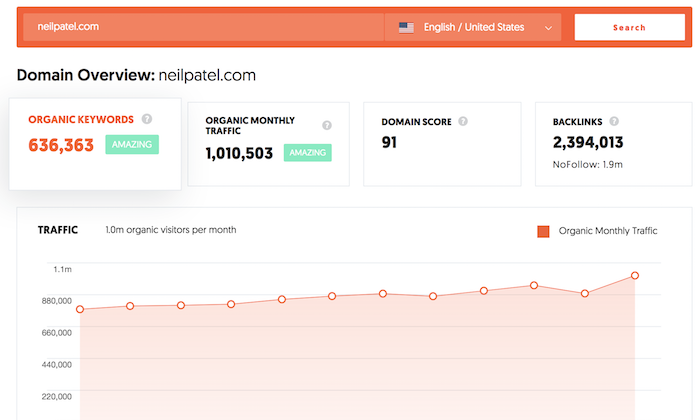
When I started doing SEO on NeilPatel.com I used this advanced formula to rank for 477,000 keywords.

Over time, my traffic started to flatline and I wasn’t ranking for many more keywords, even though I was continually creating more content.

But then I figured out a simple hack that took me from 477,000 keywords to 636,363 keywords as you can see in the image above.

So, what was this hack?

Well, it’s so effective that I just updated Ubersuggest so that includes the hack.

So how did I do it?

When someone does a Google search, what are they typically doing? They are trying to find a solution to their problem, right?

So how can you easily identify these problems people are searching for?

Typically, you want to look for 3 types of keyword phrases:

  1. Questions – people type in questions because they are looking for answers. And if your product or service helps answer those questions, you’ll see a boost in conversions.
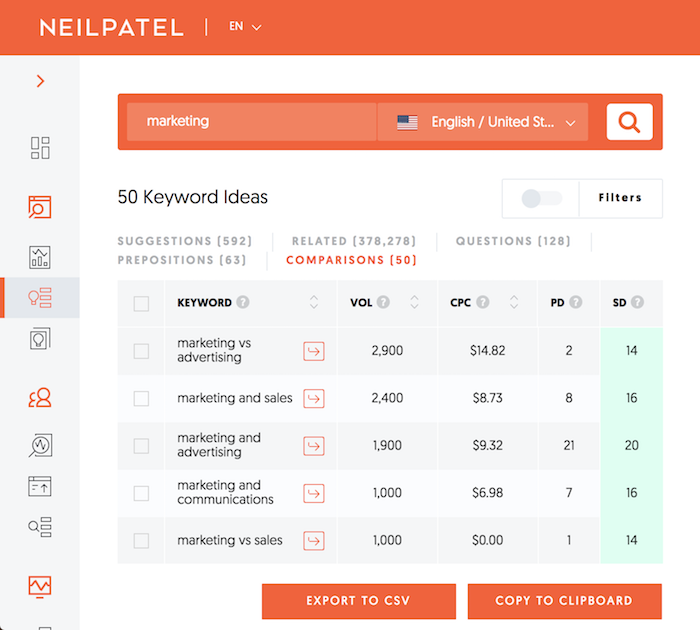
  2. Comparisons – when someone is searching for comparison keywords such as “MailChimp VS Converkit” there is high buyer intent, even if your company isn’t mentioned in the search phase. (I’ll go into how to leverage this in a bit.)
  3. Prepositions – when keywords contain a preposition, they tend to be more descriptive. If you aren’t sure what a preposition is, simple prepositions are words like at, for, in, off, on, over, and under. These common prepositions can be used to describe a location, time, or place.

But how do you find these keywords?

Well, I just updated Ubersuggest to now show you questions, comparisons, and prepositions.

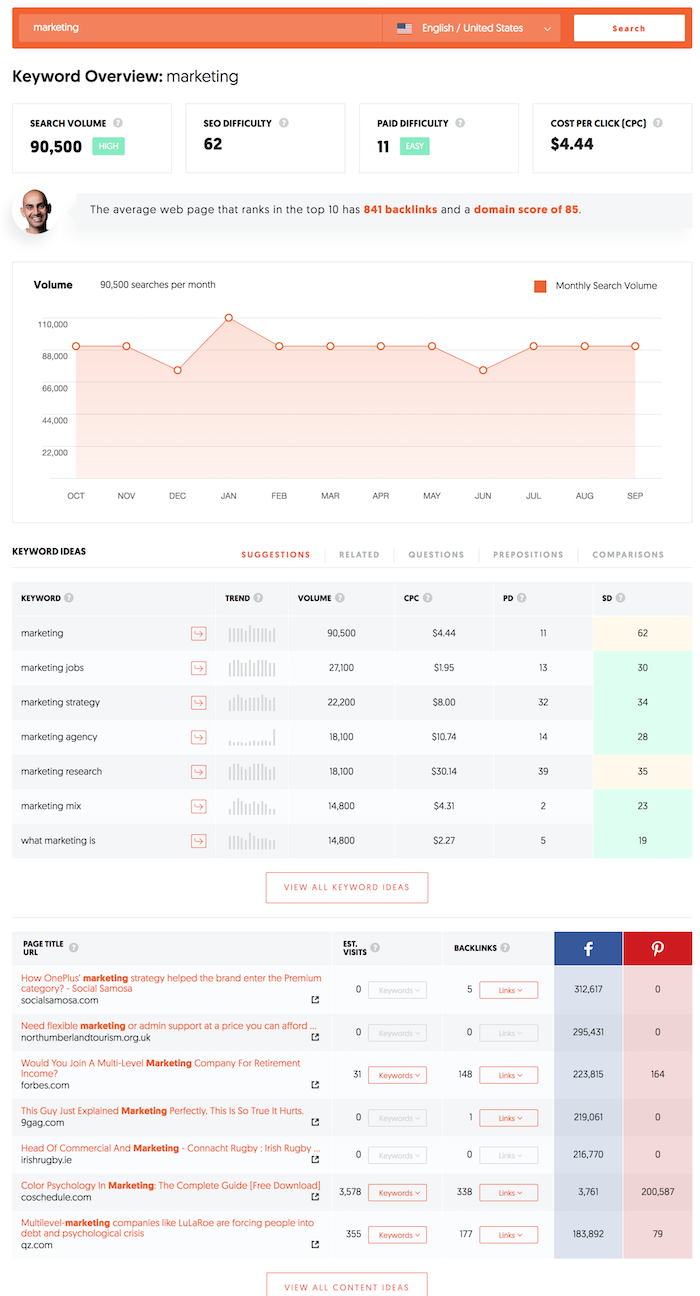
Just head over to Ubersuggest and type in a keyword that you want to go after. For this example, I typed in the word “marketing”.

Then as you scroll down, in the keywords ideas table you’ll see tabs for questions, prepositions, and comparisons.

I want you to click on the “view all keyword ideas”.

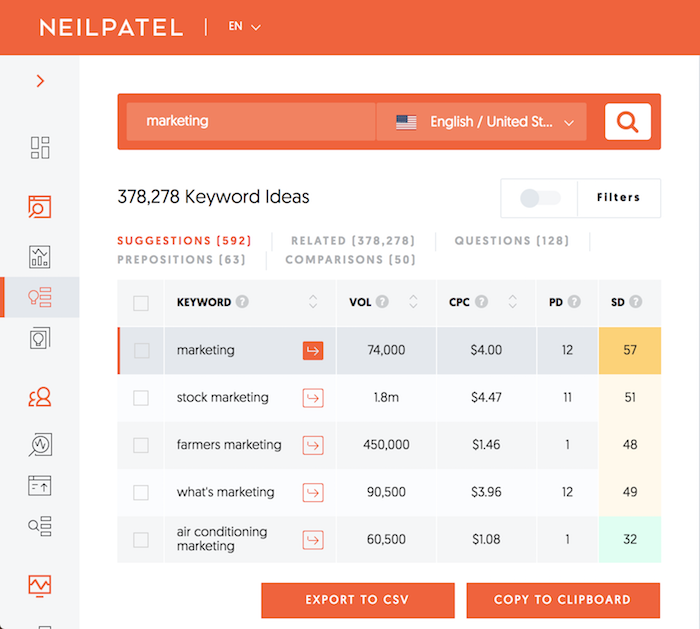
You’ll now be taken to the keyword ideas report that looks like this:

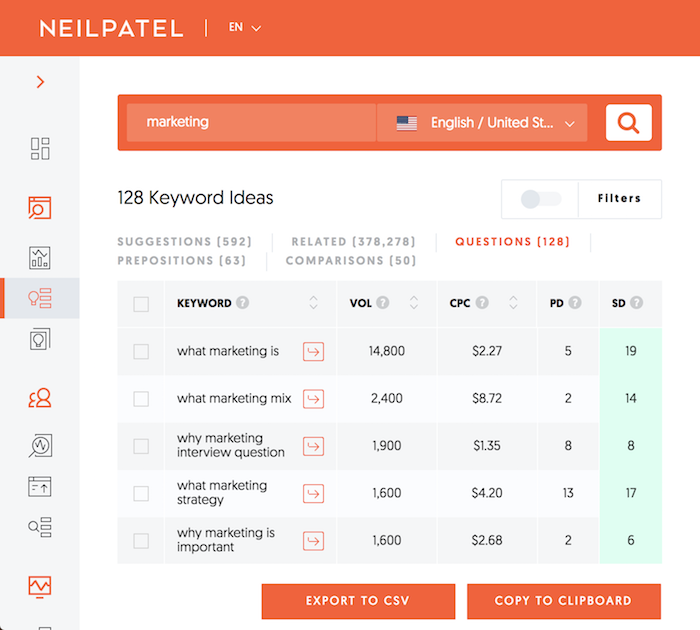
Now, click on the tab labeled “questions”. It will adjust the keyword recommendations to show you all of the popular questions related to the main keyword you just researched.

You’ll then see some suggestions that you could consider going after. Such as:

  • Why is marketing important?
  • What marketing does?
  • How marketing works?

But as you scroll down, you’ll find more specific questions such as:

  • Why a marketing plan is important?
  • How marketing and sales work together?
  • How many marketing emails should you send?

Now that you are able to see these questions people are typing, in theory, you can easily rank for them as most of them have an SEO difficulty score of 20 or so out of a 100 (the higher the number the more competitive it is).

More importantly, though, you can create content around all of those phrases and sell people to your product or service.

For example, if you created an article on “why a marketing plan is important,” you can go into how you also can create a marketing plan. From there you can transition into describing your services on creating a marketing plan and how people can contact you if they want your help or expertise in creating one.

You can do something similar with the “how marketing and sales work together” article in which you can break down how to make each department work together. From there, you can either be an affiliate for software solutions that help merge the two departments like HubSpot or sell your own software if you offer one. You can even pitch your consulting services that help tie sales and marketing together.

And as for the “how many marketing emails should you send,” you can create content around that and have an affiliate link to popular email tools that have high deliverability and offer automation. Or you can promote your own email product.

Now imagine all of the extra keywords you can rank for by going after question-related keywords. What’s amazing about this is most of these keywords are competitive and they have extremely high search intent.

Can it get any better?

Speaking of search intent, I want you to click on the comparisons tab.

You’ll see a list of ideas just like you did with the questions tab. But what I love doing here is typing in a competitor’s brand name here.

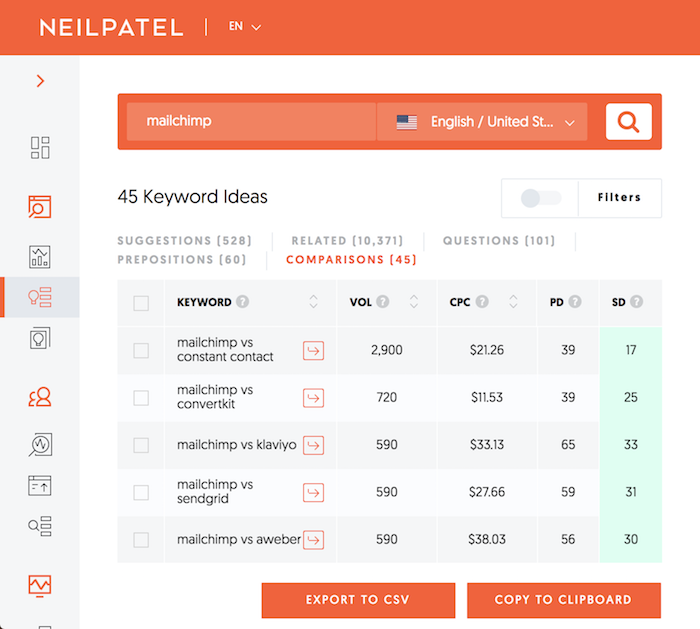
Let’s say I am offering an email marketing tool. I could type in “Mailchimp” and see what comparison ideas Ubersuggest comes up with.

Now for this example, I want you to imagine that you have an email company called Drip and Drip isn’t really mentioned in any of these keyword comparison ideas.

What’ll you want to do is create articles on all of the popular comparison terms like “Mailchimp vs Constant Contact” or “Mailchimp vs Convertkit” and within those articles break down the differences and also compare them with your own tool Drip.

Be honest when writing the comparisons. Show off which is the best solution using facts and data and break down how you are different and in what ways your own solution is better than the two solutions the reader is comparing.

This will bring awareness to your solution and you’ll find that people will start purchasing it even though they were comparing two of your competitors.

If you want a good example of how to create a neutral comparison type of blog post, check out this article comparing web hosts.

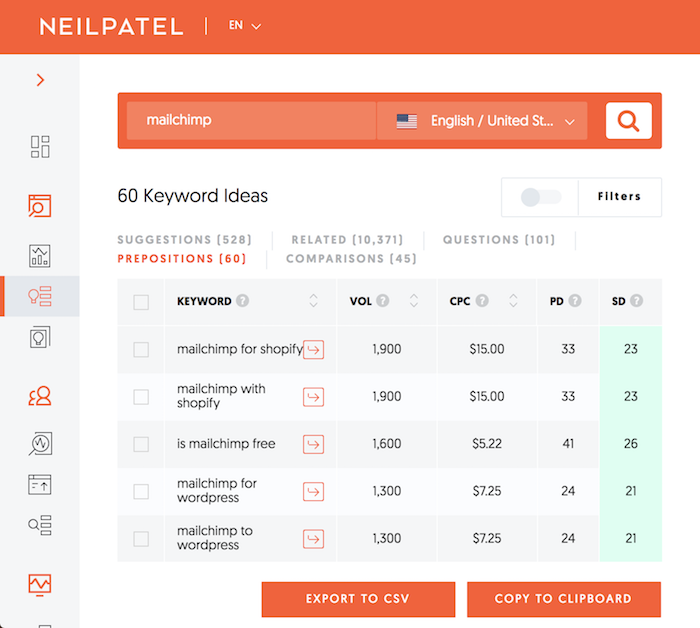
And if you want to take it one step further, you can click on the “prepositions” tab to find even more ideas.

Sticking with the Mailchimp example, you can see that people are curious about Shopify and WordPress integrations.

You can write articles related to integrations and also push your own product and break down how it differs from the others.

If you want to take it one level deeper, it will give you ideas on how to modify your business. For example, if I created an email marketing tool, I would create a Shopify, WordPress, Woocomerce, and Squarespace integration based on the ideas I got from the prepositions tab.

So how did I rank for 636,363 keywords?

I didn’t use all of the examples above on NeilPatel.com because I am not really trying to sell a product and I don’t have the time to write thousands of new blog posts.

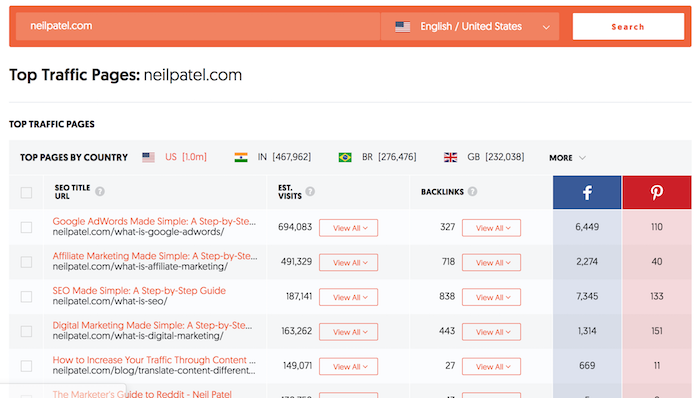
But I did type in my domain name into Ubersuggest and then headed over to the top pages report.

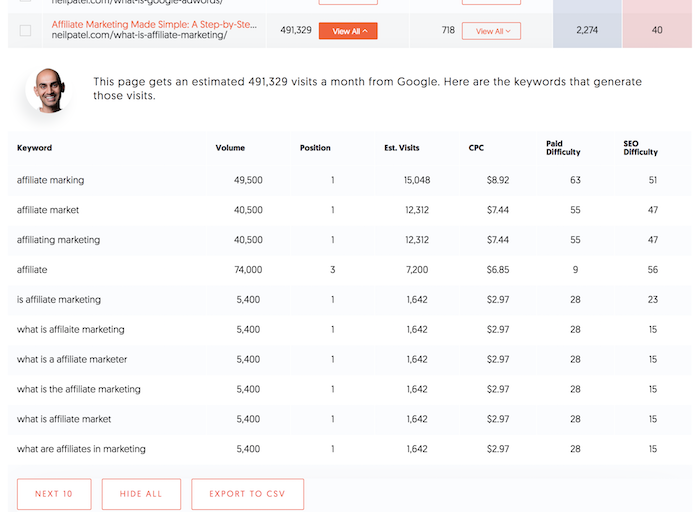
From there I looked at the pages that are already ranking well on Google and clicked on the “view all” button to see the exact keywords each page ranks for.

As you can see from that page I rank for questions like “what is affiliate marketing” as well as popular prepositions and comparisons.

How did I do this?

Well, that top pages report shows you keywords each of your pages already ranks for. So all you have to do is research each of those terms through Ubersuggest and find popular questions, prepositions, and comparisons.

Conclusion

The natural instinct for any SEO or marketer is to rank for popular terms that have a lot of search traffic.

But there is an issue with that strategy. It takes a lot of time, it’s extremely competitive, and many of those search phrases don’t cause a ton of conversions as they are super generic.

So, what should you do instead?

Focus on solving people’s problems. The way you do this is by creating content around the questions, prepositions, and comparisons people are searching for in Google.

What do you think about the new Ubersuggest feature?

The post How I Ranked For 636,363 Keywords Using This Simple Hack appeared first on Neil Patel.


from Blog – Neil Patel https://ift.tt/2lahe2w
via IFTTT

5 Unexpected Content Marketing Benefits of B2B Podcasting

The Content Marketing Benefits of B2B Podcasting

The Content Marketing Benefits of B2B Podcasting We all know by now that podcasting is a fantastic content marketing tactic, right?  To review: 
  • Over 81 million people listen to podcasts (Edison Research)
  • 80% finish the majority of every episode on their favorite podcasts (Edison Research)
  • Most people who listen to one podcast are likely to pick up more (Edison Research)
In other words, there’s an enormous audience out there, ready to spend multiple hours with your quality content. And now they can get your episodes right on the Google results page. So, since you’re ready to start your podcast anyway, how can you use it to elevate the rest of your content marketing efforts? It turns out podcasts can do more for your editorial calendar than just deliver value to your subscribers. At Content Marketing World this year, I saw a presentation from Ryan Estes of Frontline Education about the hidden marketing powers of podcasts. The points he hit on were spot on with how we view the potential of B2B podcasting. So, with a tip of the hat to Mr. Estes and his Field Trip podcast...

B2B Podcasting: 5 Unexpected Content Marketing Benefits

#1: Content Research

Say you’re a marketer who just got hired by a supply chain logistics company. Odds are you don’t yet know how your target audience thinks and talks about supply chain issues. You might not even know what problems supply chain folks are currently looking to solve. You’re good at marketing; you’re not a subject matter expert... yet. Usually, the answer is to fire up your web browser, pull up some industry publications, and do hours of research.  Certainly, some first-hand research is a must, but what if you could deepen your knowledge and create content at the same time? Interviewing industry experts for your new podcast will help you learn the industry, the lingo, the concerns, the potential solutions, you name it. Each interview is a podcast episode and a treasure trove of audience research, all in one.

#2: Prospect & Customer Relations

Planning a B2B podcast means finding subject matter experts — trusted voices who can lend credibility to your podcast and provide riveting content. When you’re looking for these guests, include prospects and customers in your search.  For prospects, the podcast interview can be a great way to start a conversation. Which is more compelling:
  1. Let’s book a half hour so we can talk about our supply chain solution?
  2. I would love to get your industry expertise in an interview for our podcast.
The second one is clearly the easier (and more value-driven) ask.  Inviting customers on your podcast can help deepen that business relationship, too. But it also provides proof to your prospects that you support and promote your customers — something that will come in handy for the next deal.

#3: Influencer Relations

We may have mentioned this before: Co-creating content with influencers results in better content an a wider audience to receive it. Podcasts are no exception. In fact, the basic interview format that is a perfect fit for podcasts is also the perfect way to engage industry influencers. We have found that people are amenable to an audio interview who would never, say, contribute a guest post to your blog. It’s easier to say 2,000 words than to type them out. Simply put, a podcast gives influencers another option — a fun and creative one — for co-creating content. [bctt tweet="Simply put, a podcast gives influencers another option — a fun and creative one — for co-creating content. @NiteWrites #B2BPodcasting #ContentMarketing" username="toprank"]

#4: Repurposing Possibilities

Think of a podcast as you would any other marketing content: When you’re producing it, you can plan for endless content repurposing. That doesn’t mean just using the transcript in a blog post, though you should do that, too. You can pull quotes for an eBook, do a roundup with highlights from every episode, even add video to portions of the audio for organic social or YouTube. Here's a recent example from SAP*. Following the release of Season 1 of its Tech Unknown Podcast, original and previously unreleased content was brought together for a tales from the trenches eBook. My favorite repurposing tip, though, comes from Ryan’s session: When he does a podcast interview with a Frontline Education customer, the first half of the interview is customer-focused. There’s no talk about the education software Ryan’s company sells, no testimonial, just the customer’s story about finding and solving a problem. That part is what goes into the podcast. The second half of the interview is explicitly focused on how the customer used the software to solve a problem. Ryan then repurposes that audio into case studies, using embedded audio excerpts to emphasize the customer quotes. It’s a powerful way to get a podcast episode and a case study in one go.

#5: Podcast Cross-Promotion

We know that people who listen to one podcast are likely to listen to more. That makes podcasts unique among marketing channels: Other podcasts aren’t your competition. Your ideal potential listener is the one who makes podcast listening a habit, who is looking for the sixth or seventh show to round out their weekly listening. As such, having a podcast gives you the opportunity to cross-promote with other podcast hosts. Look for podcasts where your host might make a knowledgeable, valuable guest. And look for podcasts hosts who might bring value to your show. The ability to expand and cross-pollinate audiences is one of the cooler aspects of the whole podcast community. Read: How to Promote Your B2B Podcast

Cast Your Pods to the Wind

A podcast in and of itself is a great channel for bringing valuable content to your audience. But the benefits don’t stop there. From filling out your editorial calendar to spicing up your case studies and beyond, a podcast can elevate your B2B content marketing efforts across your entire strategy. Guess what? There happens to be an on-demand webinar covering the art of B2B podcasting, featuring moi and TopRank Marketing President Susan Misukanis: The 4 P's of B2B Podcasting Success. Check it out! *Disclosure: SAP is a TopRank Marketing client.

The post 5 Unexpected Content Marketing Benefits of B2B Podcasting appeared first on Online Marketing Blog - TopRank®.


from Online Marketing Blog – TopRank® https://ift.tt/2mlnUea
via IFTTT

Email Marketing Isn’t Owned Media—It’s Granted Media

Email marketing has an unfortunate reputation as being owned media. It’s unfortunate because it doesn’t align marketers with their subscribers and inbox providers, who are the true owners of email. And that results in strategies and tactics that invariably end up hurting their email programs and their businesses.

Some of you might be thinking, Wait, but we own our list. We spent a lot of time and money collecting those email addresses.

It’s true that brands have ownership over the email addresses they’ve collected. They can use them to identify customers and prospects across channels, and even sell them to other companies (which we highly discourage). But, beyond owning them as an identifier, brands don’t own email addresses because they don’t own the relationship that makes up the vast majority of each address’s worth.

In my book Email Marketing Rules (3rd Ed.), I say, “Lists are owned only to the extent that someone can own a collection of nonbinding handshake agreements.” Subscribers can nullify most of the value of a brand knowing their email address by withdrawing their permission—either by unsubscribing, reporting the sender’s emails as spam, or simply by ignoring the sender’s emails for a while, at which point their inbox provider will start junking or blocking their emails to the individual.

Permission is where the vast majority of email’s value comes from, and no one can own or sell someone’s permission. Period.

You might concede that point, but be thinking, But for those people who have given me permission, I own that right to reach them via email so long as I maintain their permission.

Unfortunately, that’s not completely true because of inbox providers. In exercising their right to protect their users, inbox providers routinely junk and block emails from senders both on an individual level and global level. So, the emails you send to your very happy, very engaged subscribers could be completely blocked because of how your other subscribers are reacting to your emails.

You not only need to maintain permission with individuals, but stay in good standing with the community of users at each inbox provider. And that’s in addition to staying in the good graces of blacklist operators

Okay, you might be thinking, permission is critical. But just like I can’t force people to give me permission to email them, I can’t force people to come to my website or store either and I definitely own those. So, how is email not owned like I own my website or store?

There are definitely some parallels, but the comparison breaks down pretty quickly. The biggest thing is that people are in complete control as to when they visit your website or store. If they don’t want to go, then they don’t go and that’s the end of the story.

Email doesn’t work that way, especially in the US where opt-out is still the law of the land and many brands only follow the law rather than best practice. If you’re a customer, you can expect to get transactional emails, some of which stretch the definition of being essential to an ongoing business relationship. Oftentimes, especially in the US, being a customer means that you’re automatically opted in to receive marketing emails. Sometimes those marketing emails come from multiple lists, and brands don’t always make it clear or easy to unsubscribe from all of those lists.

Getting away from permission for minute, let’s talk just about engaged subscribers, people who absolutely want to hear from you via email. Imagine that every time you opened your web browser, the websites to your favorite stores routinely popped up, even if you weren’t in the mood to shop.

Wait a minute. That’s an unfair analogy because they gave us permission, remember? They said it was okay to contact them.

Let’s be honest: Most brands don’t do a great job of telling people at signup how many emails they’re going to receive. To be fair, that’s in part because it can and should change. It’s also rare for brands to give subscribers the ability to change the frequency at which they receive emails. 

Yes, some brands, including many Oracle Marketing Cloud Consulting clients, wisely alter email frequency on a per-subscriber basis depending on RFM modeling and email engagement levels, including significantly lowering email frequency for inactive subscribers. However, most brands don’t yet take those actions.

Email frequency is a tricky issue, for sure. My point here is that email marketing has additional rules of engagement that your website and store don’t simply because of the fact that email is largely a push channel, whereas your website and store are purely pull channels. 

Alright, you might admit, but I still own my email creative. I design and code my emails just like I design and code my website. Again, I definitely own my website, so I own at least that element of email as well.

That’s not totally true either. First, subscribers can block images in your emails, hampering your ability to convey your message, especially if you’re promoting a lifestyle or physical products.

Yes, but I know that’s a possibility, which is why I code my emails so they’re able to communicate effectively when images aren’t enabled, using alt text for my images and HTML text wherever possible. 

Excellent. You should totally do that. However, a second point is that there are no rendering standards for email, unlike with web development. Code support is different across all the various email clients. For example, instead of supporting CSS- and HTML-based email interactivity, Gmail supports AMP for Email. That’s just one high profile example of the patchwork that is email rendering.

While this creates a messy design and development environment, it’s not insurmountable. The bigger issue is that it’s always in flux, and inbox providers have historically done a really poor job of notifying the email community that they’re changing the code that they support—which is to say, they generally don’t bother to let us know.

If you’re previewing your emails before sending them, rendering changes are unlikely to catch you totally by surprise. However, as more brands get an ever-increasing percentage of their email marketing revenue—in some cases, the majority of it—through automated email campaigns, this chaotic rendering environment can mean scrambling to update a lot of triggered emails all of a sudden. Rendering changes is certainly one reason to always be optimizing your automated emails and never setting and forgetting them.

Okay, you might say, if email marketing isn’t owned media, then what is it?

The root of the misconception here is that email marketing doesn’t fit into the traditional paid-owned-earned (POE) media model. That model is outdated. In fact, social media doesn’t fit into that model either. The model needs to be expanded to include leased media to account for social media, and granted media to account for email marketing, as well as a few other marketing channels that don’t fit in the POE media model. 

Adding leased and granted media to the mix gives you the more accurate and comprehensive POGLE media model, which I discuss in Email Marketing Rules and map out in the chart below.


What are the key characteristics that distinguish granted media from owned media?

While owned media is content created by the brand that’s distributed to an audience developed by the brand via a closed platform controlled by the brand, granted media is content created by the brand that’s distributed to an audience developed by the brand via an open platform that’s regulated and controlled by multiple third parties.

The other three media types are also unique in terms of who creates the content, who developed the audience it’s being distributed to, and who controls the platform through which it’s distributed, as you can see below. 


In the case of email, the third parties that control the distribution platform are inbox providers like Google, Microsoft, Apple, and Verizon Media Group. They’re the reason why deliverability is inconsistent across inboxes and why rendering is, too.

While that can be a serious pain, it comes with major benefits as well. For instance, because no one company has total control over email inboxes,…

  • Email’s core functionality hasn’t changed radically over the years, providing stability to email marketing strategies and investments.
  • The changes that have occurred—and there have been plenty of significant ones—tend to evolve slowly, starting at one inbox provider and then becoming adopted at others, a process that typically gives brands plenty of time to adjust.
  • Email accounts can be accessed on a variety of devices, from computers and smartphones to smartwatches and voice-assistants.
  • New consumer email accounts can be created for free.
  • Sending emails is free for consumers and inexpensive for commercial senders compared to other marketing channels.

So, the next time you’re cursing your rendering or deliverability issues and are hesitant to invest in the training or consulting needed to fix them, remember that these problems are the cost we pay as an industry for email being an inexpensive open platform. The closed platforms of leased and paid media don’t have these issues, but they’re subject to instability (i.e., R.I.P. MySpace), huge business model shifts (i.e., Facebook’s organic engagement decline), and their costs are high (i.e., all paid media).

Geez, you might be thinking, while I wish email marketing acted more like owned media, I’m super glad it’s not leased or paid media. Email marketing is tough sometimes, but it’s also ubiquitous, embraced by consumers, powerful, and highly profitable. I wouldn’t change it for the world.

Me neither.

—————

Need help with your email rendering or email deliverability? Oracle Marketing Cloud Consulting has more than 500 of the leading marketing minds ready to help you to achieve more with the leading marketing cloud, including coding and QA specialists and email deliverability experts.

Learn more →


from Oracle Blogs | Oracle Marketing Cloud https://ift.tt/2kIvQpo
via IFTTT

Monday, 23 September 2019

What’s Missing In Your B2B Marketing Strategy? 5 Key Elements You Don’t Want to Overlook

A car engine without a water pump. A baseball team without a shortstop. A guitar without a D string. All it takes is one missing piece to prevent something from working as it should. Your B2B marketing strategy might excel in certain areas, but a single overlooked element can cause results to stall out.  I’m not talking about tactics here, because those can vary on a case-by-case basis. But there are specific considerations and focal points that ought to exist in pretty much every marketing strategy, and if we fail to account for them we are doing ourselves a disservice. This isn’t a matter of covering bases or checking boxes. This is about thinking through your marketing approach holistically to set it up for sustainable growth. If any of the following aspects are amiss for your team at a strategic level, I highly recommend addressing them.

Common Gaps in a Modern B2B Marketing Strategy

#1 - You Don’t Have a Sophisticated Content Promotion Plan

I came across two different blog posts in the past couple weeks highlighting common mistakes in content marketing – one from Social Media Today, another from Business 2 Community – and they both mentioned this in some form. There’s a good reason for that: Way too many marketers out there are narrowly focused on content creation, with promotion of said content lagging behind as a distant afterthought.  When we say that a simple checklist doesn’t suffice, this is a prime example. If you want to make a real impact, it’s simply not enough to blast the same blurb and link across all social channels, every time, and call it a day. Your promotion plans should be built in from the beginning. It should align with the purpose and goals of the specific content in question. And it shouldn’t fall into the cyclical trap of sameness that eventually causes audiences to tune out. There are plenty of creative ways to prop up content and get people’s attention. I really love the assortment of creative promotional tactics shared by our Lane Ellis earlier this year. If you’re feeling limited in ways to gain exposure, TopRank Marketing CEO Lee Odden’s mega-list of 50 content promotion tactics is an essential read. Pick the ones that jibe with what you’re creating, and who you hope to reach.

#2 - You’re Not Getting Maximum Mileage from Your Content

An excellent piece of content deserves more than one fleeting opportunity to be consumed. Yes, promotion is important to maximizing your investment in creation, but so is the extensibility of your creations. Repurposing is a concept that tends to be overly simplified – there ought to be more to it than just republishing a blog post six months later, or turning your podcast episode into a readable transcript. [bctt tweet="An excellent piece of content deserves more than one fleeting opportunity to be consumed. @NickNelsonMN" username="toprank"] Like promotion, repurposing should be wired into your planning from the get-go. When you conceive a content idea you think will hit home with your audience, think about the different ways you can package and present it. More formats equates to more ways for people to find and experience it. Staggered rollout equates to more opportunities for getting noticed over time. It’s important to remember that not every eventual hit is an immediate winner. Read: A Tasty, Strategic Content Marketing Table: ‘Repurposed Content Cobbler’

#3 - You’re Not Focusing on User Intent

Back in the day, SEO was about talking to machines. Now, it’s about talking to humans. Finding high-volume keywords and optimizing for them or bidding for them is not a straightforward recipe for driving results. We should be thinking not just about what people are searching for, but why they’re searching for it.  As Google’s algorithm grows more advanced, rankings are increasingly reflective of searcher motivation as opposed to technical signals. It’s not uncommon that I’ll search for a phrase, and the exact wording won’t appear in any of the headlines or descriptions on the first page. But the results are still relevant, because the engine is elevating results that similar searches have found useful in the past.  I firmly believe that intent should be at the heart of any marketing strategy. It is vital not only to SEO, but also operational efficiency and customer-centricity. Using data, audience research, and intuition, we need to be analytical and predictive about the intent behind each search, each click, each engagement. [bctt tweet="I firmly believe that intent should be at the heart of any marketing strategy. It is vital not only to SEO, but also operational efficiency and customer-centricity. @NickNelsonMN" username="toprank"] In her recent “Soapbox” contribution for Search Engine Land, Fractl’s marketing director Amanda Milligan argues that intent should be every marketer’s No. 1 obsession. “Without it, it’s like serving someone steak when they ordered a cheeseburger. Sure, steak is great, but it’s not what they wanted.”  Even metrics are evolving accordingly. For example, Aberdeen’s Olivia Lipkin recently wrote about a new form of lead: the Intent Qualified Opportunity (IQO). Read: The Key to SEO & Content Marketing Success: Understanding Search Intent

#4 - You’re Not Optimizing

Lee’s 2012 book Optimize! offered a simple premise: Everything is optimizable. The word has long been closely associated with trying to rank in searches (especially around that time), but it’s a practice that should be the lifeblood of any marketing unit seeking reliable growth and results. Our CEO doesn’t just preach optimization, he lives it. In his book he wrote about how he once considered himself a timid and under-equipped public speaker, but he worked systematically at improving his skills. Now he travels the world delivering major keynotes. He also applied this mindset to his diet and exercise routine, and lost 65 pounds in one year as a result. At its core, optimizing is a pretty basic and uncomplicated endeavor. It’s about experimenting with different things, measuring how audiences respond to them, then proceeding with an emphasis on what’s working and a de-emphasis on what is not. You can apply this to almost every component of your strategy. Don’t stop at A/B testing ads.

#5 - You’re Not Thinking Your Goals and Measurement Through

The term KPI has started to bug me lately. Not because of what it is, but what it often seems to represent: static and inflexible goal-setting. By definition, Key Performance Indicators are vital to ongoing measurement and optimization, but it’s a mistake to get too caught up in one single metric or to use it as a blanket across campaigns and initiatives. Goals should always be laid out from the start, and they should always be tailored to what you’re trying to achieve with any given initiative. For example, I rather like the way LinkedIn’s* revamped interface for advertisers promotes this type of process; called objective-based advertising, the new experience compels users to select an objective and desired outcome from the outset, then places them at the center of campaign creation.

Eliminate Holes to Make Your Strategy Whole

If your marketing strategy isn’t quite yielding the results you desire, the fix might be relatively minor. In many cases it’s just one or two missing or insufficient elements that greatly affect overall performance, like absent cogs in a clock’s gearwork.  Taking a step back and looking at the totality of your strategy – especially in terms of how the five functions above are working in unison – can make all the difference. Sometimes, it helps to gain an outside perspective or expert diagnostic (I happen to know of one agency that specializes in such assessments).   Don’t let unaddressed holes diminish your whole marketing strategy. Once you’re hitting every necessary note, you’ll know it by the harmonious result. Another key aspect of a B2B marketing strategy? Documenting it! If you’re wondering where to start, check out our three-point checklist. * Disclosure: LinkedIn is a client of TopRank Marketing.

The post What’s Missing In Your B2B Marketing Strategy? 5 Key Elements You Don’t Want to Overlook appeared first on Online Marketing Blog - TopRank®.


from Online Marketing Blog – TopRank® https://ift.tt/2kAdA1y
via IFTTT

Effective Marketing Operations & Enablement: How to Facilitate Understanding of the Tools ...

In the digital era, marketing success demands that teams stay up to date on the latest technologies and tools and take the fullest advantage of them when planning and executing their campaigns. However, marketers need to understand the tools they use in order to unlock their greatest potential and achieve stronger results.

What is the best way to go about this?

Relationship One had BlackRock’s John Pavlick on the Inspired Marketing Podcast to ask him just that question. Pavlick is BlackRock’s VP Oracle Eloqua Platform Manager. He has over 10 years of experience implementing and optimizing global email marketing campaigns. As a certified Oracle Eloqua Luminary, he specializes in messaging and delivery for retail financial advisors, institutional investors, and personal investors. He has also gained a great deal of expertise and insight into marketing automation, demand generation, and lead scoring as a lead for Oracle Eloqua training sessions with hundreds of regional marketers.

As a part of his role at BlackRock, Pavlick ensures his team is aware of the marketing tools available to them and that they know how to properly use them. To aid in this, he streamlined the marketing ops team to better integrate them into the organization and build a strong foundation for marketing processes.

Facilitating Understanding

Pavlick views his main responsibility as managing Oracle Eloqua and ensuring the platform is set up for success across the organization. This means he has to help users understand the power of the platform and how it can help them optimize campaigns. He strives to help marketers gain an understanding of how to leverage all the tools Oracle Eloqua has to offer in a way that is simple and seamless to execute.

Essentially, he facilitates understanding of Oracle Eloqua and other martech tools for his organization. To help with this, he oversees:

  • New hires attending MarTech One-on-One Discussions, wherein all the platform owners at BlackRock walk everyone through what exactly is available on their platforms for them to use

  • Marketers who have been at the organization for a while staying up to date and understanding what is changing on the platforms they use, specifically which new features and capabilities have become available and when they can start using them

He emphasizes “Demos, Not Decks,” meaning that you shouldn’t just tell people what they can do on any platform. You have to go onto the platform yourself and demonstrate as simply as you can how they can use the platform.

For example, during the one-on-one discussions, he’ll sit down and explain the email component for Oracle Eloqua, so that new users understand that it’s more than just email. They can also make forms to help profile clients and use them to create landing pages and microsites that have more engaging experiences in line with client interests and preferences.

Getting Ahead of the Curve

Pavlick has developed a unique way for the marketing ops team to work with marketers at BlackRock. The primary responsibility for marketers is to quickly, easily, and efficiently build their emails inside Oracle Eloqua. The marketing ops team works alongside them on a day-to-day basis to bring everything else to life: campaign canvases, forms, landing pages, reporting, and more.

He currently has a marketing ops team of 20. The team is divided into three parts:

  • Orchestration

  • Segmentation and data

  • Development (which includes landing pages, forms, and templates)

Additionally, the team enforces governance across the Oracle Eloqua platform to ensure:

  • Guidelines are being followed

  • Templates are being properly used

  • Data is being stored in the right way

That way, when marketers need to execute, everything is ordered, organized, and in place for them. Marketing ops also help any marketers who want to become more involved at the operational level, so that there is a specialized team within the marketing team that can lend a hand in ops if needed. To that end, marketing ops can work with marketers in developing a combination of different skills through  one-on-one discussions and getting them the B2B Master certification through Oracle Education.  

The goal with this set-up is to be as nimble as possible and to:

  • Reduce back and forth and get communications out with more speed

  • Empower different groups in marketing to working together to be more compliant and optimized

  • Ensure everyone has the guidance needed to get ahead of the curve in understanding the platform and what new features will be coming out and how to utilize them

The Process Is the Hardest Part

Getting the process of how marketing and marketing ops can work together right is the hardest part, Pavlick believes. Once you have it down, it becomes easy to scale capabilities that maybe weren’t being utilized to their fullest extent before (such as dynamic content and personalization).  Also, you can better reap the benefits of your new set-up, such as:

  • More easily sharing projects, ideas, content, and recommendations across different marketing groups

  • Identifying themes and needs across the organization that need to be discussed and could be resolved using Oracle Eloqua

With a strong foundation now put into place for marketing processes across the organization, Pavlick is eying the future and looking at:

  • What other channels to engage audiences with beyond just email

  • Working with a customer data platform to improve segmentation and use better data sources with Oracle Eloqua

It all starts with everybody being on board with having a strong foundational knowledge of Oracle Eloqua to better aid them in their day-to-day marketing abilities.


 Learn “Five Keys to Successful Automated Marketing” to see how Oracle Eloqua can give you a competitive edge.

Find out more.


from Oracle Blogs | Oracle Marketing Cloud https://ift.tt/2IhzZJs
via IFTTT