Tuesday, 26 May 2020

GDPR vs CCPA: Social Listening and Sentiment Learnings

The consumer privacy landscape has changed dramatically over the past few years. First, the General Data Protection Regulation (GDPR) went into effect in 2018, giving European Union citizens more privacy rights and limiting businesses’ ability to collect, share, and sell consumer data without permission. Then, the California Consumer Privacy Act (CCPA) was passed that same year and was enacted on January 1, 2020. When the law goes into enforcement on July 1, 2020 it will affect all companies doing business with Californians.

We were curious about how businesses and consumers were adapting to these laws and how their attitudes about privacy laws in general might be changing, especially since more privacy laws are on the horizon. To get a partial picture of how people reacted to both GDPR and CCPA, Oracle CX Marketing Consulting’s Social Media Strategy & Analytics Services team used social listening to check the reaction on social media. We compared social media mentions of GDPR to that for CCPA during key time periods, looking for similarities and differences in what people were saying about the laws.

While some of our findings weren’t shocking, others were definitely a surprise:

Businesses dominated social media mentions during pre-enactment periods of GDPR and CCPA.

The months and final days leading up to the enactment of both GDPR and CCPA were dominated with news, speculation, and industry preparedness mentions related to businesses. Consumer chatter was almost nonexistent during the leadup and only picked up after enactment, which is when the law started to affect them directly. 

Social media activity was highest around the time of enactment.

Chatter about GDPR and CCPA reached its peak around the time of enactment. For example, the volume of mentions about GDPR one year after enactment was down from this peak by approximately 12x.

Consumer social media commentary spiked after enactment.

Our social listening found that consumers had very little to say on social media about GDPR until they started receiving a slew of email notifications on the subject. After enactment a large portion of the conversations came from people complaining about all the emails showing up in their inbox—particularly from brands they felt they hadn’t interacted with in a long time. Consumers were annoyed and didn’t understand or care that these notifications were legally mandated by GDPR.

Negative sentiment around GDPR was highest at the time of enactment.

While you might think it was because of businesses despairing on Twitter about how to become compliant, it was actually because those frustrated consumers were getting inundated with GDPR notification emails. Also, some consumers shared their frustration with GDPR updates causing apps to fail.

Those two issues caused negative sentiment to increase by 3x the day after GDPR’s enactment.

Privacy wasn’t the thing that consumers commented about most with GDPR.

One of the bigger questions we wanted to explore through social listening was if there were concerns about privacy laws. While we found that there were some, they appeared to take a back seat to other items, such as the annoyance with the GDPR email notifications. 

 In addition, some people tested sites and shared how much faster sites loaded after GDPR, since much of the web tracking that businesses did on their sites is now illegal. All of the tracking processes used had the effect of dramatically slowing down site load times. So, while GDPR was born out of privacy concerns, what consumers noticed and commented on was the vast improvement in the user experience and the decrease of intrusions.

Consumers wished that all countries would adopt GDPR.

In another sign that consumers viewed GDPR positively, the improvement in website load times and other changes had a lot of people hoping that other countries would follow suit and remove back-end tracking. Some hoped that GDPR would push the industry to adopt the guidelines globally instead of doing things one way for the EU and another way for everyone else. Then, consumers believe, everyone would be on the same playing field.

CCPA received a lot less attention on social media and lower negative sentiment, too.

GDPR was a huge, disruptive change that affected every company in Europe and every global company. Following two years later in the wake of GDPR, CCPA was clearly seen as far less disruptive. In fact, global companies based in the US needed to do very little to comply with CCPA.

Because of this, our social listening found that CCPA mention volume on the date it was enacted was approximately 73x lower than what was generated when GDPR was enacted on May 25, 2018. In addition to lower volume, CCPA captured lower negative sentiment than GDPR during that same time period.

Consumer reaction to CCPA on social media focused on how they could increase the privacy of their accounts.

When CCPA was enacted, consumers didn’t comment much on the privacy notification emails—likely a sign that businesses had tightened up their audiences after seeing how people were irritated to get GDPR notifications from brands they hadn’t interacted with in years. 

Instead, the social media conversation was largely around how to exercise their new privacy rights, with people frustrated with companies either not complying with CCPA or not making it easy for people to exercise their rights. For example, on day one of enactment, some consumers posted asking if others had found the “do not sell my data” buttons on businesses’ websites because none could be found. There were also complaints about error messages received when trying to use CCPA functionality.

Our social listening also found that people were discussing how CCPA would impact the rest of the US, as well as the steps that other states and the federal government are taking to improve privacy protections. People applauded some companies like Mozilla for providing CCPA protections to all Americans, not just those in California.

Fines don’t get much attention.

The first GDPR fine—which was a record £183 million fine against British Airways for a 2018 data breach that affected 500,000 customers—didn’t generate much social media activity. Compared to activity pre-enactment, at the time of enactment, and at the one-year anniversary, the first GDPR fine generated the lowest mention volume of all four time periods analyzed.


We anticipate that CCPA will follow the same pattern. The State of California has said that it won’t bring enforcements against companies until July 1, giving businesses extra time to get into compliance. However, the first class-action CCPA suit has been filed, with Salesforce and Hanna Andersson in the cross-hairs. So, the first CCPA fine may be on the horizon.

Based on our social listening, we think that consumers are increasingly expecting more control over their privacy and that businesses are having less anxiety about complying with new privacy regulations. That’s good news, because more states will undoubtedly be passing privacy legislation, which will ultimately result in new federal legislation to create a national standard to ease the burden of compliance.

 —————

Need help with social media listening and analytics? Oracle Marketing Cloud Consulting has more than 500 of the leading marketing minds ready to help you to achieve more with the leading marketing cloud, including a Social Media Analytics & Strategy Services practice.

Learn more or reach out to us at CXMconsulting_ww@oracle.com.

For more information about trends that impact social media marketing, check out the Modern Marketing Blog’s latest posts concerning social.


from Oracle Blogs | Oracle Marketing Cloud https://ift.tt/36zKC5y
via IFTTT

The Small Business Guide to Podcasting

The Small Business Guide to Podcasting written by John Jantsch read more at Duct Tape Marketing

The term podcasting has become mainstream these days and interest in this medium is on the rise and, rightfully so. Not only is it convenient for listeners who want topics that they’re interested in on-demand, but it’s also valuable for the person or business hosting them.

Below find seven great reasons every business should consider starting a podcast

Getting started is easier than it looks

The secret’s out, podcasting really isn’t that difficult to get started. People often assume that podcasts require a lot of fancy equipment and a large investment, and while you certainly can get to that point, you definitely don’t have to start there.

As long as you have a microphone that works, a way to record a conversation with guests (if you have guests), and a way to share the content with your audience, you’re really all set. Here’s a simple set-up that covers what you need.

  • Microphone USB Mic such as a Blue Yetti
  • Recording – You can use Squadcast, Skype or Zoom
  • Editing – Garage Band or Audacity
  • Hosting – Libsyn or Blubrry
  • Publishing – Podcast on WordPress using Blubrry Plugin
  • Distribution – iTunes/Apple, Spotify, Google Podcast, Stitcher, TuneIn

You can repurpose episodes into other forms of content

Since podcasting is audio-based, repurposing the material into other forms of content, such as video, a blog post or a series of blog posts, is a great way to create content without reinventing the wheel. Additionally, it helps to further expand your reach because part of your audience may not be podcast listeners, but they may be blog readers, and vice versa.

Rev.com is a great transcription service.

Podcasting is great for networking and building referrals

Reaching out to others to have them as a guest on your show is a great way to build your network and will also give you more chances to be asked to be a guest on other podcasts, furthering your connections even more. The more people you can connect with, the more you’ll increase the chances of referrals, leading to more opportunities and business for your company.

Along with networking and building referrals, podcasting can expand your public speaking skills as well which can lead to in-person speaking events (a great way to establish authority and credibility in your field).

It establishes an emotional connection with your audience

The format of a podcast allows you to develop a deeper relationship with your audience. You’re not hiding behind words on a page. Hearing your voice on a frequent basis makes your audience feel like they actually know you, and the more likely you are to establish an emotional connection with them, the more likely they’ll be to follow your brand and buy from you.

You can make money from it

Not all podcasters want or need to monetize, but if you are interested in making money from your show, there are a number of ways to do that, including:

  • Sponsorships
  • Affiliate marketing
  • Product promotion (be careful with how you go about this, your podcast should be entertaining and educational, not “salesy” if you want it to truly be effective)

You can increase traffic to your website

The audio portion of your podcast can drive traffic to your website simply because it helps to build your credibility and authority on your topic which often makes your audience want to visit your website to learn more. Another way this boosts site traffic is that podcasts often come with show notes (at least they should) that people can review for resources and an outline of the show. If people are on your site reviewing the show notes, or even the episode transcript, they’ll be more likely to visit other areas of your site, which will increase the odds of them converting to customers.

Another way podcasts boost site traffic is that they often come with show notes (at least they should) that people can review for resources and an outline of the show. If people are already on your site reviewing the show notes, or even the episode transcript, they’ll be more likely to visit other areas of your site, which will increase the odds of them converting to customers.

Podcasting is a type of long-form content that people actually pay attention to

Hate to say it, but our attention spans are fading. We live in a world of information overload where we only have the time to consume small bits of information at a time. With podcasts however, you can consume them at times when other forms of content are unavailable (hopefully you’re not reading a blog post while driving to work in the morning). Whereas with a podcast, you can sit in traffic for an hour and consume valuable information. Since people are engaged with podcasts for longer periods of time than other content, this gives you opportunities to showcase your knowledge and expertise in a way that you’re unable to with other formats.

Podcast Guesting is a Killer Marketing Tactic

So far we’ve focused on creating your own podcast but there are many benefits associated with being a guest of someone else’s podcast.

There’s no denying that interest in podcasting has increased over time, especially within the last 5-6 years. I think this is for a couple of reasons:

  • Content has become the air that drives so many channels
  • It’s portable and allows for multi-tasking nature of it

The combination of the two has allowed the popularity of this medium to skyrocket, both from listening and production standpoints.

While I think producing a podcast is a great idea and can provide many benefits for your business, there are also a plethora of opportunities that are there in podcasting for any business owner, namely through being a guest on another person’s podcast. Let’s dive in.

Guest interviews

Putting yourself out there as a guest on podcasts (as opposed to traditional PR with radio and TV) is one of the best things you can do for your business these days, but let me be clear, in order to be successful with it,  you must put yourself out there and pitch yourself on an ongoing basis, and truly build this as a channel for your marketing efforts.

A podcast interview is not only content, it’s great quality content. It’s a tremendous way for you to build expertise, authority, and branding for you and your business. When people hear your voice, it adds a deeper level to building trust, and the more a person trusts you, the more likely they’ll be to buy from you.

SEO and the benefits of podcasting

My friend, Phil Singleton, is one of the most knowledgeable people on SEO that I know, and he recently stated (over this past weekend, in fact) that of all the time he has spent on SEO, podcasting may be the best SEO tactic to give you the biggest bang for your buck. Being a podcast guest provides the following benefits:

  • Gives you access to an engaged audience
  • The host does the majority of the work
  • You have virtually no preparation (especially in comparison to guest blog posts)
  • High production value will make the content more shareable
  • There will likely be show notes that will drive links back to your website
  • Reviews can help build authority and credibility
  • There is a ton of repurposing potential with the content

At the end of the day, SEO really comes down to three main things:

  • Keywords– You must know what keywords your ideal client is searching for
  • Content– You must build those keywords into your content on a consistent basis
  • Links– That content must be seen and shared by other people by acquiring links from other sites to link to that content. From that, Google surmises that it’s good content.

If you focus on those few things over time, you will show up, and likely rank highly, in search engine rankings. What this means, is that a guest appearance on a podcast is your content on steroids. You get high-quality content and awareness to the podcaster’s audience (podcasts get shared more than blog posts).

Guest blog posts are a lot of work and time-consuming. Even if a podcast doesn’t have a huge following, it will likely still have more engagement than blog posts and have the ability to get more shares than regular blog posts and you will get links back to whatever it is that you’re promoting.

To make this even better, a lot of podcasters, including myself, are also creating transcripts along with their podcast episodes to have the written word content go along with the spoken content. In many cases, if you appear on a podcast, and they don’t transcribe it, many podcasters will let you transcribe it and repurpose it for additional content on your site; again, which will help to boost your SEO.

How to get on shows

Remember, this is a consistent process, not just something you do every once in a while, so it’s important that you allocate time and attention to this. Below are a few ways you can approach getting on podcasts.

Google search

Google is great at showing podcasts. Start by searching with an industry you’re interested in and google “[industry] podcast” and see what appears. Simple enough, right?

iTunes

iTunes not only categorizes podcasts, they include related searches like Google as well.

Amazon

If you click on an author link, Amazon will show related authors, which can help expand your search.

From your research, build a spreadsheet of hosts you want to reach out to. Most podcasts have some form of contact information or a form asking people to pitch themselves as a guest.

Once your spreadsheet is filled out, one of the things I’d spend time on is to think of your objective for being on a show. Make the podcast host understand the value they’ll get by interviewing you.

From a content and link objective perspective, don’t worry about how big the show is or the size of the audience. Focus on the links and content and make sure they align with your objective.

In almost all cases, you need to go out and pitch people. I can’t emphasize this enough if you listen and subscribe to their show and know the host’s listeners, what they talk about, and how they deliver value, you’ll do a much better job of showing how you’ll benefit their listeners in your pitch.

These days, podcasters are looking for guests to have one-sheets that include your bio, why you’re a good fit, what you have to offer, places you’ve appeared, what others have said about you, and so on. If a podcaster is trying to decide between you and another guest, the one-pager can go a long way. The more professional you’ll look, the better your odds are of getting chosen for the show.

How to be a great guest

Your work isn’t done once you book the podcast. In order to be a great guest and get the most value out of this exposure, you really need to prep for it.

Subscribe and listen

If you want to be on a show, subscribe to it, or at least listen to it and really educate yourself on the host’s style and type of questions he/she may ask.

Don’t sell

The purpose of the interview is to educate or entertain the host’s audience. You may have the opportunity at the end of the episode to say where people can find you and so on, but nothing will turn an interview sour faster than selling.

Answer questions succinctly

A minute to 90 seconds is often too long for a response. Prepping will help you be clear and concise in your delivery.

Sound quality

Nothing is more frustrating than listening to a podcast with poor sound quality. Before you hop on the interview, confirm you have a solid internet connection or cell reception, and take the call in a quiet space to try to eliminate any extra background noise.

Show appreciation for the opportunity

Once you’re on the call, remember to thank the host for having you on the show and express your appreciation. Once the show is complete, be sure to leave a review for the podcast on iTunes.

How to promote your interview

After the show, most podcast hosts will send you a link to promote the show, and may even send you proposed copy for social media posts. Sharing and promoting your appearance makes a lot of sense. It helps spread the word and it’s good content that people may want to share. Look for multiple ways to promote it to your network.

After everything is said and done, ask your host for a review and use it in your marketing to boost your authority. If you own a local business, have them do the review through Google. Think of this as an opportunity to produce content and get amazing links and put your SEO on steroids.

One of the best ways to get the interest of podcast hosts is to let them know you’ll be a great promotional partner as well as a great guest.

Below is a checklist of potential promotional activities once you’ve been a podcast guest.

  • Add it to Your Next Webinar
    • Do you host webinars? If so, why not make a highlight of your next one a chance to hear your recent podcast interview?
  • Email Newsletter
    • When someone signs up to receive your email newsletter you can include photos, teaser videos, quotes and Click To Tweets from the actual interview in your emails.
  • On Your Blog
    • Highlight the event with a blog post. You can include episode show notes, as well as the embedded video or audio from the interview. You can even repurpose your podcast interview into a long-form blog and then embed the audio of it at the end of the post.
  • Social Channels
    • Please post links to the podcast, videos, graphics, quotes, and photos. Facebook Live, Instagram Stories, and Snapchat are all great for real-time engagement. Also, Facebook, Instagram Images, and LinkedIn offer the perfect platforms for promoting evergreen content.
  • Retargeting and Paid Advertising
    • Paid advertising on social media can also be effective. With Facebook especially, you can create ads that are hyper-targeted for the ideal persona that will find value in your interview.
  • Email Signatures
    • The average person sent 34 business emails daily. Now think about if you have advertised your podcast interview in each one of these. That gives you the opportunity to reach even more people.


from Duct Tape Marketing https://ift.tt/3goh6nv
via IFTTT

How to Create Segmented User Experiences

How to Create Segmented User Experiences written by John Jantsch read more at Duct Tape Marketing

Your business doesn’t serve a homogenous customer base. Unless you’re an incredibly niche service, it’s likely that you have at least a handful of types of people who benefit from your products or services.

Because these types of customers are different from each other, they won’t all be won by the same kind of messaging. That’s why it’s helpful to create unique user experiences on your website that speak to each segment of your overall customer population.

Here’s what you must do to create a more personalized, segmented user experience for your website.

Create Target Market Personas

First thing’s first: You need to figure out what the segments of your larger customer population are. There are a number of ways to break an audience down into distinct buyer personas, and it starts with data. This might be data from your CRM, email service provider, website, or social media analytics.

Start looking for demographic and behavioral trends. Are there certain age groups, genders, or people from specific locations that do business with you? If you’re a B2B company, are there industries you work with often, or are your point-people in a particular department, or do they hold a specific job title?

Behavioral trends can help, too. Are there certain pages on your website that nearly everyone visits before they become a customer? Is there a particular email campaign that drives a lot of prospects to set up a sales call and eventually convert?

Finally, take a look at how these demographic and behavioral data points overlap. Is there a specific age group that responds well to a certain section of your website? Does your social media page generate a lot of interest from people in a particular geographic area?

If possible, it’s also a good idea to conduct some interviews with your existing customers. Hearing straight from the source about what problems your client solves and why they chose your client over their competitor can help you hone in on some of the other elements of the customer personas.

Once you’ve gathered all of your information, you can create your composite sketch of each type of their ideal customers: Who they are, what they need, and what they expect from you.

Allow for Self-Identification

Now that you understand who these different segments of your audience are, you can begin to create different messaging and experiences for them on your website.

The easiest way to ensure that each customer ends up on the path that’s intended for their persona is to allow them to self-select into the appropriate segment on your website. Websites do this all the time to great effect. Let’s say you own an architecture firm, and you handle both residential and commercial projects. On the homepage for the website, build a splash page with two separate buttons—one for those interested in each type of project.

Each button will take the visitor to a separate homepage for that specific audience, with a navigation bar that speaks to their needs (i.e. those who click on residential will see the portfolio for homes the architect has designed, and informational content about the process of undertaking home renovations).

Design Unique Landing Pages

I’ve already covered one instance in which unique landing pages can work on your website to speak to different audiences. This is also an effective tactic when you’re driving traffic from ads to your website.

Take, for example, a paid search campaign. Let’s stick with the architectural firm example and say that within your commercial work, you have two distinct personas: You work regularly with private schools and non-profit organizations. You design a Google Ads campaign targeted at private school leaders and board members. When they click the ad, rather than taking them to the generic landing page for commercial projects, why not create a landing page specifically about your work with other schools?

This customized landing page is effective in immediately addressing the pain points of your distinct persona. That board member of the private school might be somewhat interested in your work for other types of commercial properties, but when they see right off the bat that your architect has designed beautiful spaces that address the specific needs of a client in private education, that prospect feels an immediate connection to your work. They feel seen and understood, and you begin to immediately build trust.

Select Channels Based on Audience

Once you’ve captured the attention of each segment with an effective strategy to get them onto your website, continue to dazzle them with content that speaks specifically to their needs.

Of course, you want the meat of the content to be relevant to the audience. That means topics that matter, filled with advice and helpful information, rather than sales pitch after sales pitch.

But in addition to considering what you’re going to cover in your content, you want to think about how you’re sharing it. Typically when people think of content, they think blog posts, but there’s so much more to it than that: Podcasts, explainer videos, webinars, infographics, and ebooks—there’s a wide variety of ways to reach your audience.

For example, did you know that video, while a popular medium with all consumers, is even more effective with Baby Boomers? It might surprise you to learn that they watch 10 percent more videos on YouTube than Millennials. Meanwhile, Millennials and Gen Zers outpace Boomers and older generations when it comes to podcast listening.

So while you want to be providing a variety of content to each of the segments of your audience—because no one wants to be greeted with the same content format over and over again—think about ways you can lean into certain types of content for specific personas.

Invest in Hub Pages

Hub pages do a lot of good in organizing content on your websites. In addition to giving you great SEO juice and breathing new life into old content, it can also establish thought leadership in specific areas that are important to your different personas.

Let’s return to the architect example. If you know that your commercial clients are mainly in the private education and non-profit worlds, it makes sense to build hub pages around those two areas. One hub page can be specifically for that private school audience and include content that speaks to topics like fundraising and budgeting for major capital improvements, planning your construction around the school year, and designing a modern education building that speaks to what today’s parents are looking for.

Different segments of your audiences will have different needs and expectations when it comes to what they’re hoping to get from your business. By identifying these different buyer personas and creating specific customer journeys for various groups, you get a better chance at directly addressing pain points, building trust quickly and efficiently, and moving new prospects towards the sale even faster.


from Duct Tape Marketing https://ift.tt/3gmfzhP
via IFTTT

How to Create Your Referral Engine

How to Create Your Referral Engine written by Jenna Jantsch read more at Duct Tape Marketing

Marketing Podcast with John Jantsch

Today I want to talk about what is probably the highest pay off marketing activity right now. Obviously there is a lot going on in the world today. I find that a lot of people are looking around trying to figure out what they can do marketing-wise. Obviously a lot of businesses are being displaced. With the massive change businesses are feeling it is also being experienced by customers. Long time customers are being disconnected from longtime providers. Customers are being forced into changing their purchase behaviors, how they research, think, and buy.

This can be leveraged as a huge opportunity. Many companies are still looking at how to remake themselves. But I’m suggesting it is the time to look inward. To seek referrals from existing customers and strategic partners as the primary lead generation initiative. Listen to find out how to do this.

Tips discussed during the podcast:

  1. Highest payoff marketing activity right now is referrals
  2. How to ask your existing customers for referrals
  3. Referrals can benefit both your business and customers
  4. Some people may need what you do so reach out to them
  5. Talk to other businesses to strategize and find ways to help each other
  6. Make partnering up with other businesses successful and bring something of value to the table

Like this show? Click on over and give us a review on iTunes, please!


Klaviyo logoThis episode of the Duct Tape Marketing Podcast is brought to you by Klaviyo. If you’re looking to grow your business there is only one way: by building real, quality customer relationships. That’s where Klaviyo comes in.

Klaviyo helps you build meaningful relationships by listening and understanding cues from your customers, allowing you to easily turn that information into valuable marketing messages.

Want to learn more? Head to Klaviyo.com/ducttape to schedule a demo.


from Duct Tape Marketing https://ift.tt/2X2UaTh
via IFTTT

Ubersuggest Chrome Extension

Please note: Once you install the extension all you have to do is go to Google and perform a search. That is where you’ll see data.

It’s been a long time coming. And now, it is finally here.

Today, I want to introduce you to the Ubersuggest Chrome Extension.

From being in the SEO industry for over 21 years now, I know that it would be more convenient to do your SEO research while you are browsing the web or searching Google than constantly having to come back to Ubersuggest.

That’s why I created this Chrome extension.

So, what’s inside the Chrome extension?

Well, the easiest way to know what’s included (it’s free), is to just go and install it and test it out.

But here’s what’s included…

Keyword overview

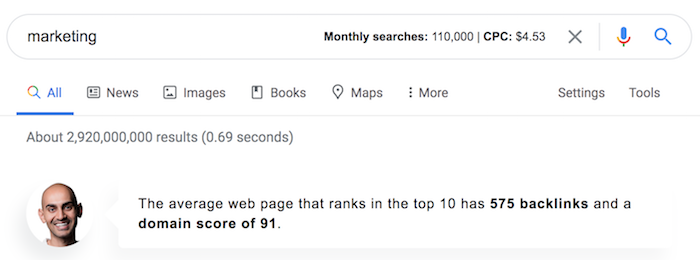
When you are searching Google, you’ll see an overview within the search bar.

You’ll see the monthly search volume and the cost per click for that keyword.

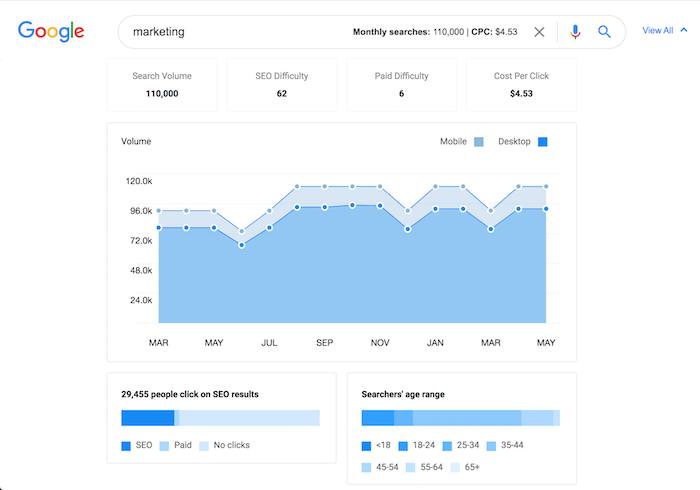
When you click the “view all” link, you’ll see a detailed overview for that keyword.

The graph breaks down the total monthly search volume. What’s cool about the chart is that it shows you both the monthly mobile searches and desktop searches.

And above the graph, you’ll get metrics on how hard that keyword is to rank for (SEO Difficulty) and how competitive that keyword is from a paid advertising (Paid Difficulty) standpoint.

Under the graph, you’ll also see 2 bar graphs. The first one breaks down whether or not people are clicking on the SEO results, paid results, or not clicking anywhere at all.

The second one shows data on the age range of all of the searchers.

Link overview

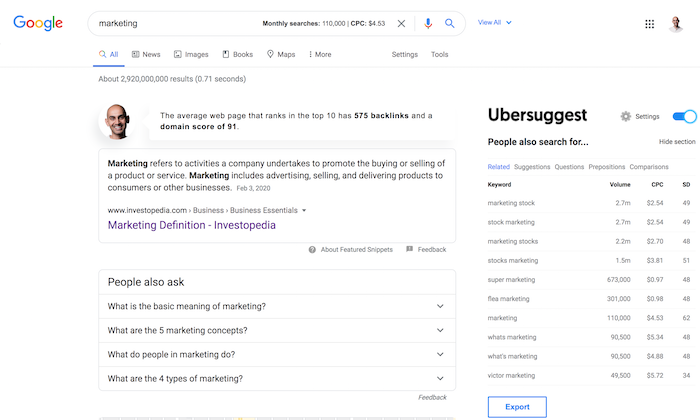
Above the organic results, you’ll see a speech bubble that breaks the average authority of the sites that are ranking (domain score) and the average number of referring domains the top 10 results have (backlinks).

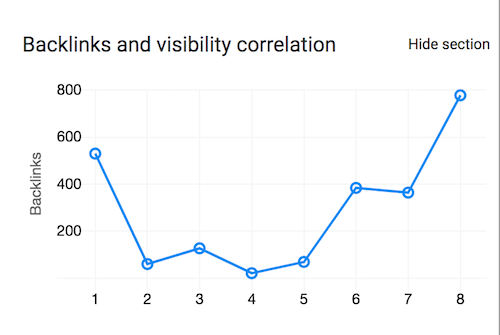
If you want a more detailed overview, you’ll see a graph in the sidebar that breaks down how many referring links each of the top 10 listings have.

Keep in mind the link metrics are based on referring domains. So, if a website has 100 links from the same domain name, it will only count as 1. Because what really matters when it comes to SEO is how many unique, relevant sites you can get to link to you as opposed to having the same site linking to you over and over again.

Even more keyword data

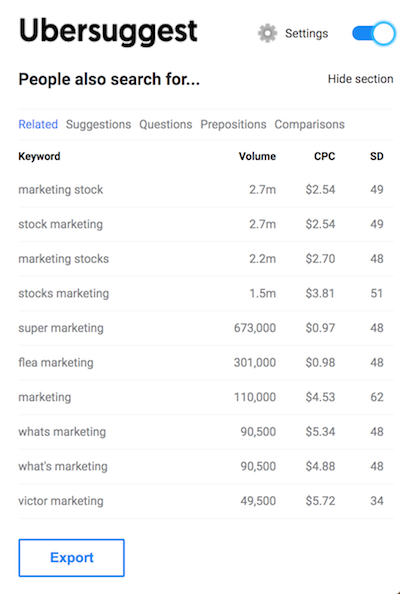
In the sidebar, you’ll also find even more keyword data.

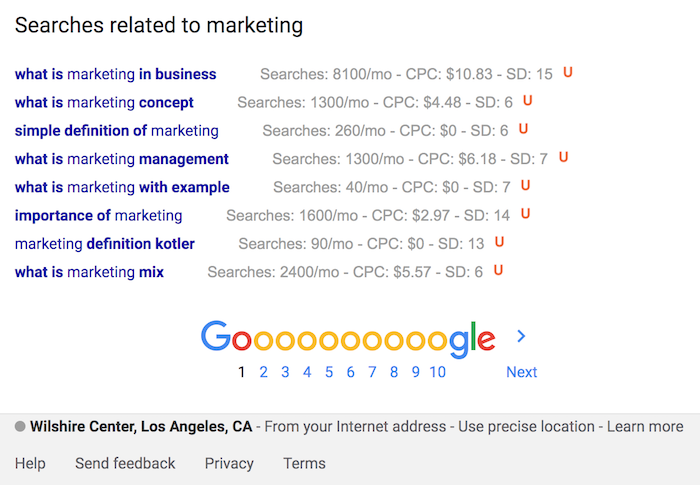
You’ll see a list of other popular keywords that are similar. You’ll also get metrics on each keyword… from how often it is searched (volume), to what it would cost to bid on that keyword (CPC), to how difficult the keyword is from an SEO standpoint (SD).

And if you scroll to the very bottom of the screen, you’ll see a list of related keywords that Google provides.

Again, you’ll be provided with data like search volume, cost per click, and SEO difficulty data.

URL metrics

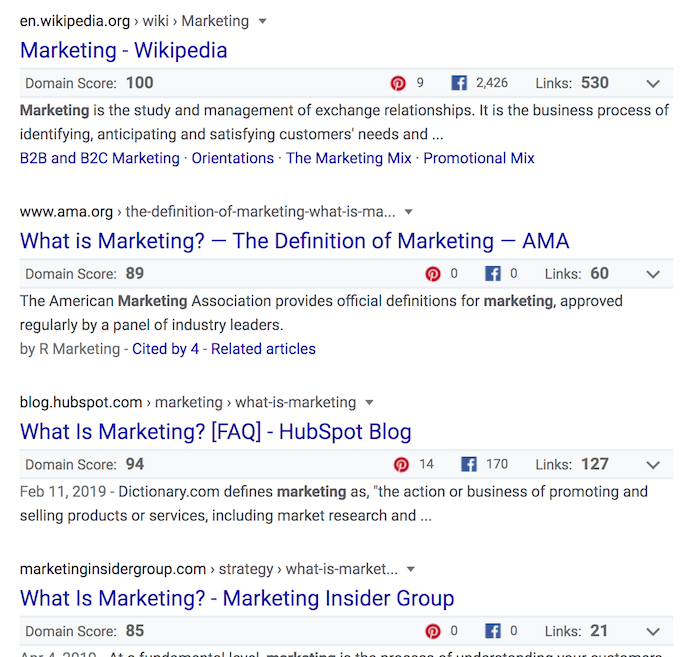
Whenever you perform a search on Google, you, of course, see a list of websites that rank for that keyword.

As you can see, under URL you see the authority of the website (domain score), how many Pinterest and Facebook shares the URL has, and how many unique domains are linking to that result.

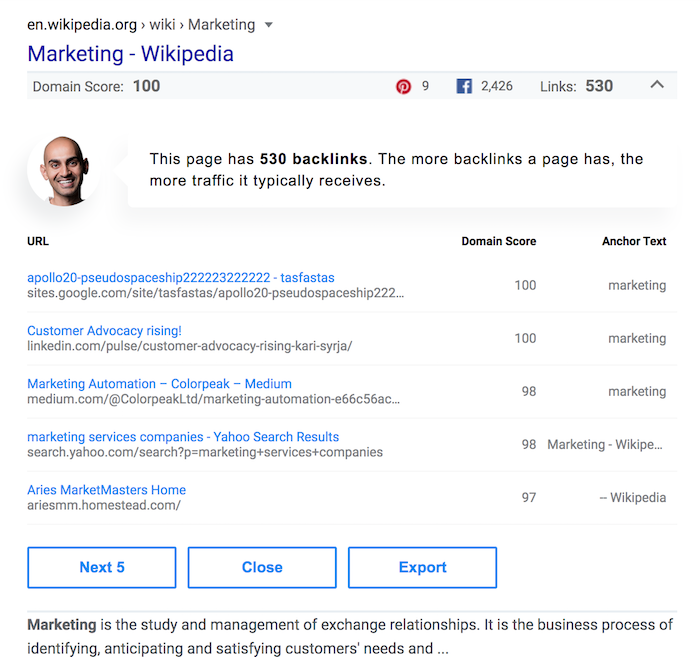
What’s cool is you can click on the “down arrow” next to the link count and see the exact list of sites linking as well as their domain score and anchor text they used for the link.

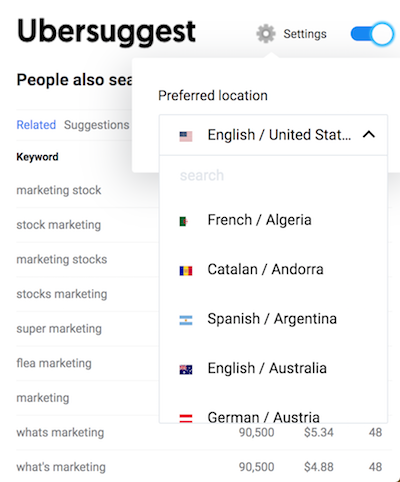
Pick your country and language

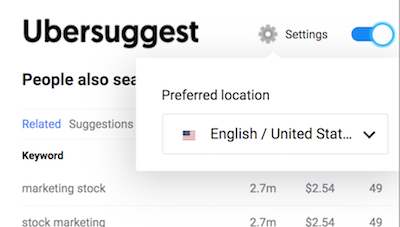
The last feature in the extension is that you can change your location and language.

All you have to do is click the “Settings” link in the sidebar.

You’ll see a long list of languages and countries that you can choose from.

No matter what version of Google you are using, such as Google.com.br or even Google.co.in, you’ll see SEO data whenever you perform a search.

Conclusion

I have some more big changes coming to the extension in the near future but I would love to hear what you think about it so far.

And if you have any feature requests, just leave a comment below. That way we can prioritize what we add to the extension next.

So go checkout the Ubersuggest extension and give it a try.

What do you think of the extension? What other features would you like me to add?

The post Ubersuggest Chrome Extension appeared first on Neil Patel.


from Blog – Neil Patel https://ift.tt/2B3pFnL
via IFTTT

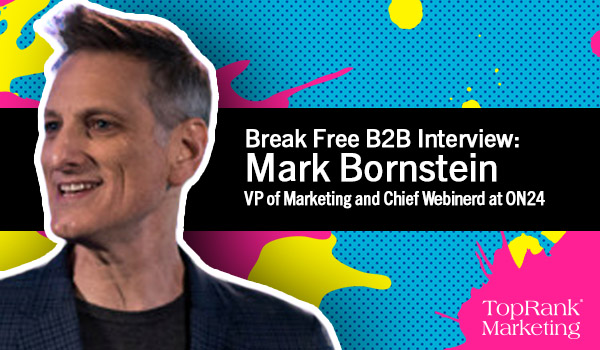
Break Free B2B Marketing: “Webinerd” Mark Bornstein of ON24 on Dialing In Digital Experiences

Break Free B2B Marketing Mark Bornstein Image

Break Free B2B Marketing Mark Bornstein Image Like many other digital experiences, the webinar has traditionally been viewed as a means to an end: Create something that seems valuable to your audience, and use it as a vehicle to acquire contact information for lead generation purposes. But marketers like Mark Bornstein take a different angle: What if we view the webinar itself as an end — an extremely valuable marketing tool on its own? What if we’re just muddying it up with all these mandatory form-fills and sales-y follow-ups? “You need the name once, you need the demographic information one time,” he observes. “But why do we keep putting forms together again and again? What matters is the experience.” [bctt tweet="“Why do we keep putting lead gen forms together again and again? What matters is the experience.” — @4markb on #BreakFreeB2B #DigitalExperiences" username="toprank"] Mark elaborates: “It's the experience you give, it's the way you're able to connect and interact with audiences that matters. Because that's where you're going to get the real data. That's where you're going to learn a lot about them.” Although he is a proud marketer, and VP of Marketing for the webinar solution provider ON24, this self-professed “webinerd,” Mark urges his fellow practitioners to develop a new mindset by moving away from traditional terminologies: “It's not about marketing anymore. It's about connecting people to your brand. It's relationship-building.” The days of dry, facelessly narrated slide presentations are gone, he argues. We need to dial in and focus on human connections through authenticity, empathy, and compassion. We need to learn more about our customers than how we can contact them with follow-up promotional materials. At a time where physical events and meetings are off the table, achieving these connections in the digital space via experiential marketing has never been more vital. In his 25-minute conversation with TopRank Marketing’s Susan Misukanis at B2B Marketing Exchange in February, Mark shared a wealth of insights, which have only become more useful and valuable in the weeks and months since.

Break Free B2B Interview with Mark Bornstein

If you’re interested in checking out a particular portion of the discussion, you can find a quick general outline below, as well as a few excerpts that stood out to us.
  • 0:45 - Mark's experience making webinars, and his view on lead gen
  • 2:00 - Have we reached the end of MQLs?
  • 3:15 - What is an experience and what makes a good one?
  • 5:00 - Examples of companies that are getting digital experiences right
  • 7:45 - What role will technology play in experiences going forward?
  • 10:00 - Are brands becoming more open to moving outside the box?
  • 12:00 - Finding and positioning your brand's narrative
  • 13:30 - Getting back to opt-in marketing fundamentals
  • 16:00 - Where Mark sees the industry going in 2-3 years
  • 17:30 - Who is poised to win in the short-term (SMB/verticals vs. enterprise)?
  • 20:15 - The value of compassion, empathy and connection
  • 24:15 - How can B2B marketers break free?
Susan: So you talk about an experience ... Can you take it a level deeper? What is an experience? Mark: Well, let me tell you about my world. So in the world of webinars, if you think about what a webinar was even a few years ago — and maybe in some cases still now — the webinar was a talking PowerPoint. Just a headless voice, you didn't see anybody. You just heard somebody going through the slides in a droll way and it wasn't branded and it was just boring. And maybe a lot of webinars still are kind of boring. But the fact of the matter is, what we see companies doing now is they're creating serialized programming. They're creating these really cool almost TV-like viewing experiences, where it's a show and there's hosts and the formats are changing. There's panel discussions and coffee talks and chat shows and new style formats. So companies that are trying to own thought leadership, to establish a voice, to be the company that people go to — they’re not going to do that through giving a webinar on, you know, here's our content. Here's our slide presentation. They're doing it by building experiences. And I think a really great experience has a few of the following qualities: It should be completely branded. It should be interactive. I always say give yourself the “what can they do?” test. When somebody is experiencing your content, is this all they can do? They’re reading your ebook or watching your video … is that it? An experience is a place where people can ask questions, or they can chat, or they can tweet, or they can download content. They can click on CTAs. You want to create an environment where people are doing stuff, and it's a multi-touch content experience. And so it's a different thing today. [bctt tweet="“Companies that are trying to own thought leadership, they’re not going to do that through giving a webinar that’s a slide presentation. They're doing it by building experiences.” — @4markb on #BreakFreeB2B #DigitalExperiences" username="toprank"] Susan: We keep hearing that marketing is moving toward AI and tech — in a few years, it'll all be bot-driven. How do you reconcile that with your vision? Mark: One of the things that drives me crazy about marketing in general is that we as marketers are very interesting creatures, in the sense that we're always willing to try new things. But we also get into habits we can't break. And a lot of the technologies — whether it's automation, or artificial intelligence, predictive analytics — all these amazing technologies that have been created to scale our marketing in ways like never before? Well, we are acting like this technology that was created to get people to our marketing has now become our marketing. So you need to look at, you know, artificial intelligence tells us out of this vast infinite number of people who we should be targeting, and maybe some of the topics we should be talking about. We can get a lot of great information. Automation allows us to scale that up in a lot of different ways. But ultimately, there is a moment of engagement. There still is that human engagement. And so all of that technology can inform, but ultimately, what really has to drive that engagement is the conversation that you have with them and the experience that you can deliver.” [bctt tweet="“We are acting like this technology that was created to get people to our marketing has now become our marketing.” — @4markb on #BreakFreeB2B #DigitalExperiences" username="toprank"] Susan: You tweet a lot about marketers not asking for proper permission to opt in. So maybe our prospective buyer has a need, but getting that opt-in and going about it the right way, that’s a big hurdle. Mark: It is. I mean, if you're a marketer in the U.K., you know what this pain feels like. I think especially in the U.S., but really around the globe, marketers are not ready. I don't think they're taking this seriously enough. You know, privacy legislation is in the U.S. now, but it's mostly based on privacy protections. It's not based on opt-ins and that sort of thing yet. It is coming. It is going to happen very soon, people. And so we need to prepare for this, which means we need to build our marketing around this idea of people opting in. So how do we do this? We have to be able to produce streams of programming that people will want to subscribe to, right? It's no longer about nurtures, it's no longer about ‘can you come to my event’ or ‘will you come to this one-off virtual experience or webinar,’ whatever it is. We need to find ways to get people who want our marketing to opt into our marketing. At a time when all of this digital noise is scaring them away. We need to bring them back in through more authentic, more human, more experiential marketing. We're going to get them there.” Stay tuned to the TopRank Marketing Blog and subscribe to our YouTube channel for more Break Free B2B interviews. Here are a few interviews to whet your appetite:


from Online Marketing Blog – TopRank® https://ift.tt/2ZAMOrI
via IFTTT